
Key Takeaways
- Clear requirements are the foundation of successful product development. Defining measurable requirements and acceptance criteria early helps teams prevent ambiguity and costly rework.
- Verification and validation serve different purposes. Verification ensures requirements are clear, complete, and testable, while validation confirms they address actual user needs.
- End-to-end traceability connects requirements to results. Linking requirements with risks, development tasks, test cases, and approvals helps teams demonstrate compliance and product quality.
- Managing changes requires visibility into downstream impacts. Connected lifecycle relationships help teams identify affected requirements, tests, and tasks when changes occur.
- PTC Codebeamer simplifies requirements management and traceability. Its integrated ALM capabilities connect requirements, risk management, testing, and validation evidence in one environment.
When developing a product, requirements define what the product needs to do, how it should perform, and what user needs it must satisfy. Documenting these requirements is vital to the success of the product, but this documentation is only the beginning. Teams also need to prove that those requirements are complete, understood, implemented correctly, and ultimately satisfied by the finished product. End-to-end traceability makes that possible by connecting requirements to risks, development work, test cases, results, and approvals throughout the lifecycle. ALM platforms such as PTC Codebeamer help teams manage those relationships within a shared ALM environment, but good traceability still starts with a sound requirements process.

Defining Requirements
Validation is the process of ensuring complete, correct requirement implementation, and it starts with well-defined requirements. Teams first need to gather input from users, product owners, engineering, and security teams. This process should establish what the system is supposed to do, who will use it, and under what conditions it will operate. Those needs are then translated into documented functional and nonfunctional requirements. Each requirement should be clear, necessary, and measurable enough to support design, development, and testing. A useful question at this stage is: How will we prove that this requirement has been met? If that question is difficult to answer, the requirement may still be too vague. Defining acceptance criteria early helps teams remove ambiguity before those requirements begin driving downstream work.

Verifying Requirements
Verification asks whether the requirements are clear enough and complete enough to build against. Teams should review them early for ambiguity, consistency, feasibility, and testability rather than waiting until system testing exposes the problem. Different teams offer different perspectives, so ensure individuals across teams contribute to this feedback. Testers in particular can identify vague requirements quickly because they need measurable conditions to determine whether something passes or fails. Thinking about test cases early can expose gaps before implementation begins. Fixing an unclear requirement at this stage is much easier than correcting code and other documentation later.
Validating Requirements
Validation asks a different question: Are these the right requirements for the product we are trying to build? A product can technically satisfy every documented requirement and still fail to solve the real user need. Stakeholder reviews play an important role here. Users and business owners can confirm whether requirements reflect how the product is expected to work, while engineers and testers can identify areas that may be unclear. Prototypes can also help when users have trouble visualizing how written requirements will translate into an actual workflow.
In addition to this, acceptance criteria provide another useful validation method. Asking users how they would determine whether a requirement has been satisfied can reveal whether that requirement truly captures the intended outcome. Validation should continue throughout development as requirements evolve and teams learn more about the product.
Connecting Requirements to Risk and Testing
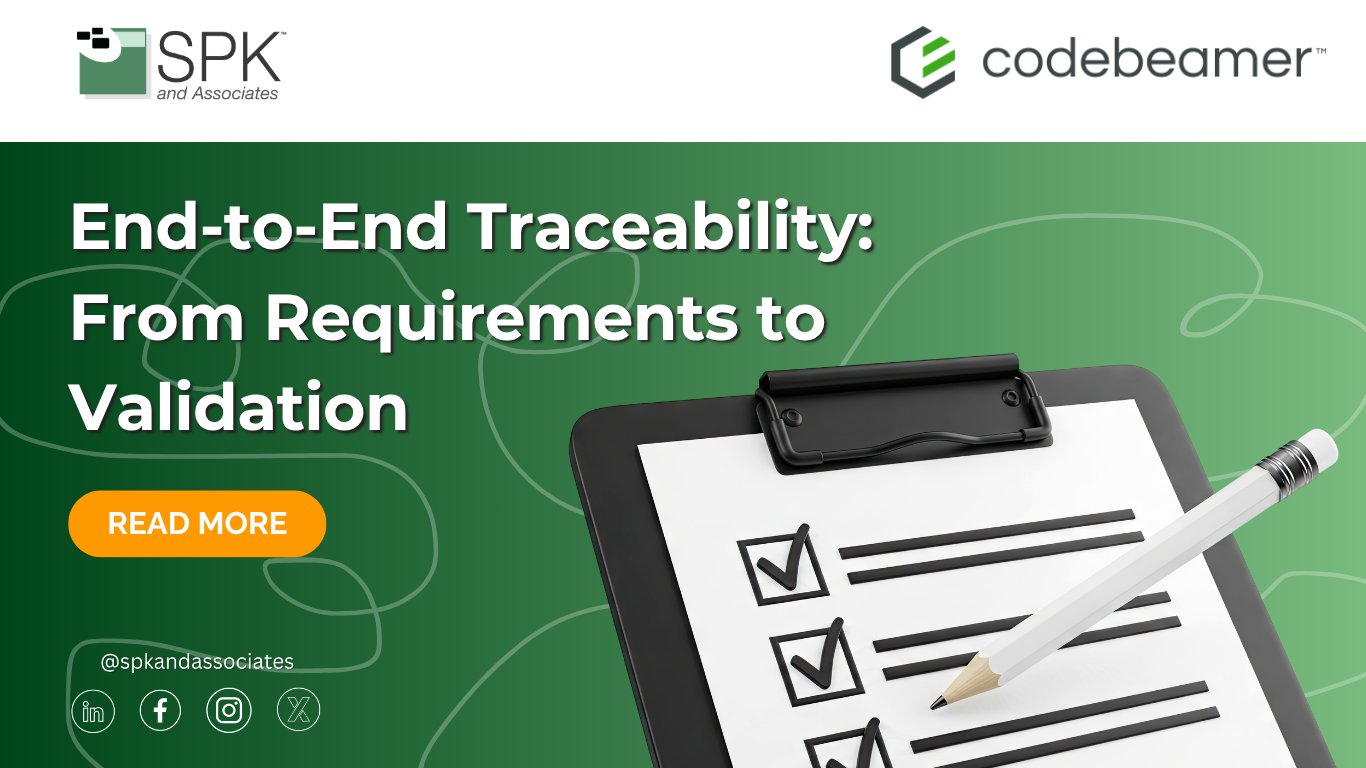
Once requirements are defined and validated, teams need to maintain the relationships between those requirements and downstream work. That traceability helps teams answer basic but important questions such as “which test proves this requirement was met?” or “if one requirement changes, which downstream items need to be reviewed?” For regulated and safety-critical products, these connections are especially important because they help teams demonstrate that risks were addressed and that the finished product satisfies its documented requirements.

Managing Requirements and Validation in Codebeamer
Managing requirements is simple with an ALM platform like Codebeamer. Codebeamer provides a shared environment where teams can manage requirements alongside risks and tests. Teams can organize requirements into structured trackers and hierarchies so higher-level user or system needs remain connected to more detailed software requirements. They can also link requirements directly to risk items, tasks, acceptance criteria, and test cases. Due to Codebeamer’s built-in risk and test management, validation evidence remains connected to the requirements it supports rather than being scattered across separate spreadsheets or documents. As development progresses, testers can execute linked test cases and record the results. Those pass/fail results, along with related records and approvals, become part of the evidence showing whether the original requirement was satisfied.
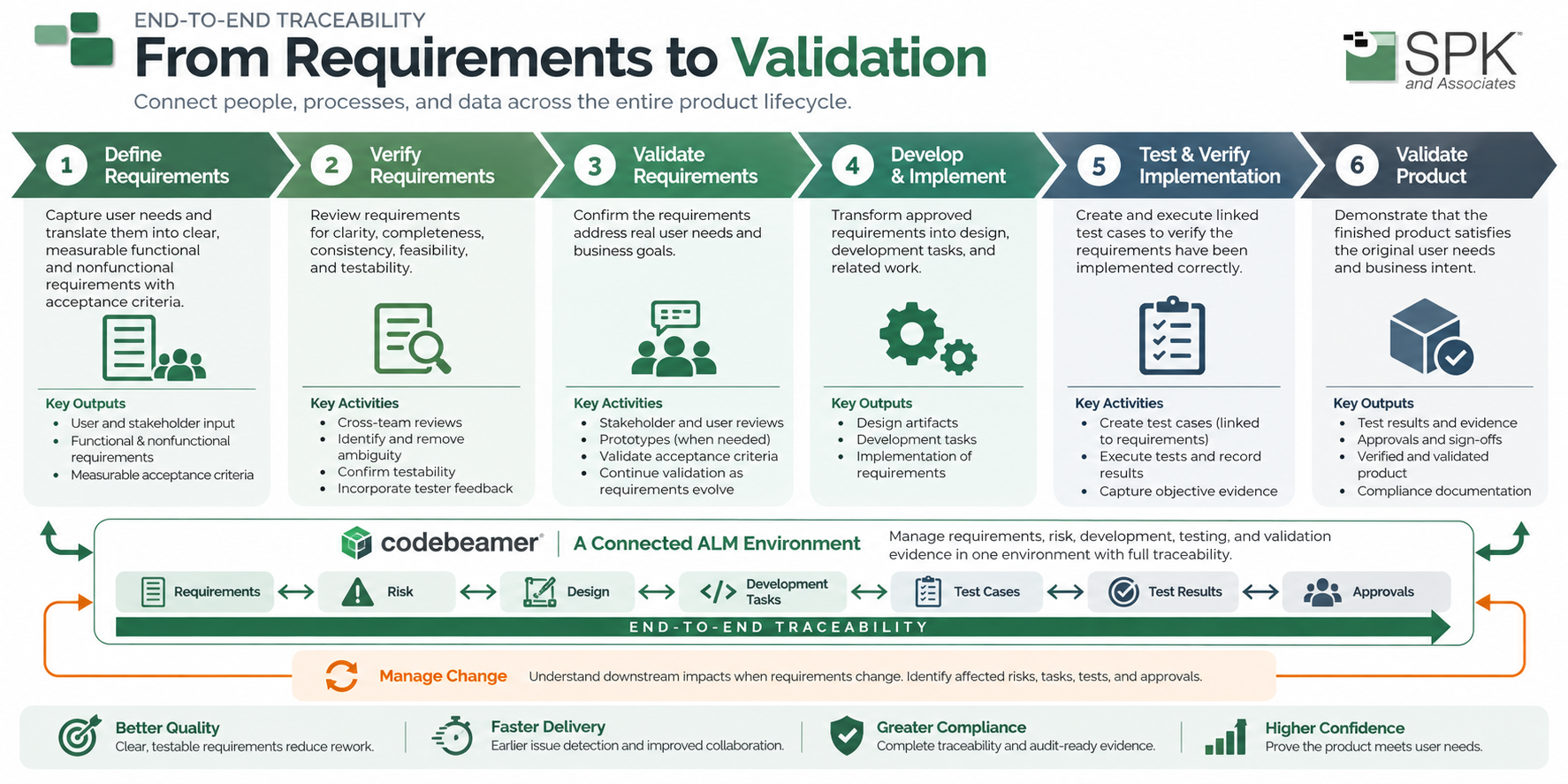
How Codebeamer Provides End-to-End Traceability
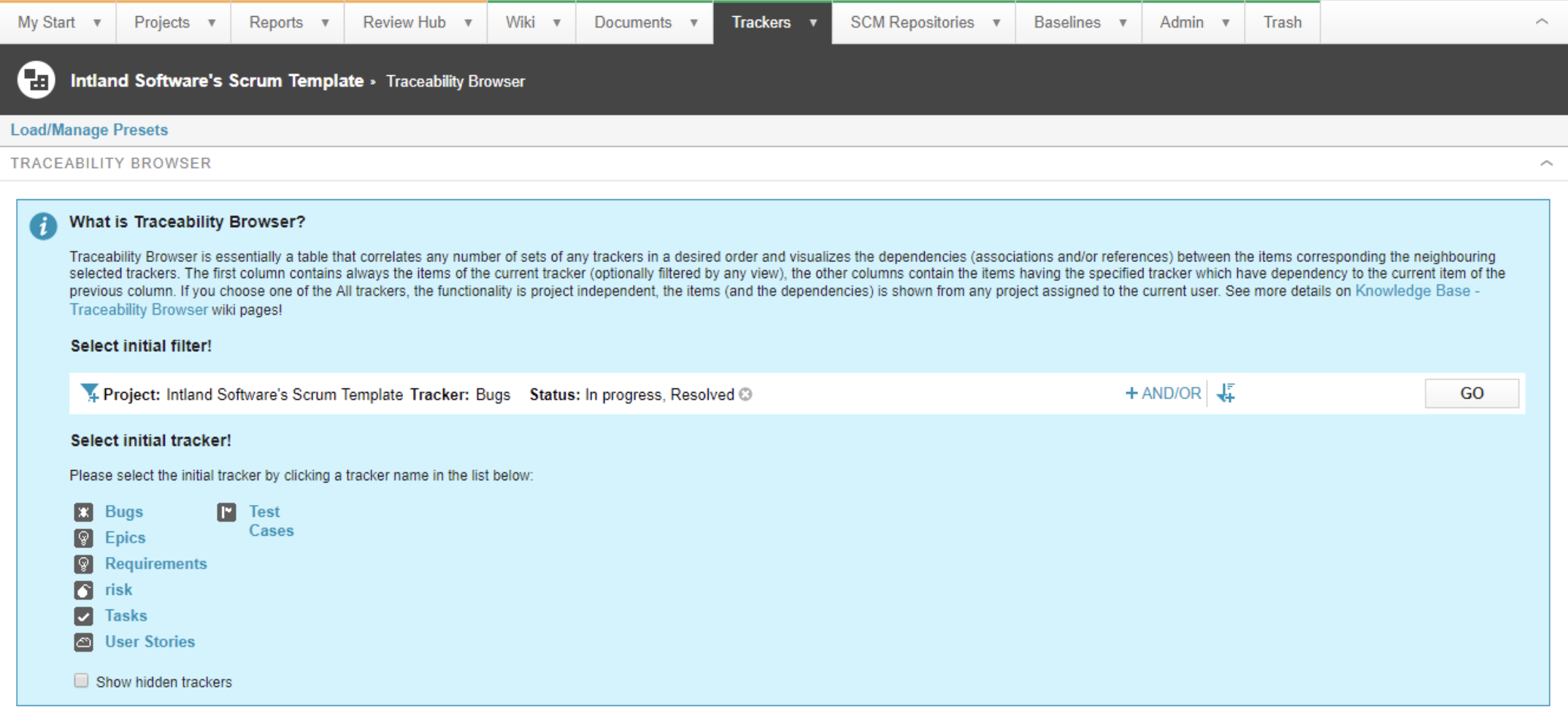
Furthermore, Codebeamer’s Traceability Browser allows teams to follow relationships across multiple levels, from a high-level requirement down to related tasks, test cases, or test results. Configuration diagrams provide another view by showing how trackers and lifecycle artifacts relate to one another. These tools help teams understand both the structure of the development process and the status of individual requirements.
Traceability can also extend beyond Codebeamer through integrations with other engineering and development systems. Most complex product organizations use multiple tools across ALM, PLM, software development, and systems engineering. When these are connected, so is the engineering information across the toolchain.
Ready to Track from Requirements to Validation?
Requirements management does not end when the requirements are written. Those requirements must help prove that the finished product satisfies the original need. Codebeamer gives teams a way to maintain those relationships across the application lifecycle. By connecting requirements with risk, development, testing, and validation evidence, organizations can maintain a clear path from product intent to proof that the final product meets its intended purpose. At SPK and Associates, we help engineering and product teams build connected, traceable development environments that support both day-to-day execution and long-term compliance needs. If your team is looking to strengthen traceability from requirements through validation, contact SPK and Associates to learn more.