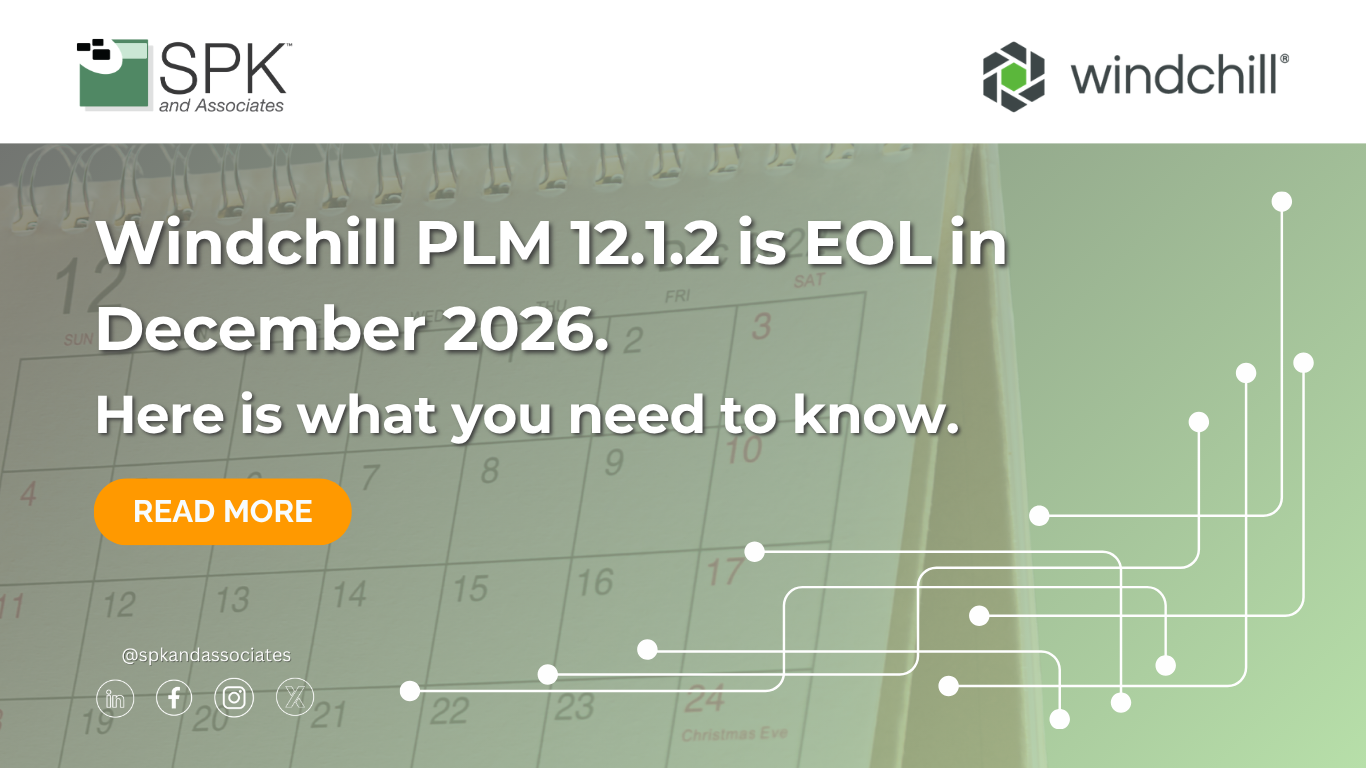

Every version of PTC Windchill eventually reaches an end-of-life milestone, and for organizations still running Windchill 12.1.2, that timeline is approaching quickly. As PTC continues to invest in Windchill 13 and newer releases, organizations using older environments need to start planning their upgrade strategy now. Windchill 12.1.2.0 was scheduled for End of Standard Support on December 31, 2025, with an Extended Support End Date of December 31, 2026. Many associated tools and components are also approaching similar support deadlines. While some organizations may still view 12.1.2 as functional, remaining on unsupported or aging PLM infrastructure creates increasing operational, security, and maintenance risks.
The challenge is that upgrading Windchill is rarely simple. Most internal IT teams do not perform these upgrades frequently. Not to mention, many organizations have heavily customized environments with integrations, plugins, and supporting applications that require careful planning. That is where SPK and Associates can help customers accelerate the process and reduce risk.

Understanding the Windchill 12.1.2 End-of-Life Timeline
Windchill 12.1.2.0 is considered a legacy version compared to the current Windchill 13.x releases. Organizations still running the platform should begin planning migration efforts now to avoid scrambling later. A few related components also have approaching support deadlines, such as Windchill Workgroup Manager 12.1.2.0 standard support ending December 31, 2026. In addition to this, Windchill 13.0.2.0 support extends through June 30, 2027. For many organizations, the safest long-term path is to upgrade to Windchill 13.x.

Waiting too long to upgrade creates several challenges:
- Increased security and compliance risk
- Reduced vendor support availability
- Compatibility limitations with newer integrations and plugins
- Higher technical debt
- More difficult future migrations
Many companies also underestimate the operational complexity of staying on older PLM infrastructure. Over time, unsupported Windows versions, database versions, Java dependencies, and third-party integrations can all become blockers that make upgrades harder and more expensive later.
Why Windchill Upgrades Take So Long Internally
Windchill is a highly configurable enterprise PLM platform. Most deployments include a combination of:
- Custom workflows
- Integrations
- CAD connectors
- Visualization tools
- Workgroup Managers
- Custom security models
- Separate Windchill modules and plugins

Due to this, upgrades are not as simple as installing a new version and clicking “next.” One of the biggest issues internal IT teams face is a lack of repetition. Most organizations only upgrade Windchill every several years, meaning the process is unfamiliar, under-documented, and resource-intensive. Internal teams are also typically balancing PLM administration alongside many other infrastructure responsibilities. Additionally, upgrades between major Windchill versions often require incremental upgrade paths. For example, moving from Windchill 12.1.2 directly to 13.1.2 may require stepping through Windchill 13.0 first before continuing to 13.1.2.
Without a well-defined process, upgrades can quickly become lengthy projects involving:
- Unexpected downtime
- Environment instability
- Database compatibility issues
- Security concerns
- Broken integrations
- Delayed user adoption
How SPK Accelerates Windchill Upgrades
SPK and Associates specializes in PLM infrastructure, cloud hosting, and Windchill application management or managed services supporting Windchill. We perform these upgrades regularly, allowing us to easily help organizations move faster than internal teams. Our approach is built around reducing downtime, minimizing risk, and ensuring users can get back to work quickly.
1. Snapshot and Backup Protection
Before any upgrade begins, we create full environment snapshots and backups. We always maintain rollback points if anything unexpected occurs. Hosting and managing environments in the cloud allows us to do this. This backup provides customers with an additional layer of protection and dramatically reduces upgrade anxiety. If an issue appears during testing or validation, we can quickly revert environments without extended outages.
2. Planning the Correct Upgrade Path
Windchill upgrades often require incremental version jumps. For example:
- Windchill 12.1.2 → 13.0
- Windchill 13.0 → 13.1.2
Our experts map the correct upgrade path ahead of time to avoid failed upgrade attempts or unsupported migration paths.
We also evaluate:
- Existing plugins
- CAD integrations
- Workgroup Managers
- Database versions
- Operating system dependencies
- Customizations
- Third-party integrations
This upfront planning helps eliminate surprises later in the project.
3. Database Backup and Schema Preparation
The database layer is one of the most critical parts of any Windchill upgrade.
SPK performs:
- Full Windchill database backups
- Creation of new empty database schemas
- Database restoration into upgraded environments
- Compatibility validation using the Windchill Upgrade Assistant
This ensures the upgraded environment is stable before production cutover.
4. Incremental Upgrade Execution
For customers moving across multiple versions, SPK repeats the upgrade process carefully at each stage.
This includes:
- Installing the new Windchill version
- Running upgrade utilities
- Validating database compatibility
- Reconfiguring services
- Verifying integrations and plugins
- Setting up Windows services
Our established upgrade workflows and repeatable processes make these steps more efficient than organizations attempting the process internally for the first time.
5. Tailored Cloud Hosting and Environment Management
Our team also manages the full hosting environment, so customers do not have to worry about:
- Cloud security
- Windows patching
- Backup management
- Infrastructure maintenance
- Disaster recovery
- Environment monitoring
We tailor each environment to the customer’s needs and deploy infrastructure in regions closest to their users for better performance and lower latency. Since Windchill environments often include multiple modules, plugins, and integrations, we gather those details early in the process so users can log in on day one with everything functioning correctly.
Why Upgrading to Windchill 13 Matters
Upgrading is not only about maintaining support eligibility. Newer Windchill releases provide meaningful improvements in performance, scalability, security, and user experience. Not to mention the integration support is unbeatable. For organizations investing in digital thread initiatives, connected ALM-PLM workflows, or modern CAD collaboration, remaining on supported infrastructure is increasingly important. Newer Windchill releases also align more effectively with modern enterprise cloud strategies and hybrid engineering environments.

Moving From Windchill 12.1.2
Organizations still running on 12.1.2 should begin planning their upgrade strategy now. While upgrading PLM infrastructure can feel overwhelming, delaying the process only increases technical debt and future migration complexity. The good news is that organizations do not have to tackle the process alone. The SPK team has deep expertise in Windchill upgrades, cloud hosting, infrastructure management, and PLM optimization. Our repeatable cloud-first approach helps customers upgrade faster, reduce downtime, and minimize risk. If your team is planning a move from Windchill 12.1.2, contact us to help you build a faster and more reliable upgrade path.