


Complex product development involves multi-disciplinary teams, with systems engineers or requirements analysts producing the requirements, and other disciplines creating designs and tests based on those requirements. Serious problems can arise if all teams do not have access to consistent, correct information. For example, if a requirement changes, but the development team is not informed of the change, this can lead to the developers building against an outdated specification. Gaps like this may seem small, but change is a constant in complex projects, and the lack of visibility to such changes creates real business costs. Disconnected requirements lead to rework, delays, compliance risk, missed expectations, and in the worst case, failure to deliver the desired product. For organizations building software-driven products, especially in regulated industries, this can become a serious barrier to quality, time to market, and audit readiness.
That is where Application Lifecycle Management (ALM) becomes essential. Using a platform like PTC Codebeamer allows teams to connect requirements directly to development work, tests, defects, risks, approvals, and releases. Instead of treating requirements as static documents, Codebeamer helps organizations manage them as living, traceable assets that guide development from concept through delivery.

Why Requirements Get Disconnected from Development
Requirements start with good intentions, such as teams documenting customer needs or creating them for regulatory obligations and product goals. However, as development accelerates, those requirements can become separated from the actual work being done.
This happens for several reasons:
- Requirements may live in documents, spreadsheets, shared drives, emails, or separate systems
- Development teams may track work in another tool
- Test teams may manage verification somewhere else
- Compliance evidence may be gathered manually at the end of the project

When these activities are not connected, teams lose the ability to see how one decision affects the rest of the lifecycle. This results in a fragmented process. Product managers may not know which requirements have been implemented. Developers may not know whether a requirement has changed. Furthermore, testers may not know which tests map to which requirement. Finally, compliance teams may not know whether the organization can prove traceability when an audit arrives. At a small scale, teams may work around this with meetings and manual updates, but at an enterprise scale, that approach breaks down quickly.
The Hidden Cost of Manual Effort
One of the highest costs of disconnected requirements is manual effort. When requirements are not connected to development, teams spend too much time searching, confirming, copying, reconciling, and reporting. A developer may need to ask whether a requirement is still current, or a quality team may need to take a lot of time collecting screenshots, spreadsheets, and approvals to prepare for an audit.
None of this work directly improves the product. It is administrative overhead created by disconnected systems. Over time, this manual effort becomes expensive. It slows teams down, increases the chance of human error, and takes skilled employees away from higher-value work. Instead of focusing on innovation, teams become trapped in coordination work. Codebeamer helps reduce this burden by creating a structured ALM environment where requirements, development tasks, tests, risks, defects, and approvals can be managed in a connected workflow. When lifecycle artifacts are linked, teams spend less time chasing information and more time making decisions.
The Cost of Rework and Late Discovery
Rework is another major hidden cost. When requirements are unclear, outdated, or disconnected from development, teams often discover problems too late. A feature may be built against the wrong requirement, or perhaps a change may be approved without understanding its impact. In other cases, a test may fail because the original expectation was misunderstood. Maybe a team discovers near release that a key requirement was never implemented or verified.
In all of these cases, late discovery is the common factor, and it is expensive. This is because problems become harder to fix as the product moves through the lifecycle. A requirement issue found during planning may be easy to correct. The same issue found during validation, release, or post-launch can require redesign, redevelopment, retesting, documentation updates, and customer communication. When working with complex products, especially those involving hardware, software, and systems engineering, rework can affect multiple teams at once. A small change may impact code, test cases, documentation, suppliers, and release timelines.
Codebeamer supports end-to-end traceability, which helps teams understand these relationships earlier. Requirements can be connected to design elements, development work, test cases, defects, and other lifecycle artifacts. When something changes, teams can perform impact analysis before the change creates downstream disruption.

The Compliance Risk of Broken Traceability
For regulated industries, disconnected requirements create a serious compliance challenge. Organizations must often prove that requirements were not just reviewed and approved, but implemented, tested, and controlled. They also need audit trails that show who made decisions, when changes occurred, and how those changes were evaluated. When requirements are managed in documents or disconnected tools, traceability becomes difficult. Teams may rely on spreadsheets, naming conventions, meetings, and after-the-fact reporting to prove compliance. This increases audit preparation time and raises the risk that evidence will be incomplete or inconsistent.
In industries such as automotive, aerospace, and medical devices, traceability is not optional. Standards and regulations such as ISO 26262, DO-178C, and FDA 21 CFR Part 11 require disciplined control over requirements, verification, changes, and documentation.

Codebeamer helps address this by providing:
- Traceability metrics
- Audit trails
- Automated reporting
- Workflow controls
- Role-based access
- Approval gates
These capabilities help organizations maintain compliance evidence as work happens rather than scrambling to assemble it later.
Why ALM Matters for Requirements Management
Effective requirements management is the backbone of successful system delivery. ALM provides the structure needed to manage requirements as part of the full development ecosystem rather than as isolated documentation. With ALM, requirements can be connected to the teams and artifacts that depend on them. Business analysts, systems engineers, developers, testers, quality teams, and compliance stakeholders can work from a shared source of truth. This improves alignment and reduces the risk that different teams are working from different assumptions.
ALM also strengthens change and configuration management. Versioning, baselines, and controlled workflows help ensure that teams understand which requirements are current, which changes have been approved, and how those changes affect related work. This is especially important as products become more software-driven. Modern products often involve complex relationships between customer needs, system requirements, software features, hardware constraints, safety requirements, cybersecurity needs, and verification activities. Without ALM, those relationships become difficult to manage.
How Codebeamer Connects Requirements to Development
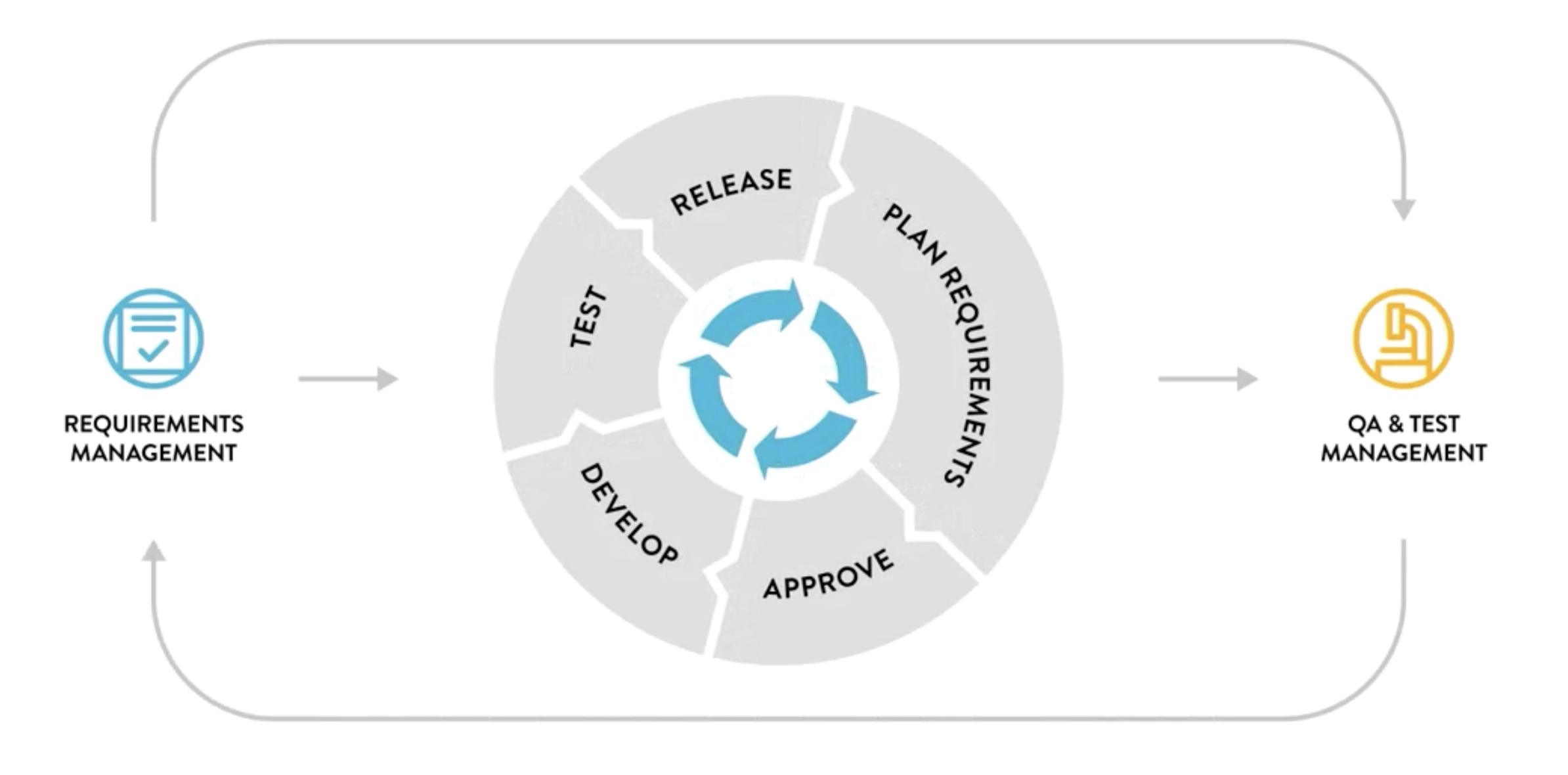
Codebeamer is designed to support connected ALM for complex and regulated product development. It helps organizations move away from disconnected, document-driven processes and toward structured lifecycle management. With Codebeamer, teams can manage requirements as structured data. Requirements can be linked to development tasks, test cases, risks, defects, reviews, and release activities. This provides teams with visibility into how requirements progress through the lifecycle and whether they have been properly implemented and verified.
Codebeamer also supports collaboration across disciplines. Instead of separate teams maintaining separate versions of the truth, stakeholders can work within shared workflows. Developers can understand the requirement behind the work. Testers can see what needs to be verified. Quality and compliance teams can review traceability and audit evidence more easily. The value is not just better documentation, but better decision-making. When requirements and development are connected, teams can answer critical questions faster. Answering questions like has this requirement been implemented or who approved the latest version helps reduce uncertainty and improve confidence throughout development.
The Business Impact of Connected ALM
Connecting requirements to development creates measurable business value. Teams reduce manual effort because information is easier to find and report. Additionally, they reduce rework because changes and dependencies are visible earlier. Quality also improves because requirements, tests, and defects are connected. Finally, compliance strengthens because audit evidence is captured throughout the process. Teams can make better decisions, respond to change more effectively, and reduce the risk of late-stage surprises. For organizations in regulated industries, this is especially valuable. Codebeamer helps support process governance through standardized workflows, approval gates, role-based access, traceability, and reporting. That structure helps teams move faster without sacrificing control.
Connecting Requirements and Development with Codebeamer
Disconnected requirements create costs that are easy to overlook but difficult to ignore. As products become more complex, organizations need a better way to connect requirements with development, testing, risk, and release management. Codebeamer provides that foundation through structured ALM, end-to-end traceability, change control, collaboration, audit trails, and process governance. If your team is ready to ensure compliance with proper traceability, reach out to our experts about Codebeamer.