
Introduction to Oboard
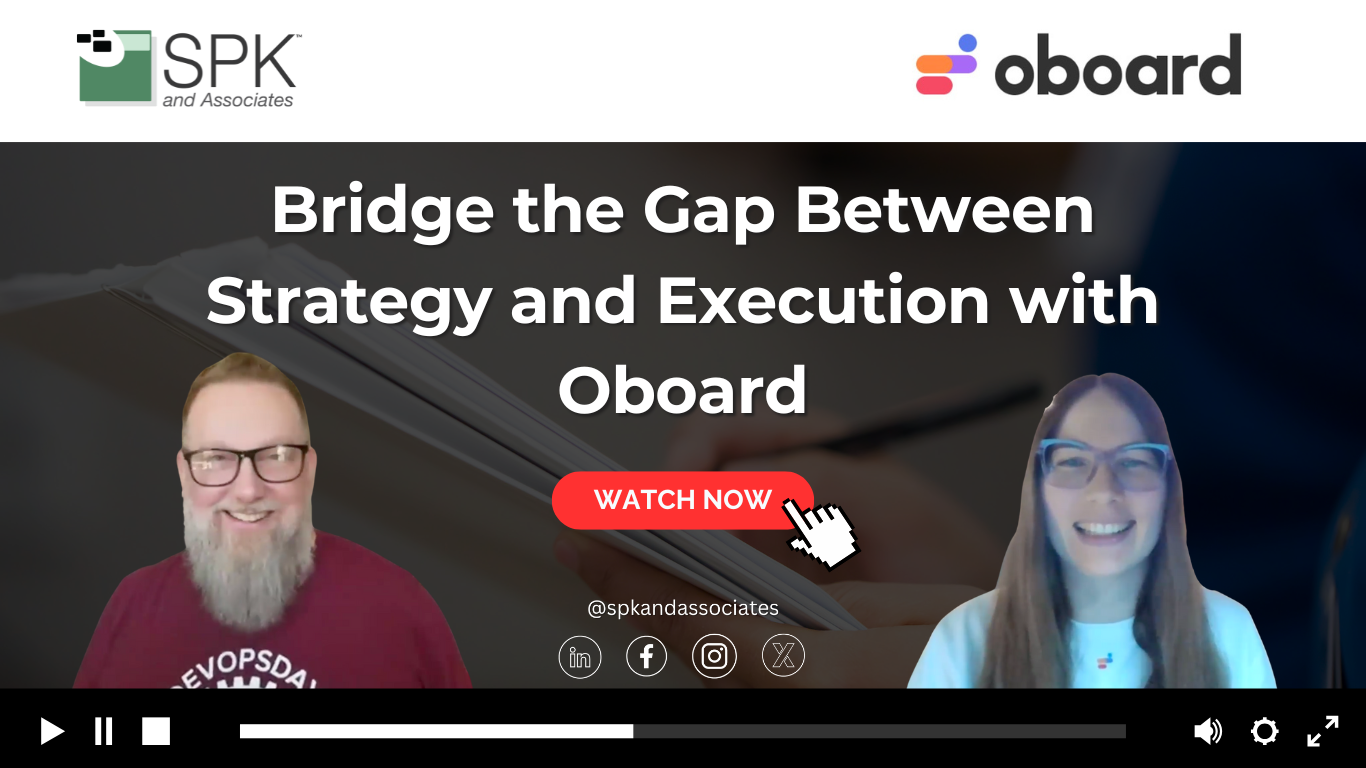
Hello everyone, and welcome back to another SPK and Associates vlog. Today, we’re diving into, I think, one of the bigger challenges that organizations face, and that’s turning strategy into meaningful execution. It’s one thing to set ambitious goals, but it’s another to be able to make sure that the entire organization, from a day-to-day perspective, actually can drive to that success.
That’s why I’m really excited to be joined today by Margo from Oboard. Margo, feel free to introduce yourself.
Thank you so much, Michael. So my name is Margo. I am Head of Marketing at Oboard. And basically, what we are trying to do is to connect strategy to execution.
You know, these spreadsheets, the slide decks that are written at the end of the year, and then everyone forgets about them—to make them actionable, to bring them to life, and to connect with the daily work that’s happening within the teams. And Michael, I’m so happy to be here today.
I’m glad you’re here, because there’s a bunch of stuff that I think will be valuable for our viewers here. So, in this episode, we’ll try to explore how Oboard is helping connect strategy to execution inside and outside of Jira, giving leaders the visibility and alignment that they need to help deliver results.
So, I want to jump in, and Margo is my expert here, because the more that we talk, the more that I’ve found that she has a lot of good information here that our folks are going to really love.
Atlassian Team ’23
So, I know, Margo, you may want to share a little bit of how we met several years ago—a little bit of story around that. There were some rockets at an Atlassian team event. I’ll let you.
It was Las Vegas. That was pretty fun. I stopped by the booth. I was thinking, like, “Well, this partner looks interesting. Maybe we can do something cool together.” And you were having this awesome swag with the rockets flying, and my kid loved them so much.
And then we were having a follow-up meeting that I was hosting at a nearby café, and it was, I think, summer, and suddenly a lot of sun appeared, and my camel glasses they got totally black. And I was thinking, like, “Oh my god, this is so embarrassing. It’s not like a polished partner meeting. Probably we will never talk after.” But it’s great to hear from you again.
And we’ve also done a couple of good content together, like on the blog. There are a lot of articles about OKRs, about strategy, about bringing it to life. Really great content to explore.
From OKR Tool to Strategy Management Platform
Awesome. So I know there are some updates with Oboard. So I want to give you the floor. Tell me a little bit about what’s new at Oboard.
Sure. So we’ve got a huge summer update. Before that we were only an OKR solution, and now we are going into the broader strategy management space. We’ve brought KPIs into the platform, and we’ve also brought a check-in component to keep everyone updated, to keep this recurring right now within the product.
So this is the dream report for every executive. What you can have within Oboard is a very explicit space to communicate your vision, your mission the way you need it, and all the key information that is valuable for your team.
You can also have your OKRs, where you have your objectives, you have key results on the company level, and then on department level. You can also track your KPIs, your day-to-day metrics, and that is an easy way to communicate the value to the C-level executives. You don’t need to go to tons of different places to collect this information.
And what is great about it: it’s also connected to Jira. So if you do project management in Jira, you can get the updates automatically. So it works really great for product and engineering teams who are working towards big launches. No manual updates for the status reports anymore for the C-levels. You can just connect all your work here and it will be updated.
Check-ins, Reporting, and Integrations
Another great thing that is coming soon is we have the check-ins already, where you can view the feed of the updates that were happening recently. You can read the context that your team shared. You can have custom schedules for different teams and organizations on that.
Soon we will have filtering here, so you will be able to see what was done within which department, which is also very exciting. And you can also integrate it with Slack, Microsoft Teams, Discord, email, so that everyone’s updated and on the same page.
So I guess these are the most important reports for now. No more manual updating and creating reports.
I love it. That’s a big thing for me. I hate doing manual updates that are never going to be seen again. So the fact that it’s great.
Customer Stories: How Different Companies Use Oboard
So, Margo, can you give me a little bit more about some of the recent customer stories that I know we talked a little bit about—some of the ones that are listed on your website? Can you give a little bit more detail and context around some of those things?
Sure. We are very lucky to support a lot of customers within their strategy execution, within their implementations. And you can also go to the Oboard.io website and read some of the stories to learn from the customers.
Tago
During the last couple of months, we released a couple of great customer stories. So, for example, we’ve got one with Tago, who are an excellent booking accommodation platform, who were very successfully blending with AI within their implementation. So that is something that is hot and interesting for everyone.
They also were quite… had an interesting approach to their OKR cycles. So instead of classic quarterly cycles, they were having one cycle for six months—for the summer, which is hot season, and then the winter, which is low season for them because they’re in the travel industry. And this is very significant because a lot of customers are facing this seasonality.
Basically, they defined the structure for their OKRs so that during the summer they are focusing on the revenue streams, on the growth, and then in winter they’re doing the foundational work, the updates, and all the rest of the stuff. So this is how they are guiding the company.
Benefit Systems
Another great case study we recently published is within Benefit Systems. This is a company who is standing behind the Multisport cards. Probably many of you heard about them, maybe some of you even used them.
They had an excellent, very structured approach with coaching the team, with gradually implementing the OKRs. You can also read about it on our website. They had a dedicated OKR manager for the whole implementation, who was leading the process, and this is also such an important component of success, and it’s quite often overlooked, because you still will need this person and you cannot forget about it.
And they basically moved their clunky reports in Excel to Oboard in combination with Jira so that now they have their strategy and execution together.
GDM
Just, I think, the last customer I would like to highlight: this is GDM. They are in the agricultural business, and they had such an excellent and non-conventional approach to OKRs. When I first heard about it, I was surprised greatly, because it felt that it should be corrected in some way, because that felt very controversial to me.
So they said that during the initial phase of implementation, they are introducing the objectives to their teams, like the strategy objectives, and their teammates would need to link their work to the strategic objectives without specific measures of success. It felt very controversial to me. But since, you know, the culture of the company was pretty conservative, and it would be hard for them to push for the specific measurements right away, they tried this iterative approach, which is not what you read in the book, but that worked great for the company.
And I’m also having a video with them, sharing this story. So, you know, all these stories are very unique—different approaches, different interesting highlights. So please go on our website, read, and I think that would be super valuable for your implementations as well.
Flexibility and Philosophy Behind Oboard
And I think that the takeaway for folks watching here is the fact that through all those use cases that you just walked through, your tool was extremely flexible to support the way that they needed it to operate, which I think is the big part. Regardless of how you’re structured today and which methodology and which approach you have, Oboard actually has a way to connect—again, going back to the big picture here—connecting strategy to execution and getting away from spreadsheet updates and Slack, you know, random Slacks and those types of things.
I would say, you know, flexibility is our second name, but our first name is the intuitive and easy way to manage your goals. Because initially, our founder, he wasn’t happy with the existing solutions that were on the market. He was working as a product manager in a big organization, and he was doing the implementation for that organization, and he discovered that there is no good tool that would be easy and fast to implement.
And that was how he was inspired with the idea: “Okay, if we manage our work in Jira, maybe we create a tool for Jira.” And this is how we appeared within the Atlassian marketplace. And then now we have Atlassian marketplace, we have our app on Monday marketplace, we’re having an app on Salesforce marketplace, and we’re having a standalone OKR app. So this is how it grew from a simple idea from one person to a quite sophisticated ecosystem of apps right now.
AI Features Coming to Oboard
That’s awesome. And I think we can’t get out of here—when you say sophisticated, we can’t get out of here without mentioning AI. So I believe you have some new AI components that you’re looking at adding to your product as well, right?
Yeah, cannot talk a lot about it, but in the next year the new AI features are coming to Oboard. So stay tuned.
Another thing, another video to come back and watch here shortly as they launch that.
How to Learn More About Oboard and SPK
So, I think that’s a wrap for our conversation. I want to thank Margo again for being here.
Thank you so much. I appreciate your time and sharing your insights.
Thank you very much, Michael.
So if you want to learn more about Oboard or explore how SPK and Associates can help you implement the OKR-driven alignment with your organization, visit our website spka.com or reach out to our team directly on our contact form.
Don’t forget to like, share, and subscribe to the SPK and Associates YouTube channel so you don’t miss the next episode. We’ll be back here shortly, continuing to explore tools and strategies that help engineering and IT teams deliver faster, smarter, and with a greater impact.
Thanks again to Margo. Thanks again for watching. We’ll see you next time.
Thanks, Michael. Goodbye.