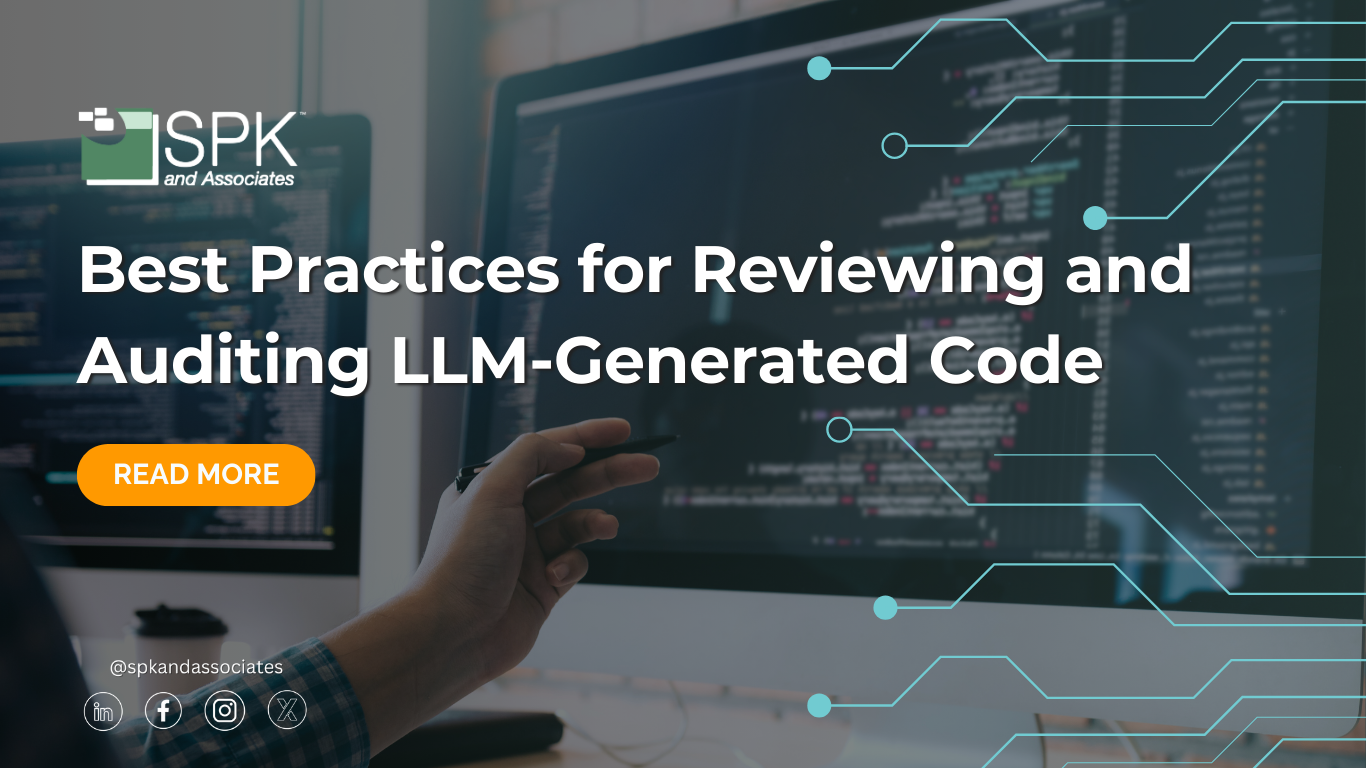

The use of Large language models (LLMs) to generate production-ready code for product engineering teams is gaining popularity. With LLM usage gaining traction, quality assurance engineers and software development managers must ensure that these LLMs meet high standards. While LLMs can dramatically accelerate development, they also introduce new risks and require review and auditing practices. In this blog, we’ll walk through why auditing LLM-generated code matters, what specific risks to look out for, and how to build robust best practice workflows for review and audit.
What is LLM-generated code?
When we talk about LLM-generated code, we refer to code snippets, functions, modules, or even entire components produced (fully or partially) by a large language model—such as GPT‑5, Claud 3.5 Sonnet, Gemini 2.5 Pro, DeepSeek Coder, Codex, or other code-oriented generative models like GitLab Duo. These models can output surprisingly effective code, but the final product often includes some key differences from traditional code generation.

Why LLM-generated Code Matters
- LLMs learn patterns from massive codebases, so their output often looks syntactically correct, but may fall short on architecture, performance, security, or maintainability. For example, research found that benchmarks focusing on correctness over deeper quality metrics can mislead about how “good” LLM-generated code really is.
- Many organizations are already incorporating LLMs into code generation or review workflows. However, simply generating code doesn’t guarantee it’s fit for production.
- As the pace of development accelerates (for example, via Autogen or Copilot-style workflows), the review burden shifts: you must now review not only newly written human code, but also LLM output. Without proper auditing, you risk hidden technical debt, poor architecture, or security vulnerabilities.
In short: using LLMs is not a substitute for rigorous review. It just shifts the nature of what reviewers must do.
Key Risks of LLM-generated code
When auditing code produced or assisted by LLMs, reviewers should pay attention to specific risk areas, not just the usual feature correctness.
Functional correctness vs hidden errors
While many code generation benchmarks emphasize “does it run” or “does it pass tests”, LLM-generated code may appear correct yet contain subtle errors. As one survey noted:
“LLM-generated solutions often contain non-syntactic mistakes, meaning the code runs without errors but produces the wrong behavior or output.”
Therefore, your audit or testing should include:
- Additional edge-case testing beyond the main path.
- Verification of intent of the code generated. For example, does the code implement the correct business logic?
- Checking for off-by-ones, null/undefined handling, error conditions, overflow, concurrency issues, etc.

Maintainability, readability & architecture
Even if code “works,” it might be hard to maintain or scale. Recent research emphasizes that LLM code generation needs greater emphasis on readability and maintainability. Auditors should check:
- Is the code modular, appropriately abstracted, and documented?
- Are names, comments, variable scopes, and code organization maintained to team standards?
- Does the code integrate well with the existing architecture? Or does it create “islands” of generated code that future humans will struggle to maintain?
Security & Compliance Issues
LLMs may generate code that inadvertently violates security best practices or introduces vulnerabilities. While this is generally not as frequent, it’s far from zero. For instance, they may rely on insecure patterns or hallucinate imports or dependencies. This creates holes in your software product that could make it to production unchecked.
Key focus areas:
- Are dependencies validated?
- Has any “hallucinated” or unsafe library been referenced?
- Are input validations, sanitization, authentication/authorization properly handled?
- Are secrets, hardcoded credentials, or insecure defaults present?
- Does the code respect regulatory/compliance boundaries (for example, in fintech, medical devices, and other regulated industries)?
Tooling, Integration & Logging
Since LLM-generated code might not follow your team’s common toolchain conventions, review should also cover:
- Does it integrate correctly into CI/CD, build pipelines, error-logging/monitoring frameworks?
- Are metrics, observability hooks, and monitoring alerts included or accounted for?
- Does it follow standard guidelines for versioning, code ownership, and branching strategy?

Bias & Hallucinations
Finally, though perhaps less obvious for ‘pure code’, LLMs can hallucinate or fabricate code elements such as libraries, API endpoints, and package names. These look plausible, but are invalid or insecure. For example, developers in this Reddit forum wrote:
“This technology produces code that LOOKS correct, wholly unaware of architectural principles, even best practices. This is insanity.”
Audit workflows need to explicitly check for “too good to be true” imports, or packages that don’t exist, and verify that referenced APIs/libraries are real and approved for use.

A Structured Review Framework for LLM-generated Code
To make auditing efficient and effective, build a structured review framework with clear stages and responsibilities. Code reviews can be done individually and recorded in Loom, or done as teams. Below is a recommended multi-stage process.
Stage 1: Prompt and Generation Review
Before you review the generated code itself:
- Review the prompt used to generate code. Was it clear, precise, aligned with your team’s architecture and design patterns? Prompt engineering and clarity reduce bad output.
- Check for generation metadata: which model was used, with what settings, what version?
- Make sure the generation included self-refinement (LLM asked to review its own output) or multiple iterations to reduce mistakes. Users recommend iterating 2-3 times.
- Capture and archive the generation prompt and output for traceability (audit trail).
Stage 2: Automated Static & Dynamic Analysis
Use tooling first to catch issues before human review.
- Apply static analysis tools (linters, security scanners, architectural rule checkers) to the generated code. Research indicates that combining static analysis with LLM-generation improves code quality significantly.
- Run unit tests / integration tests: check not only happy paths but edge cases.
- Run fuzz tests if possible, to expose unexpected behaviors.
- Validate with dependency checks: ensure no unauthorized libraries, no license/third-party conflicts, no hallucinated packages.
Stage 3: Human Code Review
After tooling, human reviewers such as senior engineers or architects should audit the code with a checklist. Key review items:
- Does the code implement the intended design and logic?
- Are architecture/abstraction layers respected? Is coupling/ cohesion appropriate?
- Are naming conventions, comments, and style guided by team standards?
- Are security, error-handling, logging, and observability addressed?
- Is there testing coverage (unit, integration)? Are there missing tests or coverage gaps?
- For LLM-generated code: check for hallucinated code – e.g., references to non-existent APIs/packages, weird default behaviors.
- Document any differences from human-written code and ensure these are accepted and reviewed.
Stage 4: Integration & Deployment Readiness Review
Before code merges into mainline/production:
- Does the code integrate properly with the build system, CI/CD pipelines, and deployment strategies?
- Is there rollback or fallback logic if something fails? If you’ve automated this part, great!
- Have any logging, metrics, or tracing hooks been added?
- Are configuration and environment-specific variables externalized? Are secrets and credentials handled per policy?
- Has performance/efficiency been considered (e.g., for high-scale systems)? If the code is auto-generated, such concerns can be overlooked.
Stage 5: Post-deployment Monitoring & Feedback Loop
Auditing doesn’t stop at merge. For LLM-generated code:
- Monitor in production for errors, logs, performance anomalies, and security alerts.
- Maintain a feedback loop: if issues arise due to generated code, update prompts, adjust review checklist, and refine tooling.
- Consider tagging/flagging “LLM-generated components” in your system so that future changes are tracked and audited more carefully.

Governance for LLM-generated code
Beyond review workflows, you’ll want organizational policies to govern how LLM-generated code is used, reviewed, and tracked.
Define a Policy for Permissible Use
- Which parts of the system can accept LLM-generated code? (e.g., internal tools vs. public-facing components)
- Which models are approved and supported? Are they enterprise-licensed, secured, and audited?
- Are there mandatory review steps for any code touched by LLMs?
- Is there an audit trail capturing prompt, model, output, and review decisions?
Assign Roles & Responsibilities
- Prompt owner: the person accountable for the prompt design and model settings.
- Generation reviewer: initial reviewer who validates that the generated code meets the prompt intent.
- Human code reviewer: a senior engineer or architect who performs a deeper code review. For bigger teams, this could be a peer reviewer on the team, but ensure they have seniority for experience and best practices.
- Audit/Quality lead: monitors compliance with policy, reviews audit logs, and ensures governance.
- Operations/Monitoring lead: ensures production metrics and logs are tracked for LLM-generated components.

Maintain Documentation & Versioning
- Each generated code component should include metadata: model version, prompt used, generation time, and reviewer sign-off.
- Version control should clearly label whether the code was human-written, LLM-generated, or modified from LLM output.
- Include in technical documentation that LLM involvement was used and how the review was done (for future maintainers).

Training & Developer Awareness
- Ensure engineers understand the limitations and risks of LLM-generated code (e.g., hallucinations, missing context, architectural mis-fits). SPK’s Application Management services take care of individual or admin training, as well as recording training for future employee onboarding to ensure lessons are shared with others in the future.
- Provide training on how to use prompts effectively, how to review generated code, and how to test edge cases.
- Encourage “LLM literacy” – i.e., teams know when to trust LLM output, when to treat it cautiously.
Metrics and Continuous Improvement for LLM-generated Code
As with any engineering practice, you should track metrics and drive continuous improvement.
Important Metrics to Consider
- Defect rate: Compare defect/bug rate for LLM-generated code vs human-written code.
- Review time: Time taken to review LLM components vs human components. Are you saving time or adding overhead?
- Technical debt: Measure maintainability scores (e.g., code complexity, duplication, code-smells) for generated code compared to baseline.
- Security incidents: Record how many security vulnerabilities were introduced in the generated code.
- Coverage of audit checklist items: For example, the percentage of items in the review checklist covered consistently.
Feedback Loop and Refinement
- Review prompts and generation processes when metrics show gaps.
- Refine the review checklist based on recurring issues.
- Update static analysis tooling to detect patterns commonly introduced by LLMs.
- Consider benchmarking different models or prompt templates to see which produces cleaner output.
- Document lessons learned and share them across teams to improve overall practice.
Checklist for Reviewing LLM-generated Code
Here’s a practical checklist you can adapt for your organization to review LLM-generated code. Use this as a quick reference during human review.
Functional & Logic
- Does the code correctly implement the requirements/business logic?
- Have edge cases been considered (null/unexpected inputs, error conditions)?
- Are tests provided? Do they cover the happy path and error/edge path?
- Does the code handle concurrency, asynchronous behavior, and state management appropriately?
Maintainability & Readability
- Are variable/function/class names meaningful and consistent with team standards?
- Is the code modular, loosely-coupled, well-abstracted?
- Are comments and documentation present, especially where logic is non-trivial?
- Are there code-smells (duplicated logic, long methods, magic numbers, hard-coded values)?
- Is it easy for another engineer to pick up and modify later?
Security & Compliance
- Are dependencies approved and verified? No “hallucinated” or malicious package names?
- Is input sanitization, authorization, and authentication done correctly?
- Are credentials/keys/hardcoded secrets avoided?
- Are logs, metrics, and error-handling consistent with security/observability standards?
- Does code meet regulatory/compliance requirements (if applicable)?
Integration & Tooling
- Does the code integrate with build/CI/CD, version control, and environment configuration?
- Are environment variables and secrets externalized properly?
- Are rollback/fallback strategies included?
- Are monitoring/trace/log hooks present or consistent with operations team expectations?
Governance & Metadata
- Is the code labelled/tracked as LLM-generated (so future maintainers are aware)?
- Is the prompt, model version, generation date, and reviewer sign-off documented?
- Are future reviewers aware of the LLM origin and extra scrutiny required?
- Has the writer/owner of the generated code been assigned, and will they maintain it?
Securing Your AI-Generated Code
The rise of large language models in code generation heralds a dramatic shift in how software is developed. For modern engineering organizations, the real question isn’t whether to use LLM-generated code, but how to review and audit it effectively.
By focusing on functionality, maintainability, security, integration, and governance metadata, you can construct a review and audit workflow that mitigates the unique risks of generated code. Combine that with the right tooling, metrics, prompt refinement, and policy framework and your team can unlock the speed benefits of LLMs without sacrificing quality.
If you’re looking for outside eyes from experts like SPK to help refine your AI/LLM code reviewing process, contact our team today for a free consultation.