

Traditional engineers often view data as a byproduct of the design process. They store data in static PDF reports or miscellaneous CAD files. However, as we enter the era of digital engineering, that perspective is shifting. Today, product data is no longer just a record of what was built, but rather the most valuable strategic asset an organization owns. At SPK and Associates, we have spent decades helping engineering teams modernize their systems. Over the years, we have seen a fundamental change: the move from document-centric workflows to data-centric, AI-enabled lifecycles. In this new landscape, the quality, context, and connectivity of your product data determine how effectively you can leverage AI to drive innovation. When data flows seamlessly across a digital thread, it becomes the fuel for smarter decisions, faster cycles, and higher-quality products.
Data for AI Engineering: The Intelligent Product Lifecycle
Digital engineering is a model-based approach that replaces manual handoffs with a continuous flow of information. This includes digital twins, simulations, and model-based systems engineering (MBSE). For these advanced capabilities to succeed, they require a strong foundation. This is where the concept of the “Intelligent Product Lifecycle” becomes critical. The effectiveness of AI and Generative AI hinges entirely on data richness: the depth, diversity, and quality of the information available. For an AI agent to be useful to an engineer, it needs more than just generic training. It needs the specific context of your products, requirements, and historical outcomes.
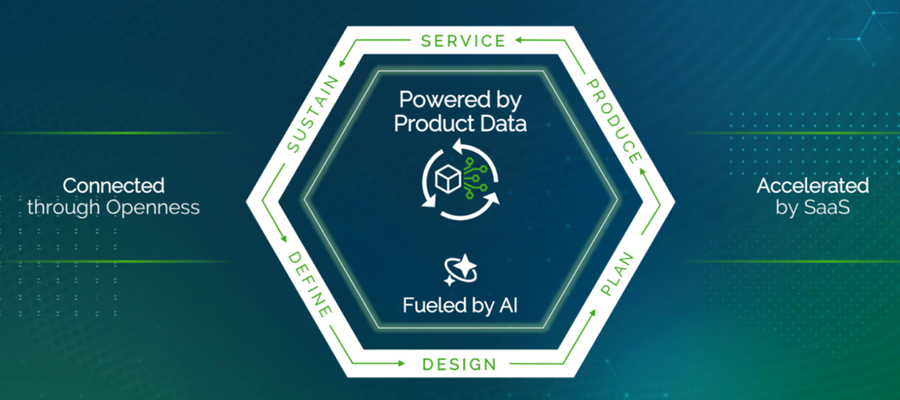
An intelligent product lifecycle uses a unified data backbone to connect every stage of development, from initial requirements to field service. When AI is embedded into this backbone, it can perform high-value tasks such as:
- Predictive Validation: Identifying design risks before they reach the prototype stage.
- Automated Traceability: Linking hardware and software requirements across complex systems.
- Impact Analysis: Instantly understanding how a change in one component affects the entire Bill of Materials (BOM) and regulatory compliance.
PTC’s Intelligent Lifecycle and Data Integration with OpsHub
To achieve this level of intelligence, engineering leaders are increasingly turning to integrated ecosystems. PTC and OpsHub provide a powerful example of how to not only build a unified data foundation but also maintain it.
PTC’s Pillars of Intelligence
PTC’s framework for the Intelligent Product Lifecycle is built on three essential pillars:
- A Unified Product Data Foundation: Creating a connected backbone that serves as a single source of truth.
- Intelligent AI-Enabled Solutions: Tools like Creo for AI-driven design optimization and Windchill for automated PLM workflows.
- Embedded AI Agents: Specialized agents, such as those in Codebeamer, that ingest documents to accelerate requirements management and agile development.
By using these tools, companies in regulated industries like aerospace and automotive can turn product complexity into a competitive advantage. For instance, in automotive engineering, linking software, hardware, and safety validation data allows teams to manage the rising complexity of software-defined vehicles without the risk of manual errors.

Breaking Silos with OpsHub
The challenge for many organizations, especially those not using a connected system like the one provided by PTC, is that their data is trapped in silos. This data may be fragmented across ALM, DevOps, CRM, and ERP systems. This is where OpsHub becomes a critical enabler. OpsHub’s integration solutions break down these barriers, ensuring that data is transferred with full context and accuracy. OpsHub provides the data richness required for AI success by connecting tools that do not have native connections. It ensures that when an AI agent analyzes a requirement in Codebeamer, it has the context of the related support ticket in Jira or the manufacturing constraint in SAP. This type of integration eliminates the hallucinations often caused by incomplete data, leading to more reliable AI outcomes and improved decision-making.
SPK AI Launchpad: Better AI Utilization
While the potential of AI is clear, many engineering organizations struggle with where to start. They often face data readiness gaps or are unsure if their current infrastructure can support advanced AI workflows. This is why we developed the SPK AI Launchpad. Our approach begins with understanding your organization’s current position. We look at your business use cases, skills, and governance. Then we provide you with a practical, 12–36 month roadmap.
The Launchpad includes three core phases:
- Assess Existing AI: We review the tools you already pay for to ensure you are utilizing the built-in AI features you already own.
- Data and Risk Review: We analyze where your data lives, identify gaps in connectivity, and assess security risks that could threaten compliance.
- Opportunity Mapping: We identify specific workflows where AI agents or automations can save time and reduce manual rework.
The goal of the AI Launchpad is to provide a clear report on where your data resides today and how you can get more value from it. We focus on quick wins that demonstrate real-world ROI while building the foundation for long-term scalability. Once we unlock the AI you own, and ensure your tools and data are connected, your teams can innovate faster and produce quality products more efficiently.

Product Data in Modern Engineering
The “business of engineering” is increasingly becoming the “business of data.” Organizations that successfully transition to an intelligent product lifecycle will build better products faster, with less risk and greater operational confidence. By leveraging a unified data foundation through PTC, ensuring seamless integration with OpsHub, and following a strategic roadmap like the SPK AI Launchpad, your team can turn fragmented information into a powerful competitive asset. If you are ready to stop managing disconnected documents and start leveraging your product data as a strategic asset, SPK and Associates is here to guide you through the journey. Contact us today to learn more about our AI Launchpad and how we can help you modernize your engineering data foundation.