

Key Takeaways:
- Disconnected PLM, ALM, DevOps, and quality systems impose a “hidden engineering tax,” turning engineers into human middleware who search for information, reconcile conflicting records, duplicate work, and chase changes by hand. The blog quantifies it with a simple formula, showing 50 engineers losing 5 hours a week at $100/hour costs $1.2 million a year.
- The financial cost comes from late discovery, when a test failure in Azure DevOps isn’t traced back to the requirement in Codebeamer or the part in Windchill, so defects get patched but the root cause repeats in the next release.
- In regulated industries, standards like FDA design controls, ISO 13485, IEC 62304, ISO 26262, and AS9100 require end-to-end traceability, and scattered data turns every audit into a weeks-long scramble to rebuild trace matrices.
- A digital thread built on PTC’s Creo, Windchill, and Codebeamer, extended through OpsHub and Exalate to tools like Jira and Azure DevOps, delivers faster change cycles, automatic traceability, always-ready audits, and the trusted data AI needs, with SPK guiding the work across five stages from assessment through managed services.
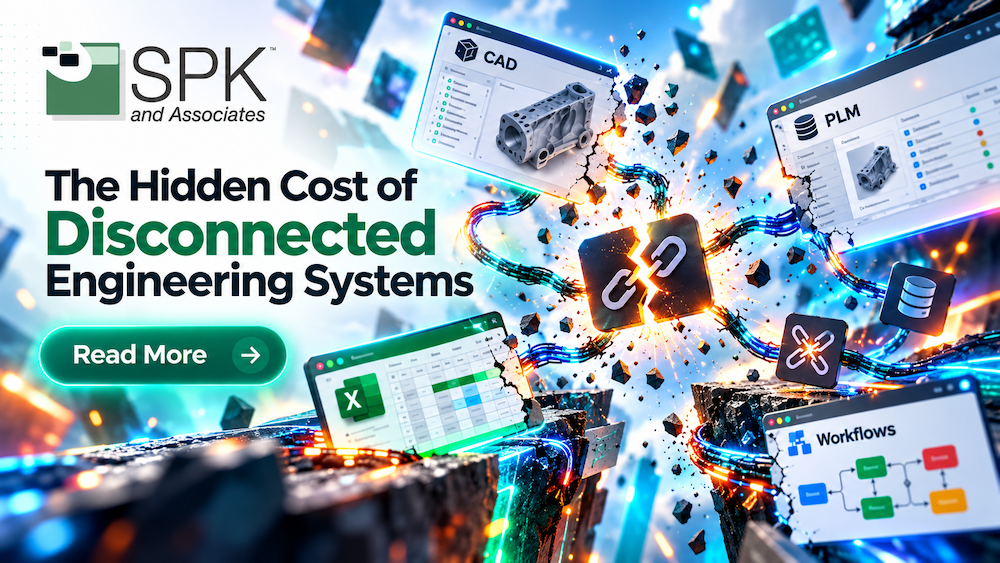
Disconnected engineering systems impose a hidden engineering “tax” on every product team. This tax, though it rarely shows up on a budget line, is paid in hours, rework, and audit risk. The consensus across engineering teams is that when PLM, ALM, DevOps, and quality systems don’t share a connected data thread, engineers become the integration layer. They are forced to manually search for information, reconcile conflicting records, recreate work they can’t find, and chase changes across tools. This results in slower change cycles, more defects that escape into production, and last-minute audits that are frantically thrown together. The solution to this isn’t another tool. It’s a digital thread: the connected backbone that lets data flow across systems so engineers can get back to engineering. And the calculation could be millions of dollars. See our example below.
Hidden Engineering Tax ($/year) = Engineers × Hours lost per engineer per week × Loaded hourly cost × 48 working weeks
For example:
50 engineers × 5 hours/week × $100/hour × 48 weeks = $1,200,000 per year
Let’s explain how to calculate the above.
The Operational Cost: Engineers as Human Middleware
Most engineering leaders underestimate how much of their week goes to work that isn’t engineering. In a disconnected environment, the tax shows up in four predictable places.
Searching for Information
A requirement lives in an ALM tool, a CAD model in PDM, a BOM in PLM, and a defect in a project management system like Jira. Engineers jump between these systems, or interrupt colleagues, just to assemble context. Each switch breaks focus, costing an average of four hours a week per worker.
Reconciling Conflicting Data
When the same part, requirement, or test result exists in several systems, the versions drift. Teams spend hours exporting to spreadsheets and comparing records to decide which one is right.
Duplicating Work
If teams can’t find or trust existing requirements, test procedures, or approved components, they recreate them. Reuse drops and inconsistency grows, which both lead to wasted time.
Managing Change by Hand
This is where cycle time suffers most. When you manage every change manually, a requirement change may never reach the design team or a Creo update may not be visible to manufacturing. Every handoff becomes a meeting, email, or status report that is outdated by the time it’s finished.
Here’s a simple illustration. If 100 engineers each lose four hours a week to switching and searching, that’s about 19,200 hours a year across a 48-week work year. That is roughly nine full-time engineers’ worth of capacity, spent on finding information instead of building products.
The Financial Cost: Late Discovery and Defect Leakage
The most expensive problems are the ones found late. Disconnected systems keep teams from seeing how a change in one area affects another, so issues surface during late-stage testing, production, or regulatory review. That is when they cost the most to fix.
Disconnected engineering and procurement workflows are a major driver of messy BOM data, late compliance failures, and costly design re-spins. On the factory floor, the same gaps feed scrap and rework. Defect leakage follows the same pattern. When a test failure in Azure DevOps isn’t traced back to the requirement in Codebeamer or the part in Windchill, the root cause stays hidden. The defect gets patched, but the underlying issue repeats in the next release or product variant. Scale only worsens this. Fragmented systems and inconsistent data across enterprises mean low confidence in that data. This results in unnecessarily difficult decision-making spanning topics such as pricing, costing, and innovation.


The Compliance Cost: Audit Readiness on Borrowed Time
For medical device, aerospace and defense, and automotive teams, traceability isn’t optional. FDA design controls, ISO 13485, IEC 62304, ISO 26262, and AS9100 all require proof that every requirement was implemented, verified, and controlled through change. When that proof lives in five systems, compliance becomes a manual assembly project. Compliance officers export data from PLM and ALM, reformat it in spreadsheets, and stitch together a trace matrix before every submission or audit. Nobody fully trusts the links, forcing organizations to add defensive overhead: extra reviews, secondary approvals, and redundant validation steps just to confirm the data is right.
That’s why audits often become stressful, last-minute exercises. Teams spend weeks rebuilding traceability and repairing reports. Missing or inconsistent records can still lead to audit findings, delayed approvals, and greater regulatory risk. The irony is that the same gaps that slow down engineering also weaken compliance. Fix the data flow, and you improve both.
How the Digital Thread Eliminates the Engineering Tax
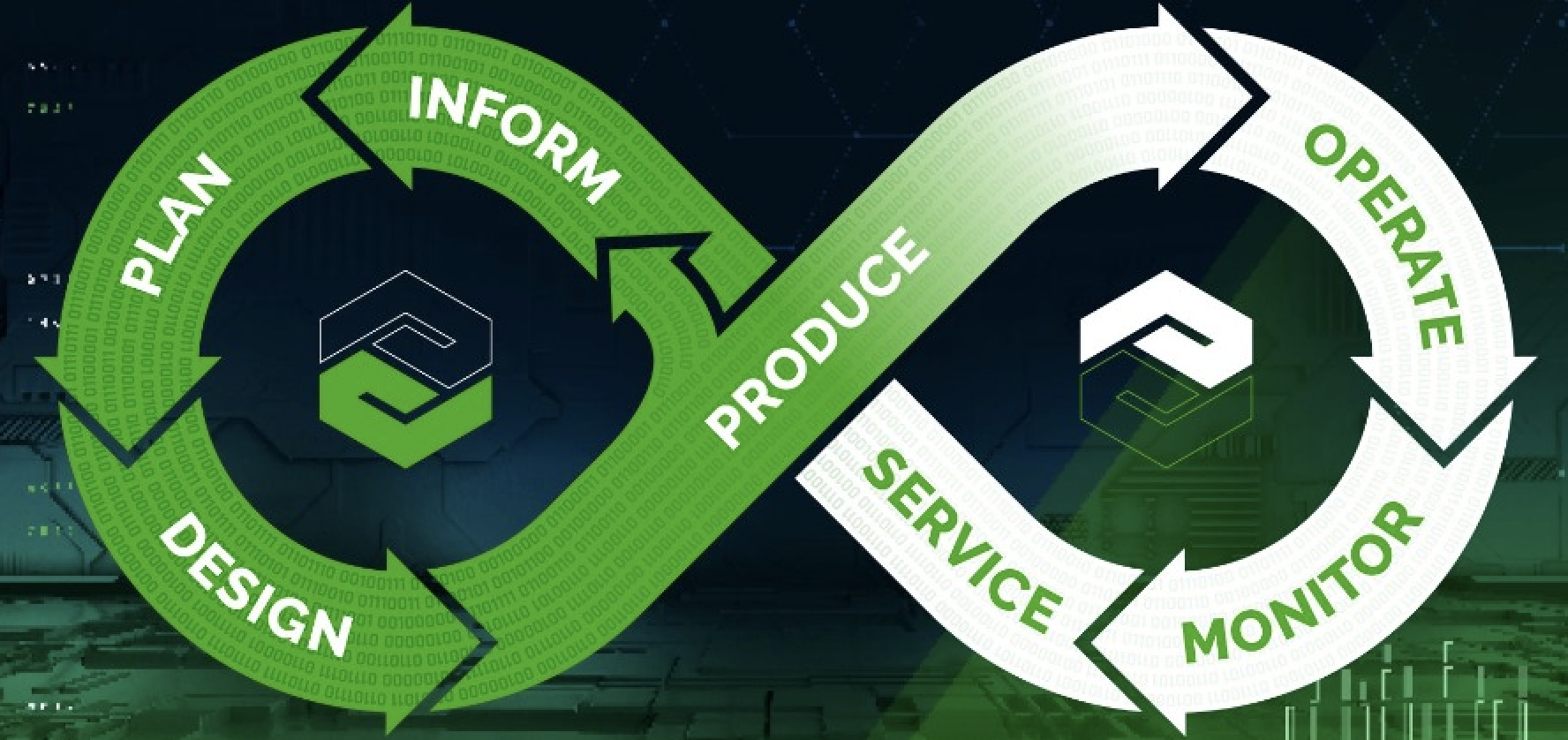
A digital thread connects product data across the lifecycle. Each team keeps working in its own tool while the information it needs flows in automatically. In practice, PTC’s platform provides the core, and integration tools like OpsHub and Exalate carry data to the rest of the toolchain.
The PTC core
Creo produces the CAD models that feed everything downstream. Windchill acts as the central nervous system, managing product structures, BOMs, configurations, and engineering change. Meanwhile, Codebeamer governs requirements, risk, and testing, with traceability built for regulated development. Together, they form the backbone of a comprehensive digital thread.
Integration for the Rest of the Toolchain
Most organizations also run Jira, Azure DevOps, IBM DOORS, ServiceNow, or additional quality platforms. Integrating these tools enhances the digital thread. OpsHub provides bidirectional synchronization between ALM and PLM tools like Codebeamer and Windchill and DevOps tools like Azure DevOps and Jira. Exalate adds flexible, scriptable sync across work management and service tools, such as Jira, Azure DevOps, and ServiceNow, including across company boundaries with suppliers and partners.
When these connections are in place, the results show up in three areas.
- Faster change cycles: When a system architect updates a model, the change is visible in Windchill right away and moves to approval without manual handoffs. Teams shift from batch updates to a continuous loop.
- Complete traceability: Links from change requests to requirements, design, development, and testing are created automatically. Nobody has to ask whether something can be traced.
- Always-ready audits: Because the data is already connected, trace reports can be generated in a click instead of being rebuilt over weeks.
The Foundation for AI
Every engineering organization is exploring AI, from requirements analysis and change impact prediction to AI assistants built into PLM and ALM. However, AI is only as good as the data it can reach. Models working from fragmented, conflicting, or untraced data produce answers nobody can trust, which is a non-starter in regulated industries. A digital thread gives AI connected, current, and auditable context, making it the operational backbone for modern engineering and AI initiatives.
How SPK Builds Your Digital Thread
A digital thread is not a single product you install. It’s an architecture that spans tools, teams, and processes, and the common challenges are real: legacy systems, data silos, security and compliance requirements, vendor lock-in, and data continuity at scale. That’s why the partner matters as much as the technology. As a PTC, OpsHub, and Exalate partner, SPK and Associates brings strategy and implementation together across five stages.

1. Assess the Tax
We map your current PLM, ALM, DevOps, and quality landscape, find where data breaks, and identify the change, traceability, and audit gaps that cost you the most.
2. Design the Architecture
We define which system owns which data, what needs to sync, and in which direction, so integrations support your business goals instead of adding complexity.
3. Implement and Integrate
Our engineers configure tools such as Windchill, Creo, and Codebeamer and connect them to Jira, Azure DevOps, and additional tools through OpsHub and Exalate.
4. Validate for Regulated Environments
We build with FDA, ISO, IEC, and ASPICE requirements in mind, so compliance becomes an operational advantage instead of documentation overhead.
5. Manage and Optimize
Through managed services and validated cloud hosting, we keep the thread healthy as your tools, teams, and products evolve.
We act as an extension of your team, not a one-time vendor, which is why our average client relationship lasts more than eight years. Check out our Engineering Digital Thread Playbook for a deeper look at how to plan the journey.
Stop Paying the Hidden Engineering Tax
Disconnected systems lead to lost hours, slow change cycles, escaped defects, and audits that drain your best people. This cost quietly spreads across every team, so it rarely gets fixed. A connected digital thread changes that. Engineers stay in their own tools while the data they need comes to them. Changes move in real time, traceability builds itself, and audit readiness becomes the default. Just as important, your organization gains the trusted data foundation that AI requires. If you are ready to see what the hidden engineering tax is costing your team, contact SPK and Associates to start building a digital thread that pays for itself.