
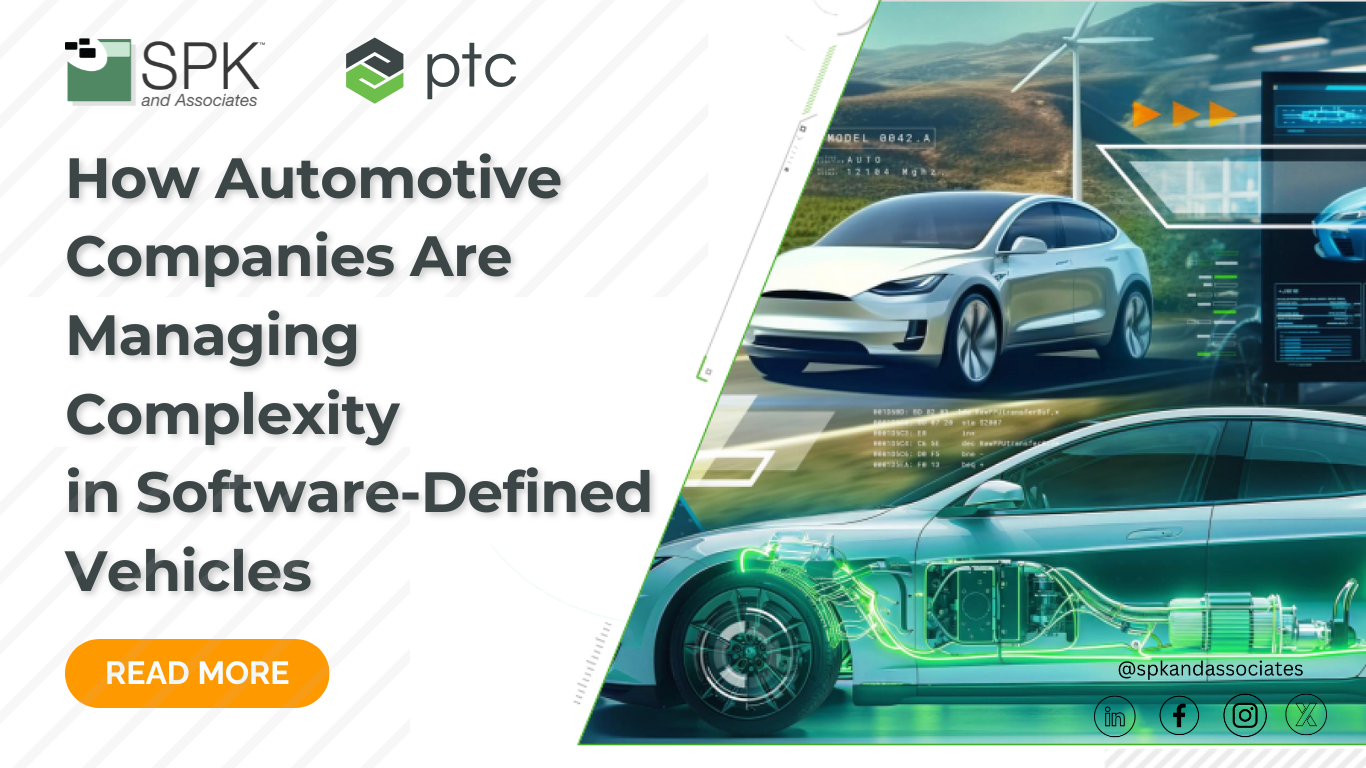

In all of automotive history, vehicles have been defined by mechanical performance, hardware reliability, or manufacturing efficiency. That has all started to change as software, connectivity, autonomy, electrification, and personalized digital experiences become a priority. This shift is creating tremendous opportunity; however, it is also introducing new levels of complexity. OEMs and Tier 1 suppliers must innovate faster, manage more product variants, respond to new regulatory expectations, and control lifecycle costs. At the same time, global competition is accelerating. The rapid pace of innovation from Chinese automotive players is putting pressure on OEMs across the globe to shorten their innovation timelines.
To compete in this environment, automotive companies need more than traditional engineering tools. They need a connected, intelligent product lifecycle. One that unifies requirements, design, software, validation, manufacturing, service, and compliance. When solutions from PTC are combined with SPK’s expertise, automotive organizations can better manage software-defined vehicle complexity.
New Automotive Trends That Are Increasing Complexity
Modern vehicles now depend on millions of lines of code, advanced driver assistance systems, cybersecurity protections, and software updates that continue long after the vehicle leaves the factory. This has created several major trends across the industry.
First, development timelines are under pressure. Automakers must bring new EV, ADAS, autonomous, and connected vehicle capabilities to market faster. This is difficult to do while also keeping up with aggressive global competitors. Traditional development cycles are often too slow for the speed of software-driven innovation.
Second, vehicle complexity is increasing. Software-defined functionality creates more dependencies between mechanical, electrical, and software systems. A change in one area can impact requirements, tests, suppliers, manufacturing processes, service procedures, and compliance documentation.

Third, cost pressure is rising. Global supply chain disruption, supplier complexity, and part proliferation are making lifecycle cost management more difficult. Additionally, disruptive tariffs and complex supply chains are increasing cost pressure for many automotive companies.
Fourth, quality expectations are becoming harder to meet. Software-defined vehicles require consistent validation across hardware and software. However, disconnected tools often make it difficult to ensure that requirements, test cases, design changes, and compliance evidence stay synchronized.
Finally, safety, regulatory, and cybersecurity requirements are increasing. Autonomy, OTA updates, and connected systems introduce new obligations around traceability, risk management, cybersecurity, software update control, and regulatory documentation.
These trends all point to the same conclusion: complexity cannot be managed effectively with disconnected tools and manual processes.
Why Traditional Engineering Approaches Fall Short
For decades, many automotive organizations managed engineering work through separate systems. Mechanical teams worked in CAD and PLM while software teams worked in ALM, DevOps, or source code tools. Manufacturing teams used MES and ERP systems, and quality teams managed QMS processes. Service teams relied on field service and service lifecycle tools. That model becomes fragile in a software-defined vehicle environment.
When requirements, design data, software work, and testing evidence are in different systems, teams lose the digital continuity they need to make fast and informed decisions. Change becomes difficult to evaluate, and reuse becomes harder. Additionally, compliance documentation takes longer, and supplier collaboration becomes riskier. Teams spend too much time reconciling information instead of solving engineering problems.
For software-defined vehicles, this is not just an efficiency issue, but a business risk. A missed requirement, unsynchronized software change, or undocumented test gap can create quality problems, warranty exposure, compliance risk, and delayed launches.
Managing Complexity with PTC’s Intelligent Product Lifecycle
PTC’s Intelligent Product Lifecycle provides a modern approach for managing complexity across the automotive enterprise. Instead of treating product data as static information spread across disconnected systems, the Intelligent Product Lifecycle creates a connected, AI-enabled foundation for managing requirements, design, software, manufacturing, service, and compliance.
This approach is valuable for automotive companies because it connects the key domains involved in software-defined vehicle development:
- PTC Windchill provides the PLM backbone for managing product structures, configurations, parts, change management, and enterprise product data.
- PTC Codebeamer supports ALM capabilities such as requirements management, test management, risk management, and traceability for software-intensive product development.
- PTC Creo supports advanced design, simulation, model-based definition, and engineering optimization.



Together, these tools help unify hardware and software engineering around a shared digital foundation. Instead of managing mechanical, electrical, and software development in silos, teams have better visibility into requirements, variants, tests, design changes, and compliance impacts.
Accelerating Vehicle Development Timelines
One of the most important goals for automotive companies is reducing vehicle development timelines. There are several ways an intelligent product lifecycle supports that goal.
Advanced design simulation helps teams digitally validate and optimize designs earlier, reducing reliance on physical prototypes. This allows engineers to identify technical risks before they become expensive redesign issues.
Parts, designs, and software module rationalization allow teams to reuse existing components across platforms. When engineers have better visibility into previous parts, designs, and software artifacts, they can avoid redundant work and accelerate development.
Collaborative hardware and software engineering enables mechanical, electrical, and software teams to work together on a shared foundation. This is critical for EV, ADAS, OTA, and software-defined vehicle programs, where system validation must happen across multiple engineering domains.
Integrated requirements, variants, and test management help teams keep requirements, tests, regulations, and product configurations aligned as complexity grows. This is a way to reduce lags in managing and integrating requirements, tests, and regulations.
For automotive companies, this means faster iteration without losing control. Teams can move quickly while still maintaining the traceability and validation needed for safety-critical products.

Reducing Vehicle Lifecycle Costs
Software-defined vehicle complexity also increases lifecycle costs. More variants, more software, more suppliers, and more configuration dependencies can quickly create inefficiencies. PTC identifies a 3% reduction in vehicle lifecycle costs as a priority outcome for automotive companies. It connects excess lifecycle cost to challenges such as limited reuse, variant proliferation, poor supplier collaboration, reliance on physical prototypes, and poor complexity management.
An intelligent product lifecycle helps reduce those costs by improving visibility and reuse. When teams can identify shared components, similar parts, reusable designs, and software modules across products, they can reduce duplication and simplify product platforms. Supply chain collaboration is also critical. Automotive companies must share accurate requirements and product information with suppliers in real time. When supplier relationships are managed through disconnected processes, companies face greater risk, slower decisions, and more rework. Connected PLM and ALM systems help ensure suppliers are working from accurate product data, which saves time and money in the long run.
Improving Quality and Compliance
Quality management is another aspect becoming more complex in the era of software-defined vehicles. A defect may no longer be isolated to a mechanical component. It may involve software logic, calibration, or cybersecurity controls. This is where connected traceability becomes essential. Automotive teams need to trace requirements through design, development, testing, manufacturing, and service. For standards and frameworks such as ISO 26262, ASPICE, UNECE R155, and UNECE R156, organizations must show that requirements were validated, risks were managed, changes were controlled, and evidence was documented.
PTC’s approach supports integrated requirements, variants, and test management. This, along with traceability and change management across R&D and manufacturing for hardware and software requirements lead to great benefits for automotive teams. Furthermore, automated regulatory management and reporting can also reduce the burden of compliance documentation and audits. For OEMs and suppliers, this means fewer manual processes, fewer documentation errors, and stronger audit readiness.
The Role of AI in Managing Automotive Complexity
AI is becoming a major enabler of automotive digital transformation. However, AI is only valuable when it has access to structured, governed, connected product data. That is why PTC’s Intelligent Product Lifecycle emphasizes a product data foundation as the contextual backbone for AI. AI is built into the product lifecycle, with intelligent solutions that leverage the product data foundation to improve performance.
In the automotive context, AI can help teams:
- Validate requirements in ALM.
- Optimize designs in CAD.
- Rationalize parts in PLM.
- Streamline field service in FSM.
- Support product configuration and change agents.
- Assist requirements and systems engineering.
- Improve manufacturing planning.
- Support service parts planning.
For software-defined vehicles, AI can help teams navigate complexity, but only when the underlying data is connected, governed, and trusted.
How SPK Helps Automotive Companies Execute
PTC provides the technology foundation, but automotive companies also need the right implementation partner to configure workflows, migrate data, and support long-term adoption. That is where SPK and Associates can help. SPK works with engineering, manufacturing, and regulated product development organizations to implement and manage the systems that support modern product development. For automotive teams, this includes expertise across PLM, ALM, DevOps, cloud infrastructure, compliance, and digital thread integration.
Our team of experts can help organizations implement and optimize PTC Windchill, Codebeamer, and Creo to support connected lifecycle management. This includes aligning requirements, design, software, testing, and change management processes so teams can improve traceability and reduce manual handoffs. We can also support cloud-hosted environments for tools like Codebeamer and Windchill, helping companies improve scalability, supplier collaboration, access control, and system performance. For teams that need to support remote engineering, supplier access, or distributed product development, our cloud expertise helps make these systems more accessible.
In addition, we bring experience in DevOps, CI/CD, managed services, and application management. That is important when dealing with a strong alignment between engineering systems and software delivery pipelines. Our experts can help connect ALM, PLM, DevOps, and cloud platforms so automotive teams can move faster while maintaining governance and compliance. Most importantly, we help organizations translate technology into operational value. That means evaluating current processes, identifying gaps, designing scalable architectures, and configuring tools around business needs. After this assessment and configuration is completed, we can also support new integrations, train users, and provide ongoing managed services to ensure systems continue evolving as the organization grows.

Managing Software-Defined Vehicle Complexity with PTC and SPK
Software-defined vehicles are changing what it takes to compete in the automotive industry. Traditional engineering approaches are no longer enough. PTC’s Intelligent Product Lifecycle helps automotive companies manage complexity by creating a connected foundation. With this, companies can improve development speed, reduce lifecycle costs, strengthen quality, and manage regulatory complexity more effectively. When these tools are combined with SPK’s expertise, automotive organizations can turn this vision into a practical roadmap. If you are ready to master software-defined vehicle complexity and build the next generation of intelligent, connected products, reach out to our team.