
Key Takeaways:
- AI is changing simulation from a late-stage validation step into a continuous part of product development, helping teams explore more designs, automate setup, and support predictive digital twins.
- AI-driven simulation still depends on high-performance infrastructure. ROMs, surrogate models, parameter sweeps, and AI training all require reliable access to high-fidelity simulation data and significant compute resources.
- Legacy workstation environments can create bottlenecks through costly refresh cycles, slow onboarding, data transfer delays, security risks, and growing IT complexity.
- vCAD provides GPU-accelerated cloud workstations for CAD and simulation workloads, while keeping engineering applications and data in a centralized environment that supports security, scalability, and distributed collaboration.
- A cloud-based engineering foundation can help teams prepare for more advanced AI and digital twin workflows by virtualizing CAD/CAE environments, centralizing data, and connecting scalable compute to ROM and predictive modeling pipelines.
Artificial intelligence is fundamentally reshaping how engineering organizations approach simulation. What was once a late-stage validation checkpoint is rapidly evolving into a continuous, predictive engine driving product development. Through automated model generation, reduced-order models (ROMs), dynamic digital twins, and physics-informed neural networks (PINNs), AI is driving efficiency. It accelerates design iterations, automates routine setup tasks, and makes simulation insights accessible across broader engineering disciplines.
However, as simulation workflows grow more intelligent and data-intensive, they surface a critical, practical question for engineering leaders: Can your current engineering and compute infrastructure actually support the performance, access, security, and collaboration requirements these advanced workflows demand? This is where SPK vCAD becomes a decisive competitive advantage. By offering a secure, cloud-hosted virtual workstation, vCAD equips organizations to accelerate AI-driven engineering.
The New Role of Simulation in Product Development
Simulation has officially “shifted left.” Rather than relying on physical prototypes and late-stage testing, engineering teams increasingly leverage simulation from day one of conceptual design.
AI acts as a major catalyst across this entire lifecycle:
- Accelerating Design Exploration: Recent industry benchmarks show AI-assisted simulation workflows help engineering teams generate up to 4x the number of design variants while achieving a 2.8x speedup in processing simulation requests.
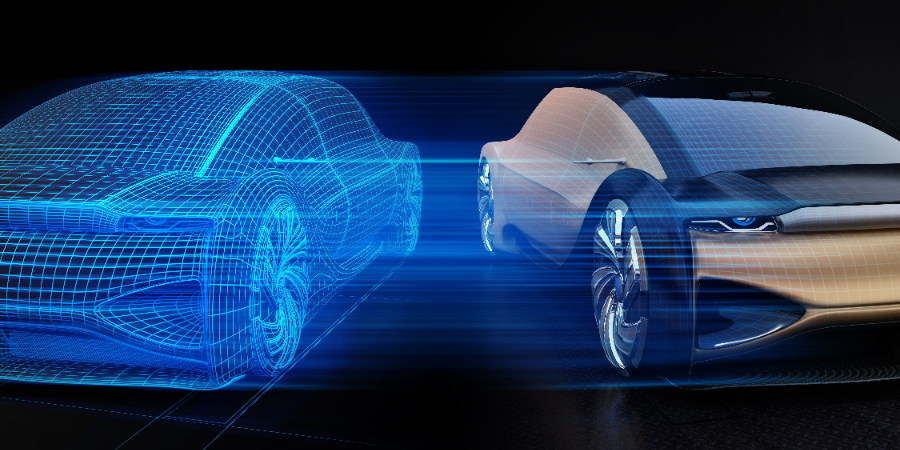
- Evolving Digital Twins: Digital twins are transitioning from static 3D digital replicas into dynamic, predictive systems. Powered by AI, modern twins can forecast structural failures, recommend real-time operational adjustments, reduce manufacturing scrap, and schedule predictive maintenance before physical assets experience downtime.
- Democratizing Engineering Insights: AI-driven interfaces and automated meshing help reduce the expertise barrier. This enables systems engineers, product designers, and non-specialists to run standard simulations without causing slowdowns for senior analysts.
- Physics-Informed Machine Learning: Advanced solvers such as FEATool Multiphysics are integrating AI/ML workflows directly, using high-fidelity Navier-Stokes and structural simulation data to train physics-informed neural networks (PINNs) for complex applications ranging from industrial fluid dynamics to medical blood-flow imaging.
Why AI-Driven Simulation Still Demands Robust Infrastructure
While AI dramatically accelerates calculation times and surrogate modeling, it does not eliminate the need for rigorous physics, high-fidelity simulation solvers, or heavy compute resources. In fact, it often intensifies infrastructure requirements.
Consider the reality of reduced-order models (ROMs) and surrogate modeling:
- ROMs Rely on High-Fidelity Ground Truth: A ROM can deliver near-instantaneous predictions, but it behaves as a data-driven approximation. Training reliable ROMs requires massive volumes of high-fidelity finite element analysis (FEA) and computational fluid dynamics (CFD) simulation runs.
- The “Black Box” Risk: When operating in highly nonlinear physical domains, uncharted boundary conditions, or complex geometric variations, data-driven approximations can break down. Engineers must continuously fall back on full multiphysics solvers to validate predictions and understand the underlying mechanics of failure.
- Heavy Compute for AI Model Training: Preparing datasets, running parameter sweeps, and training surrogate models requires reliable access to enterprise-grade GPU acceleration and multi-core processing power.
AI is an accelerator, not a shortcut around fundamental physics. Without high-performance compute environments and governed data pipelines, AI models risk being trained on incomplete data or operating without proper validation.
Common Barriers to Modern Simulation Workflows
Many engineering organizations recognize the strategic value of simulation, yet IT and infrastructure bottlenecks frequently stall simulation adoption:
Costly Hardware Refresh Cycles: High-end engineering workstations require significant upfront investment, become outdated quickly, and often leave expensive GPU resources sitting idle when not in use.
Slow Engineer and Contractor Onboarding: Provisioning, configuring, and shipping dedicated workstations to new hires, contractors, and distributed teams can delay productivity by days or even weeks.
Access Barriers for Occasional Users: Systems engineers, project managers, and other occasional users may need access to CAD models or simulation results without requiring a fully equipped engineering workstation.
Data Gravity and Network Latency: Large CAD assemblies, simulation files, and engineering datasets can reach tens or hundreds of gigabytes, making transfers across distributed locations slow and difficult to manage.
Security and Compliance Risks: Storing and transferring engineering files across local devices and remote networks increases the risk of IP exposure, uncontrolled copies, and compliance issues.
IT and Licensing Complexity: Managing software versions, licenses, GPU drivers, security policies, and engineering applications across hundreds of physical machines creates a significant burden for IT teams.
How SPK vCAD Powers Next-Generation Simulation Teams
SPK vCAD eliminates the friction of physical engineering hardware by delivering dedicated, GPU-accelerated cloud virtual workstations tailored specifically for heavy-duty engineering applications. Instead of tethering simulation performance to physical hardware, teams access high-performance virtual environments securely from any browser or thin client, anywhere in the world.
CAD and Simulation Capabilities
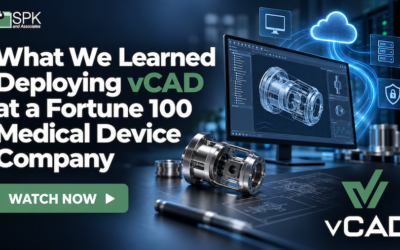
vCAD delivers desktop-grade GPU performance using enterprise cloud GPUs optimized for graphics-intensive CAD applications and demanding simulation tools. These tools include SolidWorks, PTC Creo, Siemens NX, and CATIA, as well as ANSYS, COMSOL, Abaqus, Altair, and OpenFOAM. Engineers can work with complex models and simulation workloads without relying on high-end local hardware.
By colocating CAD geometry, simulation solvers, and storage within the same high-speed cloud environment, teams can reduce large file transfer times and avoid many of the latency issues that come with moving engineering data across remote networks. This approach keeps workloads and data close together so engineers can spend more time working and less time waiting for files to move.

Security and Infrastructure
Centralized infrastructure also strengthens security and intellectual property protection. Proprietary models, CAD files, and other engineering data remain inside a governed cloud environment rather than being stored across distributed local endpoints. IT teams can apply consistent security policies and maintain greater control over where sensitive engineering data resides.
Cloud infrastructure also gives organizations more flexibility when project requirements change. Teams can quickly provision, resize, or de-provision virtual machines with different GPU, CPU, and memory configurations as workloads increase or new engineers join a project. This helps organizations scale resources without purchasing and deploying additional physical workstations.
Collaboration
Finally, a centralized environment makes collaboration easier for distributed engineering teams, external consultants, and cross-functional reviewers. Users can access the same software versions, standardized configurations, and centralized datasets, reducing compatibility issues and helping teams work from a consistent engineering environment.

Where vCAD Fits into Your AI and Simulation Strategy
SPK vCAD is not designed to replace your engineering tools, solvers, or domain expertise. Rather, it serves as the high-performance, secure digital foundation that allows your engineering teams to maximize those tools.
Modernizing your engineering environment is an evolutionary journey:
- Phase 1: Virtualize & Standardize: Migrate CAD and CAE workloads from physical desktops to secure vCAD environments.
- Phase 2: Centralize & Collaborate: Colocate large simulation datasets in the cloud to support real-time collaboration across distributed teams.
- Phase 3: AI & Digital Twin Acceleration: Connect scalable compute resources to surrogate model pipelines, reduced-order models (ROMs), and predictive digital twins.
Whether your organization’s immediate priority is virtualizing core CAD/CAE seats, eliminating workstation supply chain delays, or establishing the scalable compute backbone required for predictive digital twins and AI training pipelines, vCAD provides the underlying agility.
Modernize Your Engineering Environment with SPK and Associates
Transitioning complex engineering workflows to the cloud requires deep domain knowledge across software licensing, engineering toolchains, regulatory compliance, and cloud architecture. SPK and Associates bridges the gap between engineering goals and IT reality. With decades of focused expertise supporting product development organizations, including those operating within highly regulated environments, SPK delivers end-to-end support.
SPK supports engineering teams with simulation and infrastructure assessments that evaluate existing compute environments, solver bottlenecks, and data flows. From there, we design and deploy vCAD environments tailored to specific CAD and CAE applications, including the right cloud GPU instances, storage tiers, and network configurations. Additionally, we help integrate the broader engineering toolchain by connecting PDM and PLM systems, simulation data management, and ALM platforms. Once the environment is in place, our managed services team can handle user provisioning, software updates, GPU resource allocation, security monitoring, and ongoing optimization.

Build the Foundation for the Future of Simulation
AI is ushering in a faster, more predictive era of product development, but legacy physical workstations cannot sustain that momentum. Unlocking the full potential of modern simulation requires flexible compute, robust data security, and seamless global access. SPK vCAD empowers engineering teams to simulate faster, collaborate globally, and prepare their infrastructure for the AI-driven workflows of tomorrow. If your team is interested in deploying vCAD, talk to our experts today.