

Companies across industries are launching AI pilot programs, testing copilots, experimenting with agents, and exploring new ways to automate work. While this all sounds like great progress, for many organizations, those pilot programs never turn into meaningful business outcomes. What starts as excitement often ends as another disconnected experiment that fails to scale, integrate, or deliver measurable return. That gap between experimentation and impact is becoming one of the biggest challenges in enterprise AI adoption. A 2025 report found that 95% of generative AI pilots fail to deliver measurable impact. This is exactly why companies need more than just AI enthusiasm. They need a roadmap, a maturity model, and a strategy for turning pilots into operational value. That is where SPK and Associates’ AI Launchpad comes in.

Moving Beyond Experimentation with AI Pilot Programs
Many organizations begin their AI journey the same way. A team identifies a promising use case, launches a pilot, and tests a tool in isolation. This can be a chatbot, a coding assistant, a workflow automation concept, and so on. These pilots often generate excitement internally, but too often they remain stuck in a “lab” phase rather than becoming part of daily operations. This production gap is one of the clearest signs that companies are struggling to turn AI from a concept into a capability.
The issue is rarely that the underlying AI is incapable. In fact, AI has strong potential across software and product engineering. It can reduce routine work, strengthen traceability, help teams generate compliance documentation, and identify risks earlier in development. In regulated industries, especially, AI can help improve quality and time to market while reducing administrative burden. However, these outcomes only happen when AI is connected to real workflows, systems of record, and business priorities.

Common Issues and Failures
Integration
One of the biggest reasons AI pilots fail is poor workflow integration. Many companies treat AI as a standalone experiment instead of embedding it into the systems employees already use every day. When that happens, the pilot may look innovative, but it never becomes operationally important.
Budget
Another major issue is misaligned investment. More than half of generative AI budgets are spent on flashy sales and marketing use cases, while some of the highest ROI opportunities are actually in back-office automation and deeply integrated operational workflows. When companies chase visible experimentation instead of strategic process improvement, they often miss the use cases that create the most measurable impact.
Data Readiness
Data readiness is another common barrier. Many organizations underestimate how much effort is required to prepare, connect, and govern the data AI depends on. If data access, quality, and structure are not addressed upfront, even promising pilots can stall before they ever generate usable results.
Skills, Governance, and Expectations
There is also a growing skills and governance gap. AI tools need training, change management, and clear oversight. Without that, organizations end up with siloed experiments, inconsistent adoption, and even shadow AI, where employees bypass approved tools in favor of personal ones because official solutions are too limited. Mismanaged expectations also play a role. Some companies expect ROI within three to six months, even though successful AI initiatives often take 12 to 18 months to produce measurable impact.

How AI Launchpad Helps
At SPK and Associates, we built our AI Launchpad to help companies move beyond scattered pilot programs and toward scalable, business-aligned AI adoption. Rather than treating AI as a collection of disconnected experiments, AI Launchpad helps organizations approach it as a strategic capability tied to outcomes, workflows, governance, and long-term execution.
Our approach starts by understanding where an organization stands currently. We assess readiness across data, infrastructure, use cases, governance, and skills, then benchmark those capabilities against a practical AI maturity model. This helps identify not just what is possible, but what is missing. For some organizations, the gap is data readiness. For others, it is integration, governance, or internal expertise. From there, we build a roadmap that balances quick wins with long-term scalability.
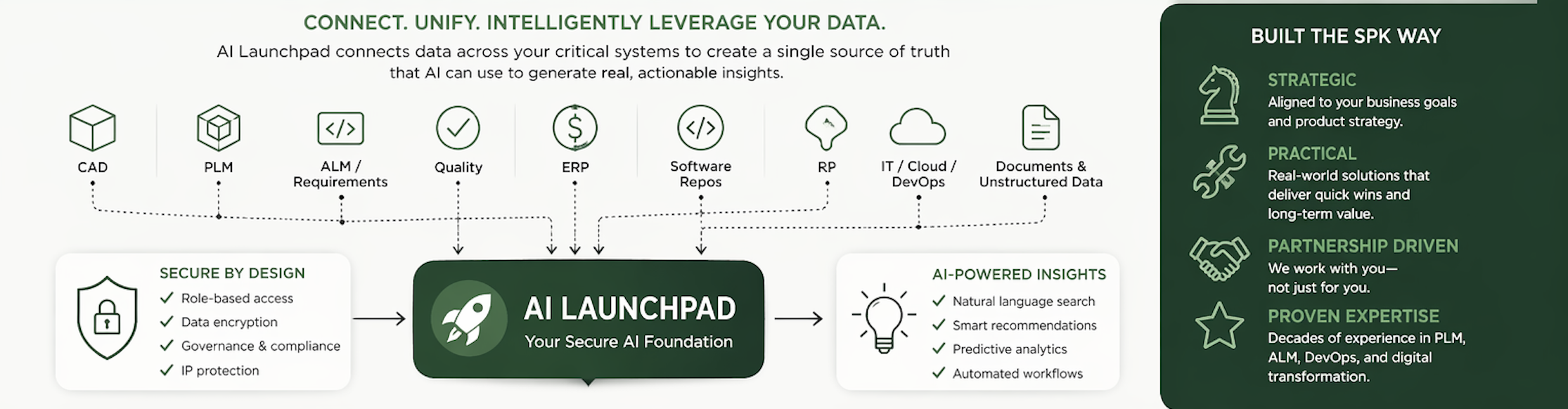
Our AI Launchpad is especially valuable because it helps companies focus on the traits that successful AI implementations tend to share. Projects that tend to succeed are highly domain-specific, deeply integrated into real workflows, supported by external expertise, and treated as process redesign efforts rather than simple technology purchases. This directly aligns with our approach. We help organizations prioritize practical use cases, connect AI to the systems that matter, and build the governance structure needed to support sustainable adoption.
In addition to this, we also help companies evaluate the AI capabilities they may already own within their existing software stack. In many cases, businesses are paying for AI-enabled tools but only using a fraction of what is available. AI Launchpad helps uncover those opportunities, assess current AI usage, and determine where additional AI agents can streamline workflows. The result is a practical action plan with a clearer path to ROI.
The Future of AI Pilot Usage
AI pilot programs are easy to start, but delivering real value from them is much harder. The companies that struggle are not necessarily lacking ambition or access to technology. More often, they are missing the strategy and roadmap needed to turn experimentation into execution. That is why so many pilots stall before they ever meaningfully impact the business. SPK’s AI Launchpad is designed to close that gap. If you are ready to empower your product and engineering teams to move toward measurable business outcomes, reach out to us today.