

Any software developer knows the reality of engineering is not always smooth sailing. Between the deep architectural work and the innovative feature builds, teams are frequently bogged down by routine maintenance, bug fixes, and context-switching. The challenge for modern engineering leadership is finding a way to handle these necessary but repetitive tasks without burnout. This is where context-aware AI agents are changing the delivery landscape. By bringing execution power directly into the planning environment, teams can now move from a Jira task to a merge-ready pull request (PR) without ever breaking their focus.
The High Cost of Context-Switching in Software Delivery
For Jira users, most development begins with a user story, bug report, or security vulnerability. However, the moment a developer begins the work, they typically leave the Jira environment for an IDE or a command-line interface. This jump creates a disconnect. When developers bounce between tools to take an idea through to deployment, they spend a significant amount of time searching for context and manually tracking work across branches, pipelines, and PRs. Every tab switch represents a loss of momentum. While strategic design and complex engineering demand this deep focus, many routine tasks do not. Resolving security vulnerabilities, cleaning up stale feature flags, and fixing minor bugs are well-understood tasks that often feel like administrative overhead. When these tasks pile up, they create a “side quest” culture where developers are constantly distracted from the core mission.

Introducing Rovo Dev: Your Context-Aware AI Teammate
This is where Atlassian Rovo Dev can help. Rovo Dev is a context-aware AI agent designed specifically for software teams. Unlike generic AI tools, Rovo Dev integrates directly into Jira, allowing it to leverage the requirements, comments, and historical context already stored within your work items. Rovo Dev turns a Jira issue from a static record into an active execution surface. Because it understands the intent behind the task, it can autonomously handle repetitive portions of the software development lifecycle. This does not mean Rovo replaces the developer; quite the opposite. The developer drives, choosing which tasks to delegate, reviewing the AI-generated plans, and approving the final code changes before someone moves them to production. The result is a significant reduction in boilerplate work and a faster path to merge-ready PRs, all while keeping the team focused on the high-value problems that require human ingenuity.
How Rovo Dev Automates Work Directly Inside Jira
Rovo Dev operates in a safe, configurable cloud sandbox, meaning your local environment remains free for complex work while the AI handles the routine tasks in the background. The workflow is designed to be transparent and controllable:
- Context Gathering: Rovo Dev pulls in information from the Jira ticket, relevant code across repositories, and any repo-specific commands.
- Plan Proposal: The agent proposes a concrete plan, detailing which files it will touch and which tests it will run.
- Execution: Once approved, it executes code changes, runs builds, and performs tests in an isolated environment.
- PR Creation: Finally, it prepares a linked pull request in Bitbucket or GitHub, ready for human review.

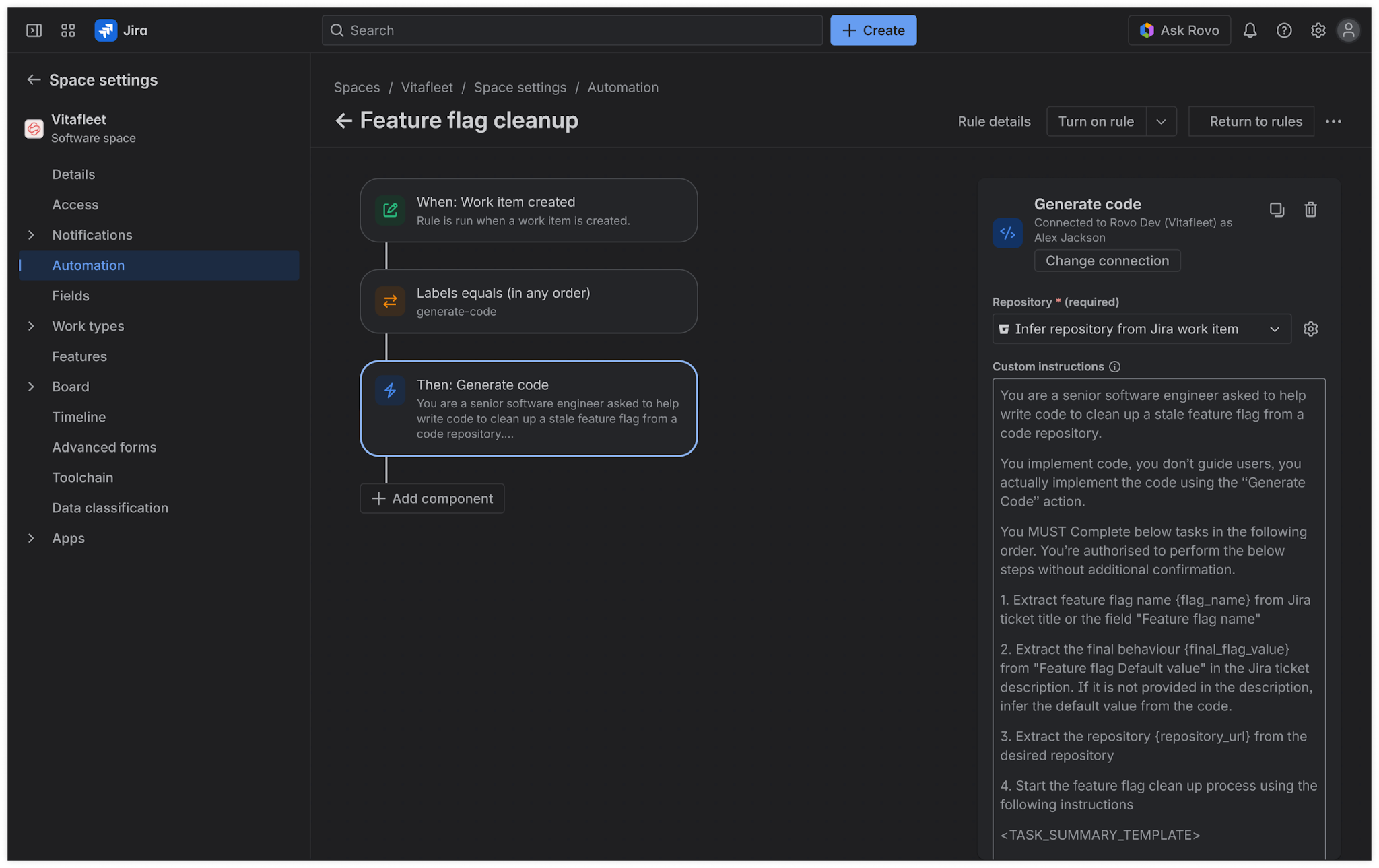
This cloud-based orchestration makes it easy to scale repeatable work. When a specific workflow, such as a library migration or a documentation update, proves successful, Jira Automation can turn it into a rule. This allows teams to trigger Rovo Dev automatically based on specific triggers, multiplying proven execution patterns across the entire organization.

Real-World Impact: Solving the Feature Flag Debt
A common example of unglamorous tech debt is the cleanup of stale feature flags. Once a dev team fully rolls out a feature, the remaining flag code quietly adds complexity and slows down the product. Manually cleaning these up requires verifying safety, hunting down references across services, updating tests, and creating PRs. Atlassian recently applied Rovo Dev to this exact problem. By creating a guided, automated workflow, they were able to clean up 12 feature flags in just two days. This represented an 85% increase in cleanup velocity. Out of 31 cleanup PRs created by the AI, 29 required absolutely no manual code changes from the engineering team.
By turning a dreaded manual task into a hands-off, AI-powered workflow, the team removed technical debt without sacrificing their primary development velocity.
SPK & Atlassian Rovo Dev
Implementing AI agents like Rovo Dev requires more than just turning on a feature. It requires an understanding of the “business of engineering.” At SPK and Associates, we specialize in helping regulated and complex engineering organizations modernize their software delivery processes. As an Atlassian Gold Solution Partner, our experts understand how to bridge the gap between raw AI capabilities and practical, compliant workflows. We know that teams in highly regulated industries must always balance speed with control. Our team has built our long-term client relationships on the fact that we don’t just implement tools; we optimize the systems that drive product development. We can help you configure Rovo Dev and Jira Automation so that your AI agents operate within the guardrails your industry demands, ensuring that traceability and quality remain uncompromised.
Moving Toward an Execution-Oriented Jira with Rovo Dev
The integration of Rovo Dev into Jira marks a shift in how software is built. Jira is no longer just a place to track what needs to be done, but where work actually gets finished. By bringing execution closer to the requirements, PMs, designers, and stakeholders can stay aligned with the actual code changes through the same issues and comments they use every day. For software teams looking to reduce friction, Rovo Dev offers a pragmatic path forward. It allows your most expensive and talented resources, your engineers, to stop acting like administrators and start acting like innovators again. If you are ready to explore how context-aware AI can accelerate your Jira workflows and reduce your team’s routine workload, SPK and Associates is here to help.