
Introduction
Michael Roberts: Hello, and welcome back to another SPK & Associates vlog. My name is Michael Roberts. I’m the Vice President of Sales and Marketing here at SPK & Associates, and today we have a special guest. I’m joined by SPK’s CEO and co-founder, Christine McHale. Chris, please feel free to introduce yourself.
Chris McHale: Hey, thank you, Michael. Hi, I’m Christine, or Chris, as I usually go by. I co-founded SPK a little over 20 years ago because I was really passionate about technology in the product development space and also about women in technology in the Bay Area. For a couple of different reasons, I thought it would be a great idea to start this company. It’s been going for that long, and we’re really focused on the technology and processes used by product and software engineering teams.
AI Agents and The Future of Work
Michael Roberts: Yeah, which leads us to our topic today. Chris, there’s a lot of discussion about AI agents and what they could mean for the future of work, but using them in product development presents some unique-
Chris McHale: Big challenges.
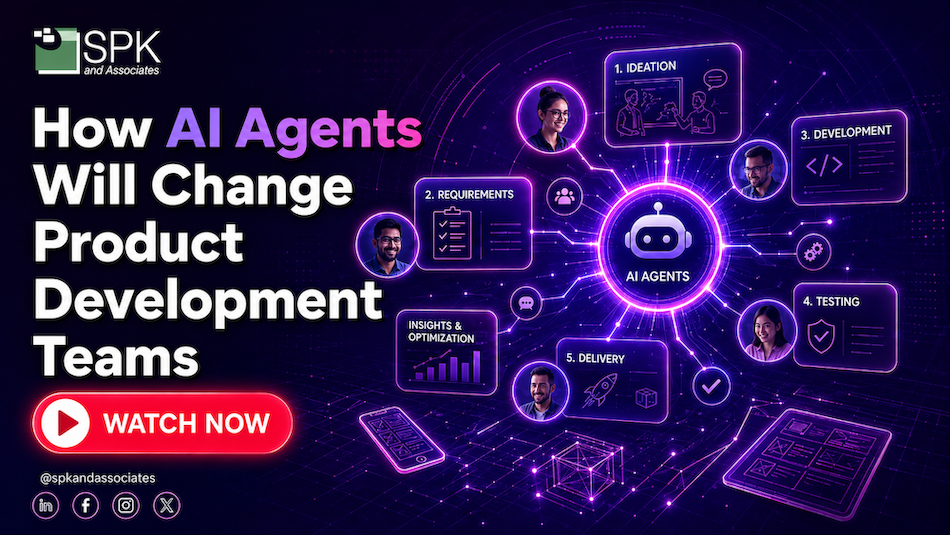
Michael Roberts: -that I think we’ve highlighted over the last couple of years, including engineering workflows, disconnected systems, and even more complex regulatory requirements and environments. There is also the need to keep humans firmly involved in that critical decision process in regulated industries. Today, we wanted to go beyond the AI hype and talk a little more about how we see these AI agents actually changing the way engineering and product development teams work.
Bridging Disconnected Product Development Workflows
Michael Roberts: Chris, first question: Many of these organizations are still struggling with a bunch of disconnected workflows across engineering, quality, manufacturing, software, and everything else. How do you see AI agents helping bridge those gaps and improving collaboration across the product lifecycle?
Chris McHale: Yeah, I love this question because I love the idea of making things more efficient in product development and engineering. Just on vocabulary, I usually say ‘software’ for software and ‘product’ for things that are more hardware- and manufacturing-related. Disconnected workflows are a really old, long-term problem in engineering – really, in anything in business, but particularly in engineering.
Siloed Teams and Disconnected Workflows
Chris McHale: I see three reasons why there are disconnected workflows, so I’ll start with that, and then we can talk about the AI side. One is organizational: the teams are managed separately and are siloed, which is a long-standing problem. The electrical engineers sit over there, the manufacturing CAD engineers sit over there, and the software guys sit over there. That’s one thing.
Chris McHale: The second is that we have different applications and data supporting different workflows, and they are separated. Therefore, they tend to create different workflows and disconnection between people. The final reason is domain knowledge and awareness. If I’m a really great coder, for example, I may not be that great at security or know very much about it, so there’s an inherent disconnection there.
Chris McHale: Where can AI help? I think AI can help enormously with the second two, but maybe not so much with the first one. The organizational part is a people problem. There are lots of tactics, and lots of people talk about how to create natural and ongoing collaboration among different domain teams, different kinds of engineers, compliance, quality, and so on.
Chris McHale: I don’t think AI can help as much there. However, in typical product development and management teams, workflows are supported by different applications, and each application manages its own data store. The barriers created between the workflows and the data can absolutely be addressed by AI agents.
Example of How AI Can Help
Chris McHale: Let’s use some examples because that’s the easiest way to see it. In the simplest form, you could have an agent looking for activity and changes in one application or workflow. I think we’ve actually done this ourselves with a client. Take something like Codebeamer, which manages requirements and tests. The agent can watch for a change, and a rule can say, ‘When you see that change, create this issue over here in Jira,’ or do something with a Jira issue related to that workflow. These are two different workflows, sometimes involving two different sets of engineers, and the agent can watch for this and create natural integration and collaboration.
Chris McHale: Some of this is already happening. Software manufacturers are also trying to create integrations, but agents give you much more flexibility over the use case and how you actually want to handle it. That would be one example.
Chris McHale: I also think AI agents can really supplement an engineer’s knowledge in a different domain. Let’s use coding as a simple example. If I’m a coder and I don’t know much about security, or there’s just a great deal of complexity around which security practices I should apply to my ongoing coding, it’s simply too much. You can’t be equally good at everything. That’s where some of these agents, almost as copilots, can help engineers strengthen their knowledge in a particular domain and bring that knowledge to their current expertise in a way they never could before, because they simply can’t know everything. Those would be some high-level answers I would give.
Michael Roberts: Nice. I especially like that last component because that’s really what we’re already seeing, right? These engineers don’t have all the domain areas mastered, and they’re using AI to strengthen themselves in those different areas.
Chris McHale: Yes.
Operational Efficiency Without Sacrificing Quality
Michael Roberts: That leads to my next question about engineering and AI agents in the engineering and development process. Where do you think they can create the biggest operational efficiency gains without sacrificing quality, governance, and compliance?
Chris McHale: Yeah. The sky is the limit in terms of what people are discussing regarding operational gains with AI, whether it’s an agent or a chatbot.
Chris McHale: I thought about this in the world of engineering: Where will there be the greatest efficiency gains with the least amount of risk? The first area, I think, is test generation and quality engineering. That one is huge because nobody likes writing test cases, and nobody likes writing tests for requirements, whether in coding or manufacturing engineering.
Chris McHale: If you have requirements, I think AI is really well suited to writing tests that will test for and meet those requirements. This is more of a quality control and compliance area. It’s nearly perfect because the human is still in the loop. AI writes the test and may conduct the test, but the human verifies everything, so it’s a great way to gain efficiency. By the way, that applies to both product and software engineering.
AI in Software and Product
Chris McHale: In software development, code review and static analysis are also huge areas. Code review for style violations, obvious bugs, missing tests, dependency risks, and other basic issues is perfect for AI. It’s tedious work that humans don’t like to do and sometimes skip, so there are lots of efficiencies available in that whole area.
Chris McHale: Then, on the product side, I have a funny story from early on. I think operational efficiencies between manufacturing and engineering are a really big area that can be addressed. I remember working with a machine shop, and the owner used to complain all the time about junior design engineers coming out of college who would design things that couldn’t be made. He would say, ‘They send me these things, and I can’t even run them through the machines. I have to redesign them or have my engineers redo them.’
Chris McHale: This is a perfect area where checking for manufacturability, as one example, or doing any other kind of design review on the product side could create a lot of efficiency. I also think CAD and manufacturing are behind coding. Programming and software development went crazy with AI early, which is very understandable. The product side is lagging a little, but I think this will come quickly. Those are the three areas I see.
Michael Roberts: Yeah, for sure. I especially love the last story you gave about manufacturability. There are going to be more than a few agents coming out in that realm and supporting that operation.
Chris McHale: Yep.
The Evolving Relationship Between Human Experts and AI Agents
Michael Roberts: Okay, last question. Obviously, we’re all excited about AI and automating tasks, and all of that is important. However, product development is still highly complex, especially in regulated industries. How do you see the relationship between human experts and AI agents evolving over the next five, 10, or 15 years within engineering organizations?
Chris McHale: Yeah, I think this is a little tricky right now. People are reading about it, and we’re seeing it in our own organization and our clients’ organizations. I’m going to say something first about junior people and AI agents, and then about more senior people. These are all engineers within a workforce and a team.
Proceeding With Caution
Chris McHale: The more we get agents to perform tedious, run-of-the-mill tasks, the less need there will be for junior engineers to do those tasks. That’s self-evident. The problem, as everyone is pointing out, is that you then don’t have as many junior engineers, and they aren’t cutting their teeth on the tasks they need to perform to gain experience and understand how things work. That experience is what allows them to become valuable senior engineers who can manage all the agents.
Chris McHale: We have to be really careful about how much we’re doing with agents and what role junior engineers will play with agents, alongside agents, and with more senior engineers. I think this whole area will have to be carefully considered over the next five years. There has to be collaboration and a thoughtful, strategic view of this. It can’t simply be, ‘Great, let’s get a whole bunch of agents and fire all these people or stop hiring them.’ It needs to be more thoughtful than that. That’s a big area I’m watching.
Chris McHale: In the world we live in, where product engineering is very complex and there are also many regulatory needs, there will continue to be a human in the loop for some time. Many tasks can be outsourced to an agent, but we won’t be able to cut those tasks loose without oversight for quite a while. It’s almost as though the agents have to earn our trust by demonstrating that they can work consistently. Those are a couple of areas I would point out.
Treating AI Like an Intern
Michael Roberts: Yeah, you’re right. We joked in a couple of other videos and webinars that agents can be like well-trained interns, but they’re still interns.
Chris McHale: Yes.
Michael Roberts: If you’re replacing those interns with AI agents, who are the next junior engineers or other people who will become the senior person serving as the human in the loop? If you don’t invest in that over time, you’ll lose those senior people. Then you won’t have a real human in the loop who understands the process. So, yes, absolutely. That’s a great point. Thank you.
Chris McHale: I was going to say that some of that understanding is very amorphous. It’s not like, ‘Learn these 10 things.’ It’s almost like a feeling you develop as a more senior person who has been around. You’ve seen things, and they inform how you decide. You make more inductive rather than deductive decisions about how to do things. That’s so valuable, and you only get it by being in the trenches for a while.
Michael Roberts: Exactly, exactly.
Chris McHale: Exactly.
Michael Roberts: Yeah, it will be interesting to see how the world evolves over the next 10 or 15 years. Thank you for that perspective. I really appreciate your time here, Chris. Thank you.
Key Takeaways and Closing
Chris McHale: Yeah, no problem. Thanks, Michael. Thanks for having me on.
Michael Roberts: I think the key takeaway from what Chris shared today is that there is absolutely an opportunity with AI agents, and it isn’t just about automating tasks. There is also a lot of opportunity to connect people, processes, and systems so product development organizations can operate more efficiently while still maintaining quality, governance, and the human expertise these environments will continue to require.
Michael Roberts: It involves organizations exploring where AI can deliver meaningful value across engineering and product development, but it also involves investing in people. Managing those two competing priorities is a tough challenge, and that’s work we actually do here at SPK & Associates. If you’re interested, contact us. We’ll include our contact information in the YouTube description. We can provide practical ways to get the most out of your AI approach while also building for the future and, as Chris mentioned, ensuring that junior engineers can still develop into senior engineers over time.
Michael Roberts: Feel free to reach out to our team. We’d be happy to have a conversation about what that looks like for you and what your roadmap looks like. Thanks for joining this SPK & Associates video today. If you’re interested in more content like this about engineering, product development, and AI, be sure to subscribe to our channel to get more content as we release it. We’ll see you next time. Thank you.