


While HaloITSM is a popular choice, when you’ve reached its limits, consider switching to Jira Service Management as your ITSM solution. JSM offers a robust, modern alternative fit for organizations of any size, anywhere. With a user-friendly interface that brings development, IT, and business teams together on one flexible platform, you can deliver high-velocity service experiences to your teams without breaking the bank. Let’s jump into the reasons why companies are choosing JSM over HaloITSM.
Unlocking High Velocity Service Teams
Whether you’re just getting started or looking to switch to a faster, more flexible ITSM solution, Jira Service Management has all the features your team needs. You can deliver great service, fast, on the same platform where developers and business teams already work. Over 60,000 customers worldwide trust Jira Service Management to help them centralize and resolve service requests, respond to incidents, streamline changes, collect and maintain knowledge, manage assets and configuration items, and more.

“Jira Service Management has allowed us to centralize our information into one point, making it easy to perform queries or searches, or even simply run reports. “
With intuitive workflows and the ability to work autonomously, Jira Service Management unlocks high-velocity service teams across the business, not just within IT. JSM is built on Atlassian’s unified cloud technology platform that powers open and efficient collaboration between teams, information, and workflows across your enterprise. Atlassian’s System of Work makes it easy for all teams in any organization to work together, fast. Jira Service Management is a key component. Give your teams a central view of their work and use integrations across the Atlassian portfolio and over 5,000 third-party tools to make work flow.

Reason 1: Accelerated DevOps for all teams
HaloITSM’s simplicity offers customers the opportunity to reduce administrative effort to achieve results for the features that are currently provided. However, HaloITSM lacks enterprise maturity and product functionality. It has gaps in its ability to support complex, automated workflows needed for modern IT and DevOps. With basic asset and configuration management, HaloITSM’s CMDB tracks and visualizes configuration items. Customers can log incidents and problems against CIs and zero in on systematic failings to prevent incidents.
In a single, flexible service management platform, Jira Service Management customers get the following:
- request management
- incident management
- problem management
- change management
- asset management
- configuration management
- knowledge management
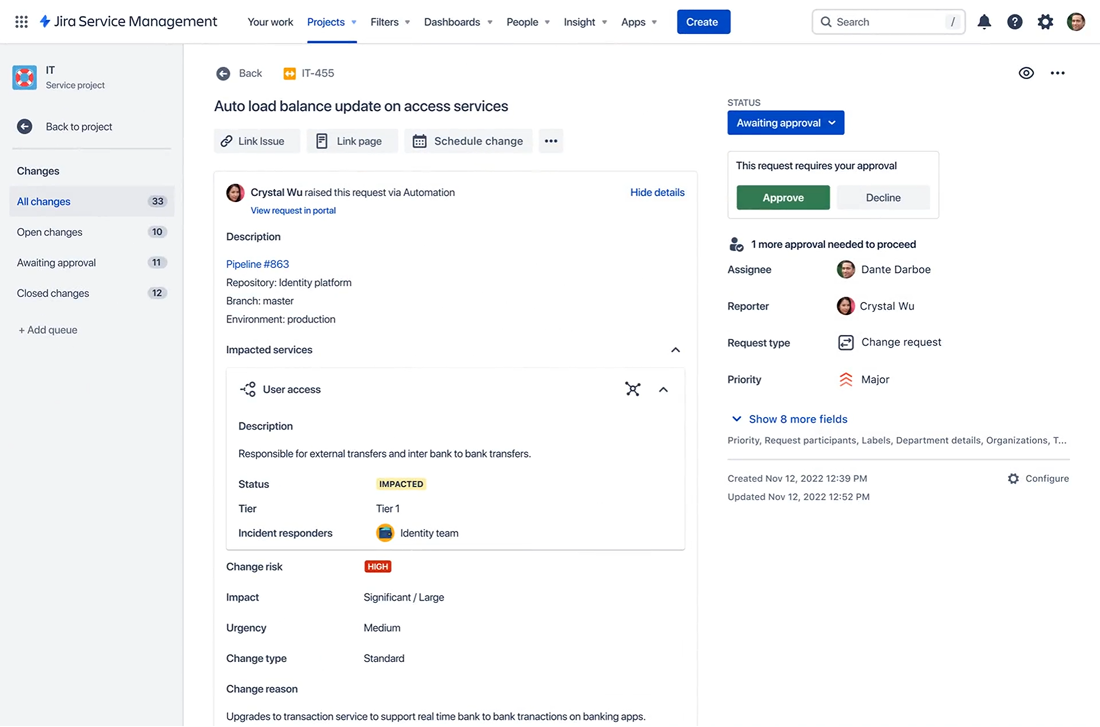
Assets is a Jira-native asset and configuration management tool that makes it easier for dev, IT, and business teams to plan and track assets collaboratively. Moving CMDB (configuration management database) into Jira Service Management means:
- Streamlining work with all ITSM (requests, incidents, changes, & problems) and CMDB information in one tool
- More context between assets & configuration items, incidents, and changes so Dev and Ops teams can get to the root of the issue faster and manage risks for more seamless deployments
Plus, automated updates for Jira Service Management Cloud mean low maintenance and intervention. By choosing JSM, companies put their Dev, ITOps, and other service teams on one platform, built from Jira. This removes siloes for better collaboration, easier communication, and faster processes.
Reason 2: An efficient, AI-powered approach at scale
As a niche player. HaloITSM lacks integrations with other developer platforms and workflows, partners, and community resources compared to Atlassian. This can limit extensibility and support for complex, multi-team environments, capping utility to smaller or static organizations.
With JSM, teams eliminate feature bloat. They harness proactive AI experiences that reduce repetitive work and drive action and resolution for IT services, employee support, HR service management, and more. Jira Service Management offers a future-proof platform with a proven track record in customers scaling from mid-market to enterprise. Using JSM, users get an open platform, robust AI, and automations that deliver more value as organizations mature. Customers unite DevOps, ITSM, customer support, and business teams on a scalable enterprise service management platform with end-to-end visibility, robust security, and collaboration.
Reason 3: User-friendly, speedy UI
While HaloITSM offers a simple interface and configuration, it lacks advanced ITSM features, like an operations assistant and AI support for change management.
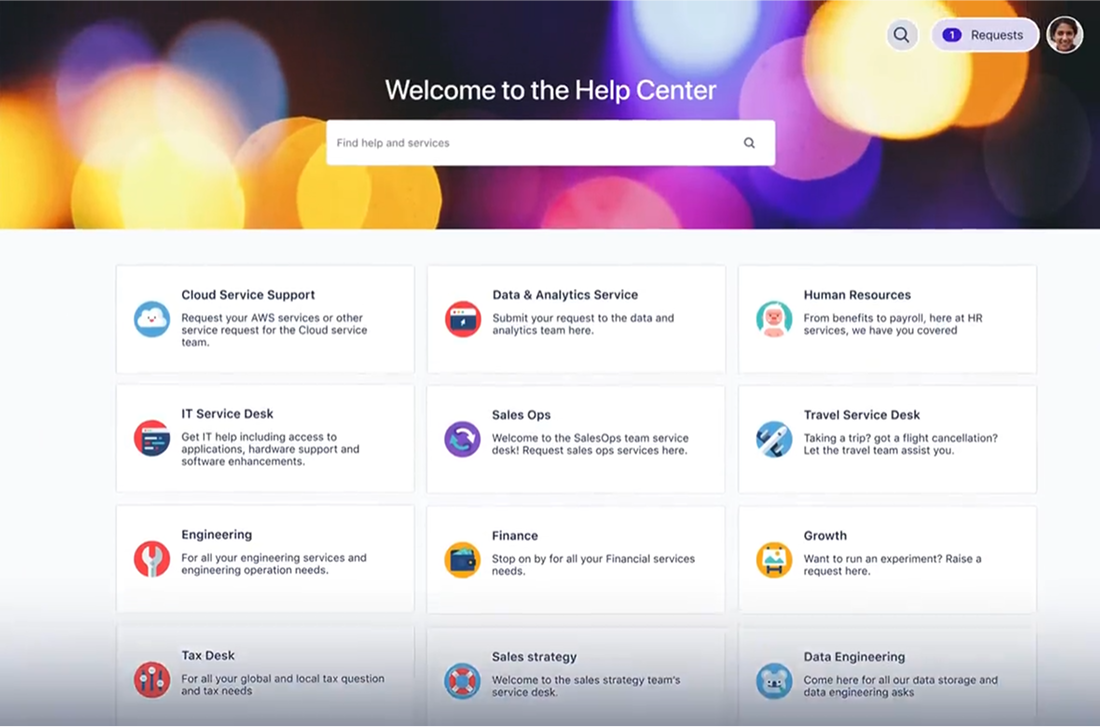
On the contrary, JSM’s easily customizable system makes getting up and running easy. Companies using JSM can manage their service desk with a very simple interface, but also an extremely flexible, low-code editor and drag and drop interface for Automations.

Reason 4: Intuitive implementation, faster ROI
Halo ITSM offers decent out-of-the-box capabilities such as basic asset and change management. It caters to low-demand, mid-maturity IT organizations.
On the other hand, Jira Service Management offers an all-inclusive platform enabling teams to spin up their own service desks at no additional cost. JSM offers a single product for ITSM, Assets, and automation, plus loads of templates and guides. This means faster deployment and time to value. See the ROI for JSM yourself here.
Reason 5: Rovo agents & AI superpowers
HaloITSM’s limited AI functionality ranked it among the lowest in the Niche Player quadrant of Gartner’s 2024 Magic Quadrant for AI in ITSM. Gartner observed that HaloITSM’s AI capabilities fall short compared to more established vendors and rely on pretrained LLMs rather than innovative R&D. The platform lacks advanced features like an operations assistant and AI support for change management. Additionally, it did not excel in any of the three primary use cases: end-user self-service, ITSM practitioners, and ITSM practice leads.
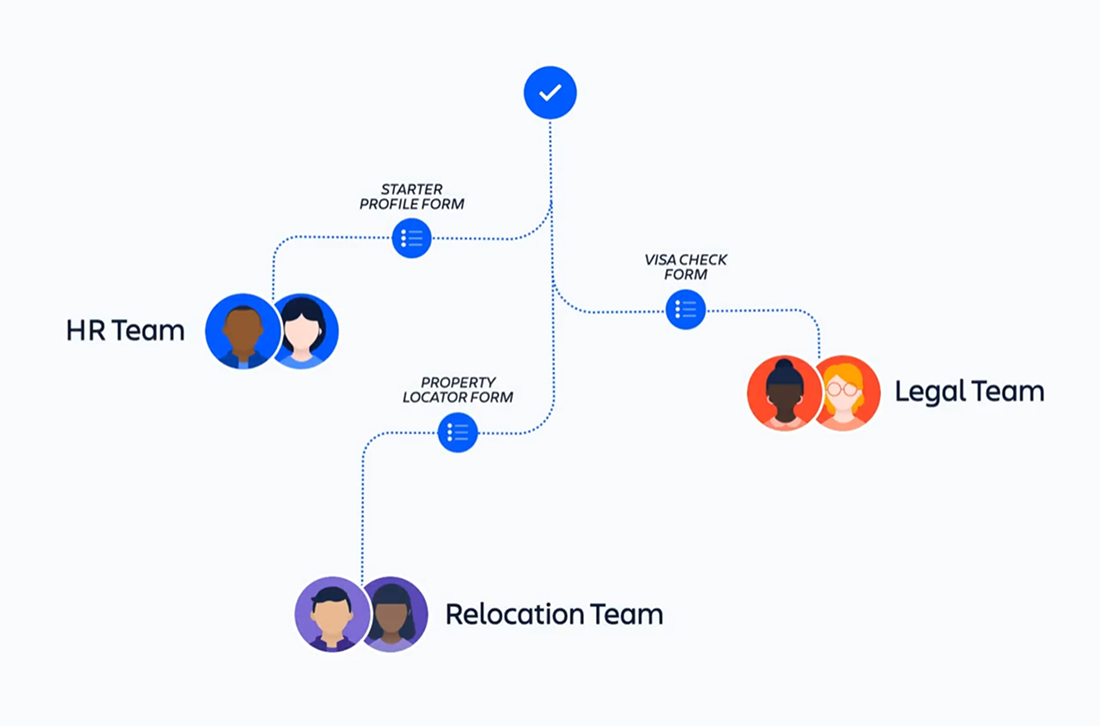
AI helps support and operations teams stay ahead by predicting issues, suggesting actions, and automating resolutions to turn insights into action. With a modern approach to ITIL and a powerful suite of AI capabilities, Jira Service Management empowers teams to work at high velocity. It uses only the features you need to accelerate incident resolution, streamline DevOps workflows, and get teams across the organization running their own service desks, without unnecessary feature bloat.
Atlassian’s virtual service agents, named Rovo, are your AI-powered teammates designed to enhance productivity by handling tasks like automated ticket responses, incident briefings, and post-incident review generation.
“With Atlassian, it’s easy to get started and spin up a solution. “
Reason 6: Unparalleled flexibility
HaloITSM does support customizable workflows. However, these workflows don’t always tie to the needed automation to provide the best governance or efficiency to reduce overhead.
JSM provides adaptable workflows that easily pivot as your team’s needs change, rather than forcing rigid, overly centralized processes or one-size-fits-all approaches.
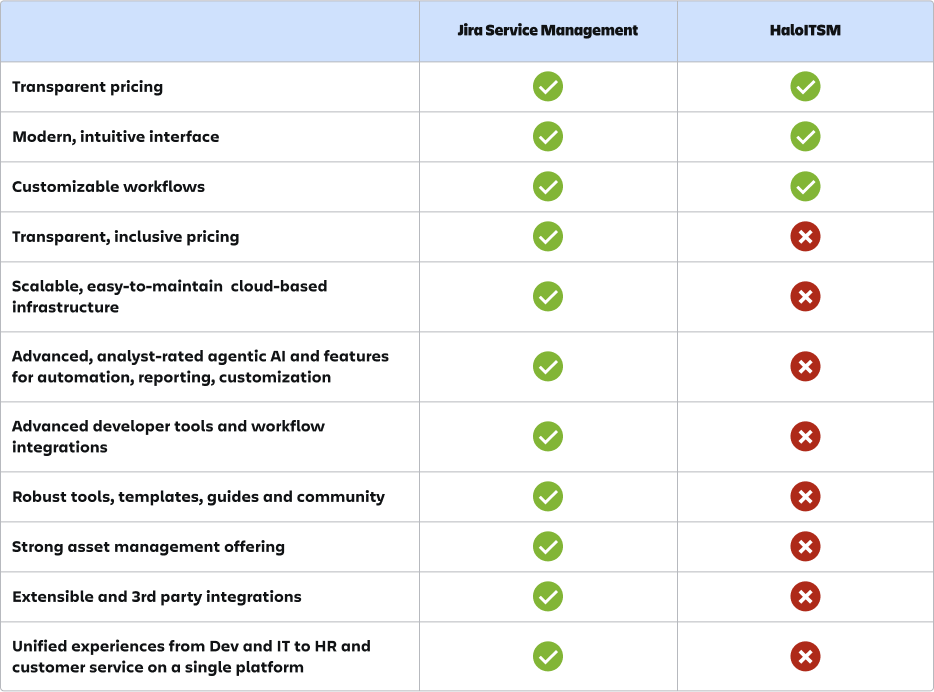
Capability Comparison: HaloITSM vs. Jira Service Management
Empower Your Service Teams with JSM
If you’ve outgrown HaloITSM’s limitations, there’s never been a better time to modernize with Jira Service Management. With Atlassian’s unified cloud platform, intuitive workflows, and AI-powered automation, your IT, DevOps, and business teams can collaborate seamlessly and deliver high-velocity service experiences across the enterprise. Whether you’re seeking faster ROI, better integrations, or the scalability to support future growth, Jira Service Management provides the flexibility and innovation to move your organization forward.
Contact SPK and Associates today to discuss how our expert team can help you migrate from HaloITSM or implement Jira Service Management so your organization can transform service delivery, eliminate silos, and accelerate performance with confidence.