

Introduction
Michael Roberts:
Hello, and welcome to another SPK and Associates vlog.
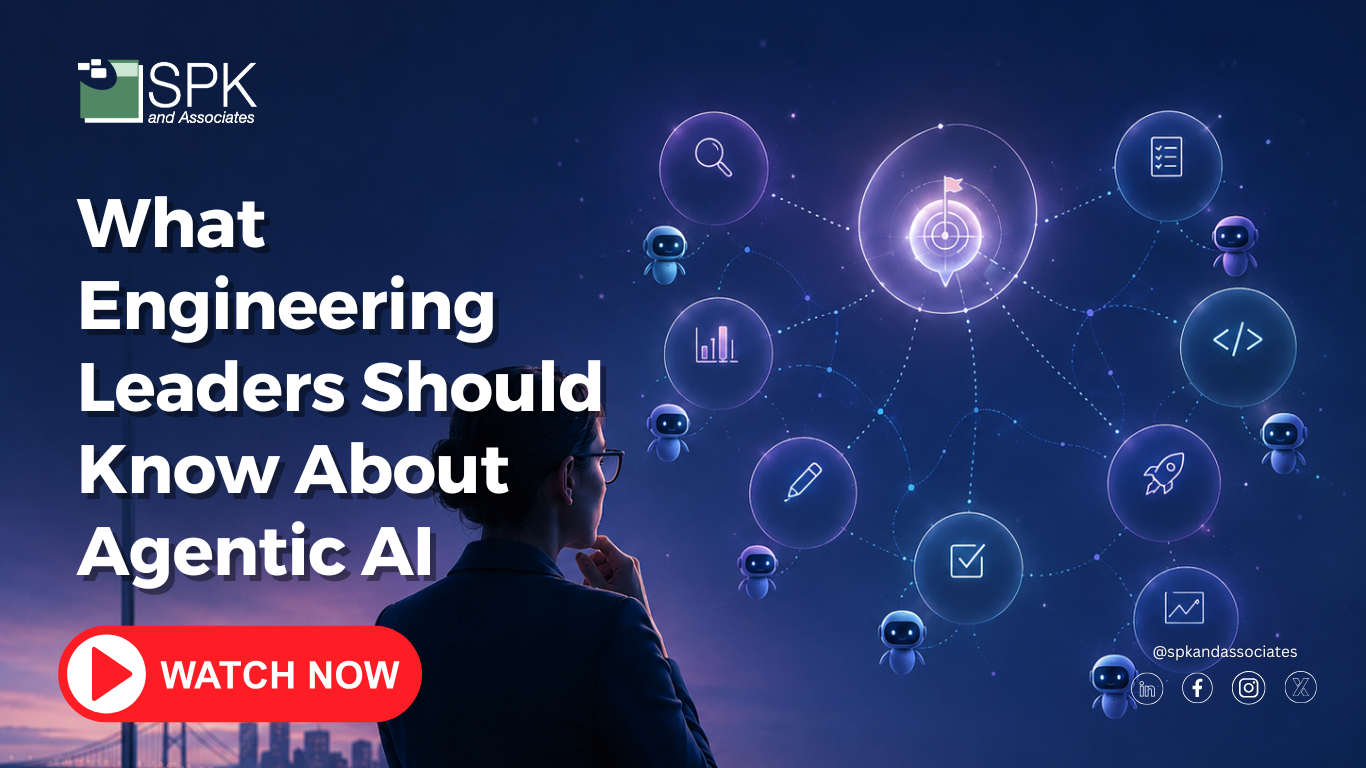
As we probably are already well aware, if you’re watching this video, artificial intelligence is evolving at a remarkable pace, and the conversations around AI are quickly shifting from AI assistants and copilots to something even more transformative: Agentic AI.
Unlike traditional AI tools that simply provide recommendations or answer questions, Agentic AI has the ability to take action, interact with systems, execute complex workflows autonomously, and a lot of other things.
For engineering leaders, this isn’t just another typical technology trend. It’s a really fundamental shift in how products are designed, software is developed, and how engineers are working inside their organizations.
So, in today’s video, we’re calling it “What Engineering Leaders Should Know About Agentic AI.”
I’m joined by SPK’s Head of Cloud and Infrastructure, Mike Solinap, so we can discuss Agentic AI, what it really means, what it means in practical terms, how it could reshape engineering productivity and operational efficiency, and what leadership teams should be doing and be aware of so they can prepare for this new era.
Mike, welcome. Please introduce yourself.
Mike Solinap:
Thanks. Thanks for the introduction.
As Michael mentioned, I lead up our Cloud Infrastructure practice here at SPK. I’ve been doing a lot with AI solutions and integrating a lot of applications, engineering applications in particular, and I’m happy to talk about it today.
What Is Agentic AI?
Michael Roberts:
Awesome.
So, Mike, we’re going to start off with the definition of Agentic AI, right? Everybody’s talking about it. They’re building some agentic solution into their tools, but many engineering leaders are still trying to understand what the term actually means.
So, how would you explain Agentic AI in practical terms, and why is it becoming such an important shift for engineering organizations?
Defining Agentic AI
Mike Solinap:
Yeah, I would say that it has become kind of a big buzzword in the industry now, and it’s not really clear to a lot of people what that means or what that consists of in technical terms.
So, at a high level, the way that I would describe it is Agentic AI is kind of like your next level of automation.
It refers basically to systems that have very specific tasks.
So historically, if you think about typical areas of opportunity in terms of being able to automate things, you might have, for example, maybe two disparate systems and you’re transposing data from one system to another.
Another good example, a very common task, is that you do periodic reviews of maybe some internal processes that you have. Or it could even be something very simple, like you want an alert or a notification based on some criteria, so you build an automation for that.
So, in order for you to perform these tasks, sometimes you need access to some tools as well, right?
So, Agentic AI leverages tools and integrations to be able to perform tasks on behalf of a user.
I would say it’s a bit of a game changer because of its ability to very rapidly develop something with more capability than a traditional automation or integration.
It’s got more smarts, and what I mean by that is now AI has context—context about your company, context about your documents, and the systems that you’re working on.
I think that can lead to much higher quality and much higher accuracy for those results that come out.
Moving Beyond Copilots
Michael Roberts:
Yeah.
I’m thinking about several tools here that have agentic capabilities, and you’re right, it’s a game changer for the things that it has access to and the ultimate things that it can do.
So we’re seeing this shift beyond copilots and chat interfaces into something that can actually take action.
I think of some of the Rovo Agents that Atlassian released, GitLab Duo, for example, and some of these other tools that have these types of agentic interfaces that can go and do these things.
They’re interacting with tools. They’re taking actions. They’re automating workflows.
So, what business impacts do you think Agentic AI will have on engineering productivity, operational efficiency, and decision-making over the next few years?
The Business Impact of Agentic AI
Mike Solinap:
Yeah. So, as I mentioned, these things can be developed pretty rapidly.
What we’ve been seeing so far with our customer base and in the industry is that engineering teams have become much more productive right off the bat.
To add to that, there are a lot of low-code or no-code solutions that make things really easy to implement. Then, iterating on those solutions is a lot quicker as well compared to your very traditional, old-school application integrations, which can also be really costly.
A lot of those integrations are very expensive, especially given the limited functionality that they have.
So, switching to an Agentic AI approach, you get a lot more value and a lot more capability there.
Michael Roberts:
Big, big time.
Preparing for Agentic AI
Michael Roberts:
Last question here, Mike.
As organizations start experimenting with these AI agents across software development, IT, and other engineering operations groups, what should leadership teams be doing to prepare?
What are all the things that should concern them and keep them up at night? Governance, security, organizational readiness—what should they do in those areas?
Governance and Security
Mike Solinap:
Yeah. So, what we’ve been communicating to our customers is that, as you design these systems and integrations, organizations have to ensure that the systems carry out actions the same way and with the same identity as the user requesting them.
So, what that means is that today you’ve got to ensure that your governance is strong. Even before AI, you’ve got to make sure your governance is strong.
Permissions and least privilege are all best practices that you need to implement before AI.
Then, once we integrate Agentic AI, ensuring that all of those permissions stay intact and that the autonomous system doesn’t risk having any more permissions than it normally would is what we design into our solutions.
If those identities and permissions stay intact, then that helps from the perspective of governance and security since we’re not really doing anything different.
You’ve got those solid foundations in place. You layer Agentic AI on top of it, and you’ll be set up for the future.
If you don’t, then people have access to a bunch of things they shouldn’t.
Michael Roberts:
That’s right. That’s the problem.
So, starting with that identity and security stuff first.
Mike Solinap:
Yeah.
Closing Thoughts
Michael Roberts:
Mike, thanks for sharing. Appreciate your insight here.
Mike Solinap:
No problem.
Michael Roberts:
So, as you can see, Agentic AI represents far more than just the next generation of chatbots and copilots.
It’s actually the beginning of intelligent systems that can reason, act, and collaborate alongside engineering teams just like teammates.
Organizations that start building the right governance, security frameworks, and adoption strategies today will be in the best position to unlock all those valuable benefits tomorrow.
So, thanks for joining us, and thanks again to Mike Solinap for the conversation.
Stay tuned for more insights from SPK as we continue to explore all these different challenges around engineering, the future of AI, and everything in between.
If you really liked this video, please be sure to subscribe to the SPK and Associates YouTube channel for more content on AI, engineering, and getting your products to market more quickly.
Until next time, thank you.
My name is Michael Roberts. Appreciate your time.