



As AI rapidly changes software development, many organizations are asking the same question:
How do we invest in GitLab Duo, AI agents, and new DevSecOps capabilities without constantly going back through procurement?
For years, GitLab licensing has largely been centered around seats. That model worked well when software development teams were primarily made up of developers using a fixed set of capabilities. Today’s software delivery platforms look very different. AI consumption is growing independently of headcount, more business users are participating in the development lifecycle, and organizations want the flexibility to adopt new GitLab capabilities without renegotiating contracts every few months. GitLab Flex was designed specifically for this new reality. Rather than purchasing individual products or AI capabilities separately, organizations make a single annual commitment that can be allocated across seats and usage-based services as business priorities evolve.
Why Traditional Software Licensing No Longer Fits AI
Most enterprise software contracts were designed around one assumption:
One employee = One license = One unit of value.
That assumption begins to break down when AI enters the picture. Today, organizations are seeing:
- AI usage growing much faster than employee growth
- Platform teams expanding GitLab usage beyond developers
- Security, operations, and product teams using GitLab capabilities
- New GitLab services, such as AI, hosted runners, artifact registries, and secrets management becoming part of the platform
Value is no longer tied solely to the number of developers you employ. It’s tied to the capabilities your teams consume and the outcomes they achieve. GitLab Flex recognizes this shift by allowing organizations to commit to an annual investment rather than locking themselves into a fixed seat-based purchasing model.
What is GitLab Flex?
GitLab Flex is a new purchasing model available for GitLab.com (SaaS), Self-Managed, and GitLab Dedicated customers.
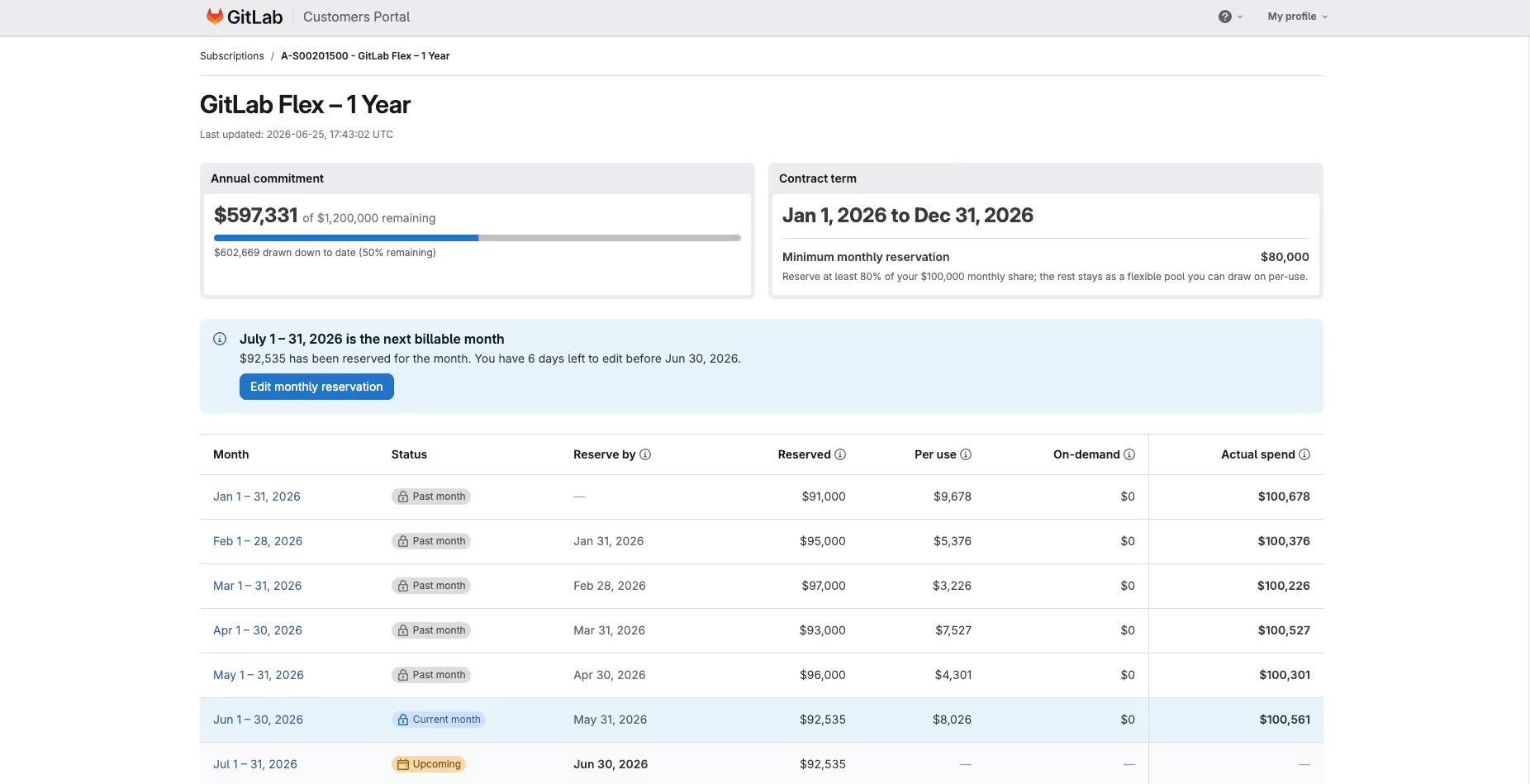
Instead of purchasing licenses individually, organizations commit to an annual dollar amount. That investment can then be allocated across:
- GitLab Premium or Ultimate seats
- GitLab Duo Agent Platform
- Hosted Runners
- Artifact Registry
- Secrets Management
- Continuous Deployment capabilities
- Future GitLab capabilities introduced during the contract term
This means organizations purchase one commitment instead of multiple disconnected products. As priorities shift throughout the year, spending can shift with them.
Why Mid-Market and Enterprise Organizations Should Care
For larger organizations, the biggest challenge often isn’t technology. It’s procurement. Adding a new GitLab Flex capability may require:
- Budget approval
- A new purchase order
- Legal review
- Vendor amendment
- Updated forecasting
Those processes can delay innovation by weeks or months. GitLab Flex removes much of that friction by allowing organizations to consume new capabilities from their existing annual commitment rather than requiring a new contract every time a feature is added. Customers can reserve monthly allocations, adjust spending between seats and usage-based capabilities as their priorities change, and maintain budget visibility with spend controls and alerts.

Why GitLab Flex Makes Sense for AI
Perhaps the biggest advantage of GitLab Flex is how well it aligns with AI adoption. Most organizations still don’t know exactly how much AI they’ll consume over the next year. Some development teams may rapidly adopt AI-assisted development. Others may take a slower approach.
Rather than overbuying licenses, or delaying adoption until the next budget cycle, GitLab Flex lets organizations shift investment toward AI as demand grows.
Instead of asking:
“How many GitLab Duo licenses should we purchase?”
Organizations can ask:
“How much value do we want AI to deliver this year?”
That is a fundamentally different conversation; one our team at SPK is helping clients work through using our AI Launchpad services.
Ideal Use Cases for GitLab Flex
GitLab Flex is particularly well-suited for organizations that:
- Have a flat or slowly growing developer headcount
- Expect AI usage to increase significantly
- Use GitLab Ultimate or Premium
- Want to adopt GitLab Duo Agent Platform
- Frequently add new GitLab capabilities
- Need predictable budgeting with procurement flexibility
- Want one GitLab investment instead of multiple contracts
GitLab identifies these as common customer signals for Flex, including organizations with growing AI investment, frustration over repeated purchase orders for new capabilities, and a desire to consolidate GitLab spending into a single annual budget.
GitLab Flex vs. Traditional Licensing
Why Work with an Experienced GitLab Partner?
Choosing GitLab Flex is only one part of the equation. The bigger question is:
How do you maximize the value of your GitLab investment?
That’s where an experienced GitLab Professional Services Partner like SPK can help. Our team can assist with:
- Evaluating whether GitLab Flex is the right purchasing model
- Forecasting AI adoption via our AI Launchpad service
- Planning GitLab Duo Agent Platform rollout
- Optimizing Ultimate licensing
- Modernizing CI/CD
- DevSecOps modernization and transformation
- Platform engineering strategy
- Developer enablement and ongoing GitLab infrastructure managed services
Rather than simply purchasing GitLab, organizations gain a roadmap for maximizing business outcomes.

GitLab Flex Frequently Asked Questions
Is GitLab Flex replacing traditional GitLab licensing?
No. GitLab Flex is an additional purchasing option. Organizations can continue purchasing GitLab using the traditional licensing model if that better fits their needs.
Can we start small with GitLab Duo and expand later?
Yes. GitLab Flex was designed to allow organizations to reserve monthly allocations and adjust those allocations as usage changes throughout the year, making it easier to expand successful AI initiatives without renegotiating contracts.
Does GitLab Flex require us to purchase GitLab Duo for every developer?
No. One of GitLab Flex’s biggest advantages is that your investment can shift between seats and usage-based capabilities over time. Instead of licensing AI for every user on day one, organizations can align AI investment with adoption and desired business outcomes.
Is GitLab Flex only for GitLab.com?
No. GitLab Flex supports:
- GitLab.com
- Self-Managed
- GitLab Dedicated
Air-gapped deployments are also supported with additional operational considerations and manual reconciliation.
Can GitLab Flex help us control AI spending?
Yes. GitLab Flex includes spend visibility, alerts, reservation management, and budget controls so organizations can scale AI adoption while maintaining financial governance.
Is GitLab Flex a good fit if our developer headcount is stable?
Absolutely. In fact, this is one of the strongest use cases. Many organizations expect AI usage to increase while developer headcount remains flat. GitLab Flex allows investment to shift toward AI capabilities instead of requiring additional seat purchases.
How can we evaluate GitLab Duo based on outcomes instead of licenses?
This is where GitLab Flex changes the conversation. Rather than asking:
“How many AI seats should we buy?”
Organizations can define measurable outcomes such as:
- Reduce pull request review time by 40%
- Increase developer productivity
- Accelerate software delivery
- Improve security remediation
- Reduce manual CI/CD work
- Increase deployment frequency
- Improve code quality
GitLab Flex provides the purchasing flexibility to experiment, measure results, and scale successful AI initiatives without repeatedly returning to procurement. That allows technology leaders to focus on business value instead of license administration.
Final Thoughts on GitLab Flex
AI is changing software development faster than traditional licensing models can keep up. Organizations no longer want to predict exactly how many seats they’ll need or negotiate a new contract every time they want to explore a new capability. GitLab Flex addresses this shift with a flexible, outcome-oriented purchasing model that lets you commit once, adapt over time, and align your investment with changing business priorities. For mid-market and enterprise organizations evaluating GitLab, GitLab Duo, or the broader GitLab platform, Flex offers a practical way to balance innovation, governance, and budget predictability while preparing for whatever comes next in AI-powered software delivery. Contact our team to learn more about Flex and how we can help implement GitLab to get the most out of your investment.