
Key Takeaways
- AI agents need lifecycle context, not just code access: Without visibility into dependencies, pipelines, security scans, and production signals, agents are more likely to generate incorrect or incomplete changes.
- GitLab Orbit creates a live context graph for software development: Orbit connects code, work items, pipelines, deployments, and production data into one queryable source of truth for AI agents.
- Orbit supports practical DevOps use cases: Teams can use it for change impact analysis, vulnerability tracing, pipeline governance, and faster developer onboarding.
- Orbit works with both GitLab and external AI agents: Integration with GitLab Duo and MCP-compatible tools like Claude Code and Codex helps teams apply shared engineering context across their AI workflows.
The goal of implementing AI into software development has always been speed and efficiency. However, many DevOps teams are finding that while AI agents are great at writing isolated snippets of code, they struggle with the system around that code. These agents can see the file they are touching, but lack the full lifecycle context. This gap leads to hallucinations, where an agent produces code that looks correct but breaks a dependency in another repository or fails a security scan it didn’t know existed. The result causes developers to spend more time fixing agent output than the agent saved in the first place. GitLab has introduced a new nervous system for the software lifecycle to resolve this: GitLab Orbit.
What is GitLab Orbit?
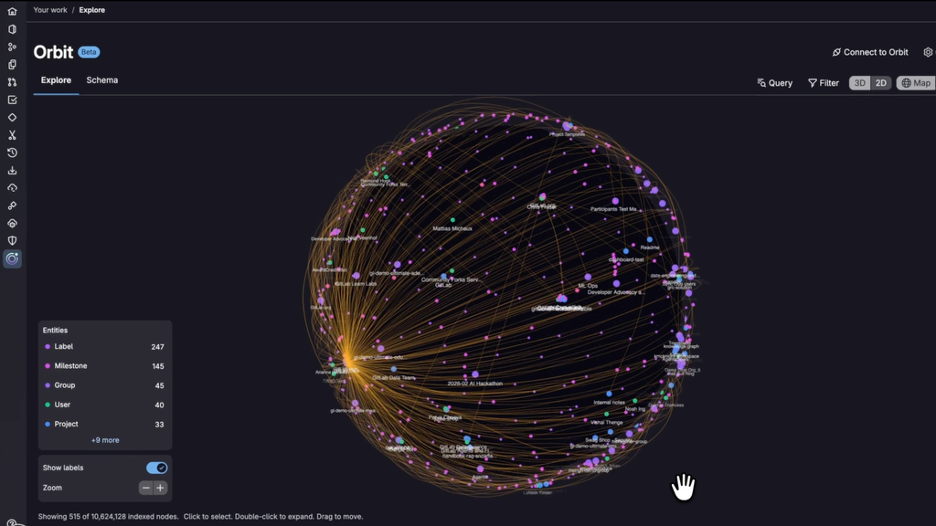
Currently in public beta, GitLab Orbit is a live context graph for the entire software lifecycle. Rather than forcing an AI agent to make dozens of fragmented API calls to different services, Orbit continuously maps code, work items, pipelines, deployments, and production signals into a single, queryable source of truth. Think of it as a map of your entire engineering organization. It doesn’t just store data; it understands the relationships between that data. Whether you are using GitLab Duo or external agents like Claude Code via the Model Context Protocol (MCP), Orbit provides the indexed facts needed to reason across the full blast radius of a change.
How Orbit Changes the Game for Software Developers
For DevOps engineers and developers, the shift from “fragmented signals” to “graph-grounded context” is transformative. Orbit addresses the primary bottlenecks of AI-assisted development: latency, cost, and accuracy.
1. Smarter Agents with Deep Context
In early internal tests, agents grounded with Orbit were up to 45 times less likely to hallucinate. The answers are reliable because the agent queries a graph of real, pre-indexed edges rather than guessing missing relationships. A test by Compare the Market found that graph-grounded agents placed inline review comments in the correct location 70% of the time, significantly outperforming traditional RAG (Retrieval-Augmented Generation) approaches.
2. Faster Resolution and Reduced Overhead
Without Orbit, an AI query often requires “N” API calls, one for each repo, service, or file type, each adding latency and authentication overhead. Orbit replaces this with a single query_graph call. This resulted in response times up to 11 times faster in internal testing. Developers no longer have to wait for an agent to “crawl” through a monorepo; the answer is delivered in seconds.
3. Practical Use Cases for DevOps Teams
- Change Impact Analysis: Ask “What breaks if I change this service?” and get a full list of every direct caller, downstream dependency, and owner across every repo in your organization.
- Vulnerability Tracing: Trace a CVE or a vulnerable library across every namespace and get a prioritized impact list with owners in seconds.
- Pipeline Hygiene: Instantly identify which teams have drifted from security pipeline standards or are using deprecated templates across thousands of projects.
- Onboarding: New engineers can use the Data Explorer to query the map of the organization, understanding who owns what and how services connect in days rather than weeks.
4. Cost Efficiency
By returning only the exact nodes and edges requested, Orbit prevents “context window bloat.” You aren’t paying for thousands of irrelevant lines of code to be loaded into an LLM just to find one relationship. This makes agents up to 4.5 times more cost-effective.
5. Integrates Seamlessly with Tools You Love
Orbit natively supports GitLab Duo Agent Platform and external agents like Claude Code and Codex via open Model Context Protocol (MCP).
SPK & GitLab: Modernizing Your Software Delivery
Our experts at SPK and Associates help engineering organizations modernize their software delivery processes and cloud environments. As a GitLab certified professional services partner, we understand that tools like Orbit are only as effective as the strategy behind them. We can help your team integrate GitLab Orbit into your existing DevSecOps workflows to ensure AI adoption delivers real business results. Whether you are migrating to GitLab or looking to optimize your current instance with AI, SPK acts as an extension of your team to ensure your digital thread remains unbroken.
Smarter Agents with GitLab Orbit
One of the largest challenges of modern software engineering is managing the immense complexity of how code interacts across a global ecosystem. GitLab Orbit provides the visibility needed to make AI agents truly useful members of the development team. By grounding agents in the reality of the full software lifecycle, Orbit eliminates the guesswork that leads to rework and risk. As this technology moves through public beta, it represents a significant step toward the future of engineering. A future where teams can move faster with greater operational confidence. If you are ready to see how GitLab Orbit can transform your DevOps workflow, contact SPK and Associates today to start building a smarter, more connected software lifecycle.