

Key Takeaways
- AI pilots often struggle in production because real enterprise environments are complex. Legacy systems, fragmented data, security requirements, and compliance constraints can quickly expose the limits of a successful demo.
- Forward Deployed Engineers bridge the gap between AI strategy and working solutions. They operate inside customer environments, connect systems, write production code, and adapt AI to real workflows.
- FDEs help make enterprise AI safer and more reliable. They build evaluation frameworks, guardrails, data pipelines, and RAG architectures that improve accuracy while protecting sensitive information.
- Successful AI adoption depends on workflow integration, not just access to models. FDEs embed agents and automation into existing processes such as ticket triage, engineering validation, and code review.
- SPK applies the FDE model through its AI Launchpad and Managed Services. This approach helps organizations identify valuable use cases, move them into production, and continuously manage the infrastructure and integrations behind them.
Organizations across industries seem more eager than ever to harness generative models, agentic workflows, and predictive analytics to gain a competitive edge. Yet, as leadership teams greenlight AI initiatives, an uncomfortable reality quickly emerges: AI is remarkably easy to demo, but notoriously difficult to deploy in production. Prototypes that dazzle in sanitized sandbox environments often stumble when introduced to messy enterprise tech stacks, siloed legacy databases, strict compliance mandates, and complex real-world workflows. To bridge the chasm between experimental AI and tangible business outcomes, leading technology organizations are turning to a specialized hybrid role: the Forward Deployed Engineer (FDE).
Here is what you need to know about the rise of FDEs and why they are essential to AI adoption.

What Is a Forward Deployed Engineer?
The concept of the Forward Deployed Engineer borrows its name from military doctrine, where personnel are stationed directly in the field, close to the front lines where operational decisions happen in real time. In the tech industry, the term was pioneered and popularized by Palantir Technologies (where early practitioners were known as “Deltas”). Palantir realized early on that deploying complex data analytics software into government agencies and global enterprises could not be accomplished with standard off-the-shelf software packages or advisory consultants. They needed hands-on engineers embedded directly within customer environments.
Today, tech leaders like OpenAI, Anthropic, and AWS rely heavily on FDEs to drive customer success. Unlike traditional solutions architects who focus on high-level strategy and proof-of-concept slides, an FDE operates like an embedded “field CTO.” They work inside the customer’s actual infrastructure, writing production-grade code, untangling disparate APIs, and building the custom pipelines that make software delivery valuable.
Why Companies Implementing AI Need FDEs
Enterprise AI initiatives frequently stall. Industry studies indicate that the vast majority of enterprise AI pilots fail to reach full production, largely due to data fragmentation, security concerns, and integration hurdles.
Here is why forward-deployed expertise has become essential to successful AI deployment:
Navigating Legacy Systems and Data Silos
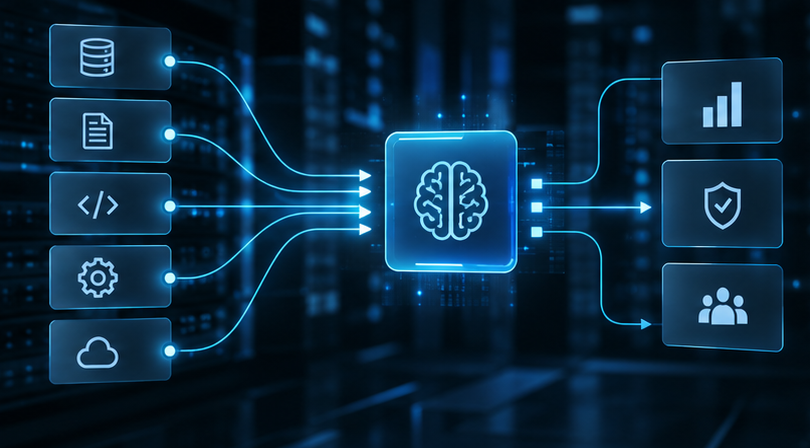
Enterprise data rarely lives in clean, unified repositories. It is scattered across product lifecycle management (PLM) systems, ALM platforms, Jira tickets, cloud databases, and on-premises file stores. FDEs have the full-stack engineering chops to build robust ingestion pipelines and Retrieval-Augmented Generation (RAG) architectures that securely connect AI models to actual source-of-truth data.
Building Realistic “Evals” and Guardrails
A customer-facing or engineering AI system cannot rely on guesswork. FDEs design domain-specific evaluation frameworks (“evals”) to measure model accuracy, minimize hallucinations, and enforce strict security, compliance, and privacy controls before systems go live.
Turning “Digital Labor” into Daily Workflows
Adopting AI is not just about giving employees another chat window, but instead, orchestrating autonomous digital labor. FDEs embed AI agents directly into everyday workflows (such as automated ticket triage, CAD model validation, or code reviews), ensuring that tools fit natural user behavior rather than disrupting it.
Accelerating Time-to-Value
Hiring and training a permanent, specialized in-house AI engineering team takes months. Embedded FDEs hit the ground running, cutting through trial-and-error to deliver working, production-ready solutions on accelerated timelines.
How SPK Applies the FDE Model to Enterprise Engineering
At SPK and Associates, we believe enterprise product development teams should not have to navigate the complexities of AI transformation alone. We take the proven forward-deployed engineering philosophy and tailor it specifically for engineering, IT, and product development environments.
We bring this model to life through two core pillars:
1. The SPK AI Launchpad: From Experimentation to Scalable Execution
Moving past scattered AI experiments requires a structured, actionable roadmap. Our AI Launchpad pairs your team with experienced engineering specialists who assess your infrastructure, identify high-impact use cases, and build production-ready AI solutions. Whether that means deploying Atlassian Rovo agents, automating code workflows, or streamlining engineering simulation pipelines, our team has you covered.

2. The Managed Services Approach: End-to-End Operational Ownership
AI is not a “one-and-done” deployment. Models require continuous monitoring, prompt tuning, API maintenance, and compliance oversight. Through SPK’s Managed Services, our team integrates seamlessly with your IT and engineering departments. We manage the underlying infrastructure, maintain tool integrations, and ensure your AI systems evolve alongside your business.
The Bridge to Practical Enterprise AI
The era of passive software implementation is over. As AI systems become more integral to core operations, enterprises need dedicated, hands-on engineering talent to make that software work within their unique operational realities. Forward Deployed Engineers provide the technical muscle, agility, and domain insight required to transform ambitious AI roadmaps into reliable business reality. If your team is ready to unlock practical, secure AI across your engineering toolchain, partner with SPK to accelerate your journey.