
Key Takeaways
- Waiting on AI is not a neutral, zero-cost decision. It adds up as slower cycle times, compounding rework, and lost competitive ground.
- Unstructured AI adoption is another form of doing nothing. Tools get bought, and tokens get burned, but no one can prove any value.
- The cost of inaction hides in the gaps between PLM, ALM, cloud, and data systems, so single-tool assessments miss most of it.
- SPK’s AI Launchpad measures those costs across the whole product lifecycle and turns them into a prioritized, governed roadmap.
While some engineering teams may slow AI adoption due to tooling costs, in the long run it doesn’t actually save them any money. Slower releases, rework, and innovative competition often cost more than implementing the tools themselves. Measuring the cost of inaction across your PLM, ALM, cloud, and data systems can show you where to invest. Every quarter an engineering organization waits, it continues to pay for manual requirement reviews and late-stage defects that AI could help catch earlier. We often see this trend in our PLM and software delivery engagements at SPK and Associates. In this blog, we dissect where the cost of inaction really lies and what our clients are learning as they move from experimentation to measurable results.
The Real Costs of Inaction
The expense of doing nothing seldom appears as a line item. It builds up in cycle times, rework, and missed opportunities that no one budget owner is tracking.
Slower Cycle Times
Engineers still spend hours looking for information, reconciling records between systems, and manually reviewing documents. Requirements reviews, change impact analysis, and test traceability are all slow, manual, and repeated every release. The competitors that use AI for these tasks are faster, and the subsequent cycles are shortened.
Compounding Rework
The vague requirement you write today will become a design problem next month and a verification failure next quarter. The later a defect is found, the more expensive it is to fix, and in regulated industries it can also mean revalidation and audit exposure. AI-powered quality checks at the point of creation break that chain early. Without them, rework slowly and silently compounds.
Competitive Erosion
Time to market is a competitive weapon. Every release that ships later than it should gives a competitor the opportunity to get to customers first. It’s hard to see that gap in any one quarter, but it does grow over time.
Unmanaged Adoption Is Also Inaction
The other way to do nothing is to just give everybody AI tools and hope for the best. Teams experiment in isolation, token bills go up, and no one can tell what’s changed. As we talked about in AI Pilots Everywhere. Value Nowhere, scattered pilots with no strategy produce cost with no proof.
What Does Delaying AI Adoption Cost Engineering Teams?
SPK can easily help your team measure inaction because we cover the entire product lifecycle. We have four main practice areas: PLM, ALM/DevOps, Cloud for Engineering, and Data Engineering, which give us visibility into the handoffs where the cost of doing nothing accumulates the most. If a vendor is focused on one platform, they may be able to tell you how AI could speed up that platform. However, they won’t tell you how much a vague requirement in your ALM tool costs when it leads to a change order in PLM, a failed build in your pipeline, or a gap in your audit trail. Those are the costs that matter most, and they live between systems.
Data readiness should be given special attention. In our PLM migration efforts, the first thing we do is check data quality: duplicate records, poor relationships, missing mandatory fields, and inconsistent data. These same problems make AI unreliable. AI can only be as good as the data it sees and trusts.
How the AI Launchpad Turns This Into a Plan
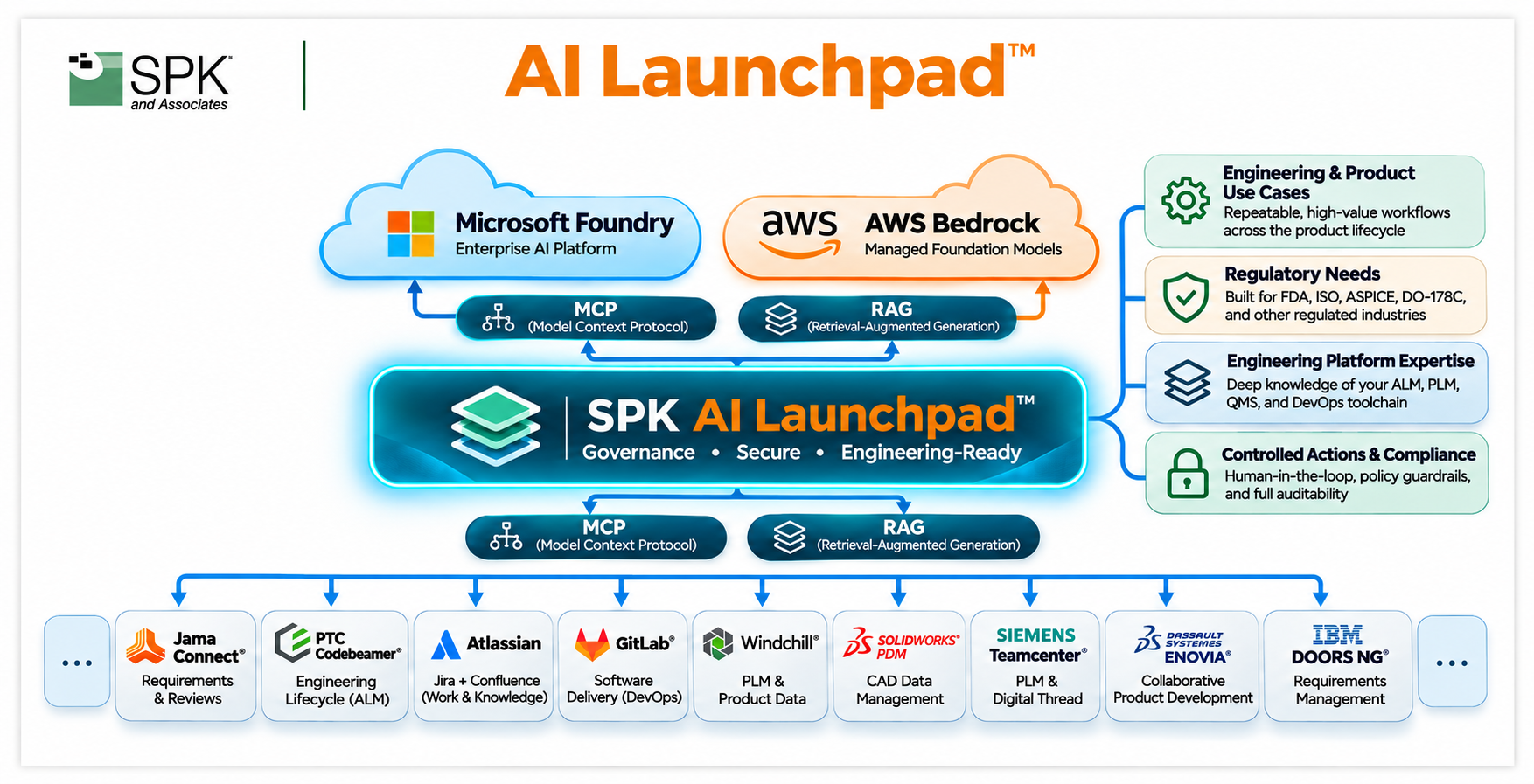
SPK’s AI Launchpad gives engineering leaders a structured approach so they don’t have to guess. We review the AI you already pay for, benchmark your current position against an AI maturity model, and find where AI agents can take friction out of real workflows. You walk away with a prioritized roadmap tied to measurable outcomes. Plus, governance is baked in from the beginning. For regulated teams, this means logged and traceable AI actions, least-privilege access, and human approval before anything touches a controlled record.
Real AI Engineering Use Cases
When discussing our PLM and software delivery engagements with clients, this is what we have seen. One company realized that requirement quality problems were being identified too late in the process, but didn’t want to wait for a full enterprise AI strategy. Instead, SPK is building an AI requirements analyzer for Codebeamer on the AI Launchpad foundation. It uses INCOSE-based checks to flag ambiguous, incomplete, and inconsistent requirements, with every AI action logged and every change requiring human approval.

Another software company spent tons of money on AI and still couldn’t answer the question its executives would eventually ask: what did we get for it? The problem is they had no KPIs, baselines, or token guardrails. We recommended starting with a few high-value scenarios, establishing baselines, and monitoring AI-generated work with human sign-off so its impact can be reported. These examples display two distinct examples of AI usage: one where it is planned and helps, and another where it is implemented with no issue, leading to little to no ROI.
Stop Letting The Cost of Doing Nothing Cost You
The most successful organizations may not be spending the most on AI, but they know what inaction costs them. They begin with focused, governed use cases and measure results across the whole lifecycle. That cross-functional view across PLM, ALM, cloud, and data is where SPK fits in. If you’d like to know more about what your engineering team is really missing out on by not doing anything, contact SPK to start building a roadmap with provable ROI.