


Modern HR teams are under growing pressure to deliver fast, consistent services across the entire employee lifecycle. From recruiting and onboarding to policy requests and offboarding, inefficient HR processes create delays that impact the broader organization. When HR relies on scattered emails, spreadsheets, and disconnected systems, employees experience slow response times, limited visibility, and inconsistent support. These operational bottlenecks can also create compliance and security risks, especially in highly regulated industries.
To solve these challenges, many organizations are embracing Enterprise Service Management (ESM). This is the concept that service management practices should extend beyond IT into departments like Human Resources. Jira Service Management has become a powerful platform for enabling this transformation. JSM helps HR teams streamline requests, improve transparency, and create a more scalable employee experience. Its automated workflows, self-service portals, approvals, knowledge management, and integrated reporting enable these results. Instead of operating through disconnected processes, HR can function as a modern service organization that delivers faster support and more consistent outcomes for employees across the business.

Reasons Why HR Teams are Adopting Jira Service Management
Here are 10 reasons why HR teams are increasingly adopting Jira Service Management to support their workforce.
1. Centralized HR Request Intake Across Channels
One of the primary challenges for HR is the “omnichannel” problem. Employees often reach out via email, Slack, Microsoft Teams, or by stopping someone in person. This leads to lost requests and a lack of accountability. Jira Service Management solves this by providing a centralized location for all HR needs. Whether an employee sends an email or uses a dedicated web portal, the request is automatically captured as a ticket in a central HR project.

This centralization ensures that no request falls through the cracks. Additionally, it allows HR agents to manage their work from a single queue rather than jumping between different communication apps. For the employee, the experience is seamless. They can interact with HR through the tools they already use every day, such as Slack or Teams, while the HR team maintains a structured record of the interaction.
2. Faster Onboarding and Offboarding Through Automation
Onboarding a new engineer in a regulated environment is a complex, multi-step process. It involves hardware procurement, software access, safety training, and compliance documentation. Manual onboarding is prone to errors, which can delay a new hire’s “time to productivity” by weeks. Jira Service Management allows HR teams to build repeatable, automated workflows for these critical transitions.
By using automation, HR can trigger a series of tasks across different departments the moment a new hire is confirmed. For example, a single “New Hire” request can automatically generate sub-tasks for IT to provision a laptop, for Facilities to assign a desk, and for Legal to send over NDAs. Automated cohort onboarding ensures that every new employee receives the same high-quality experience, regardless of how busy the HR team is at that moment.
3. Self-Service Knowledge Base That Deflects Common Questions
HR teams spend a significant portion of their day answering the same repetitive questions. These often include inquiries about holiday schedules, benefits enrollment, or expense policies. Jira Service Management integrates directly with Confluence to create a robust, self-service knowledge base. When an employee begins typing a request into the HR portal, the system uses machine learning to surface relevant articles that could answer their question immediately.

This “deflection” strategy empowers employees to find answers autonomously, reducing the volume of low-value tickets entering the HR queue. For a Director of Engineering, this means their team spends less time waiting for HR responses and more time focused on product development. A well-maintained knowledge base serves as a single source of truth. Furthermore, it ensures that policy information is consistent across the entire organization.
4. AI-Powered Virtual Agent for 24/7 Employee Support
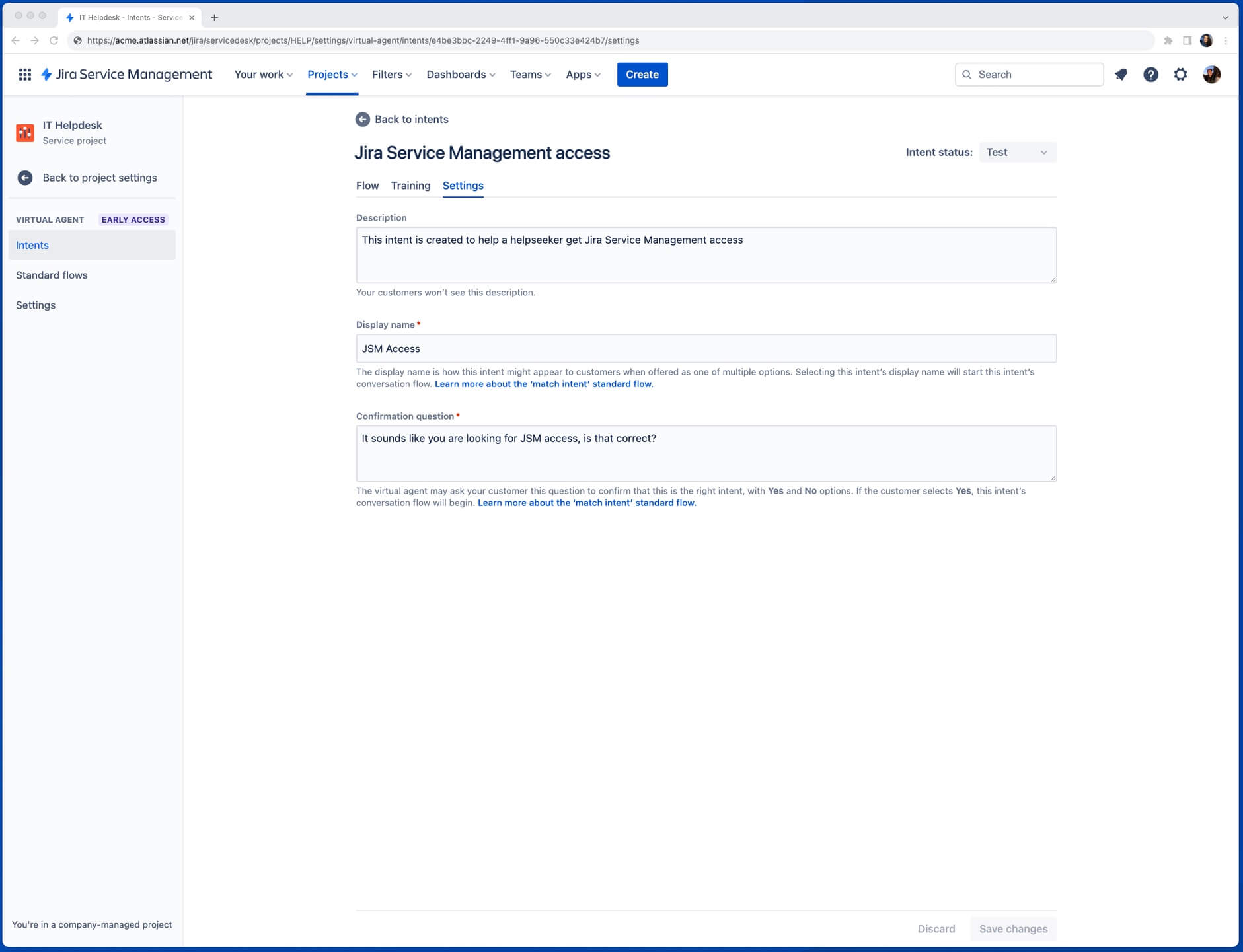
In a global engineering firm, employees may need HR support outside of standard business hours. Jira Service Management includes an AI-powered virtual agent that can provide 24/7 assistance. This virtual agent can be integrated directly into Slack or Microsoft Teams to provide instant answers to common questions.
The agent does more than just link to articles. It can perform basic triage and even execute simple tasks. If the AI cannot resolve the issue, it intelligently routes the conversation to a human HR agent with the full context of the interaction. This ensures that employees feel supported at all times, while HR agents are only brought in for complex cases that require human empathy and decision-making.
5. Flexible, Dynamic HR Intake Forms Without Code
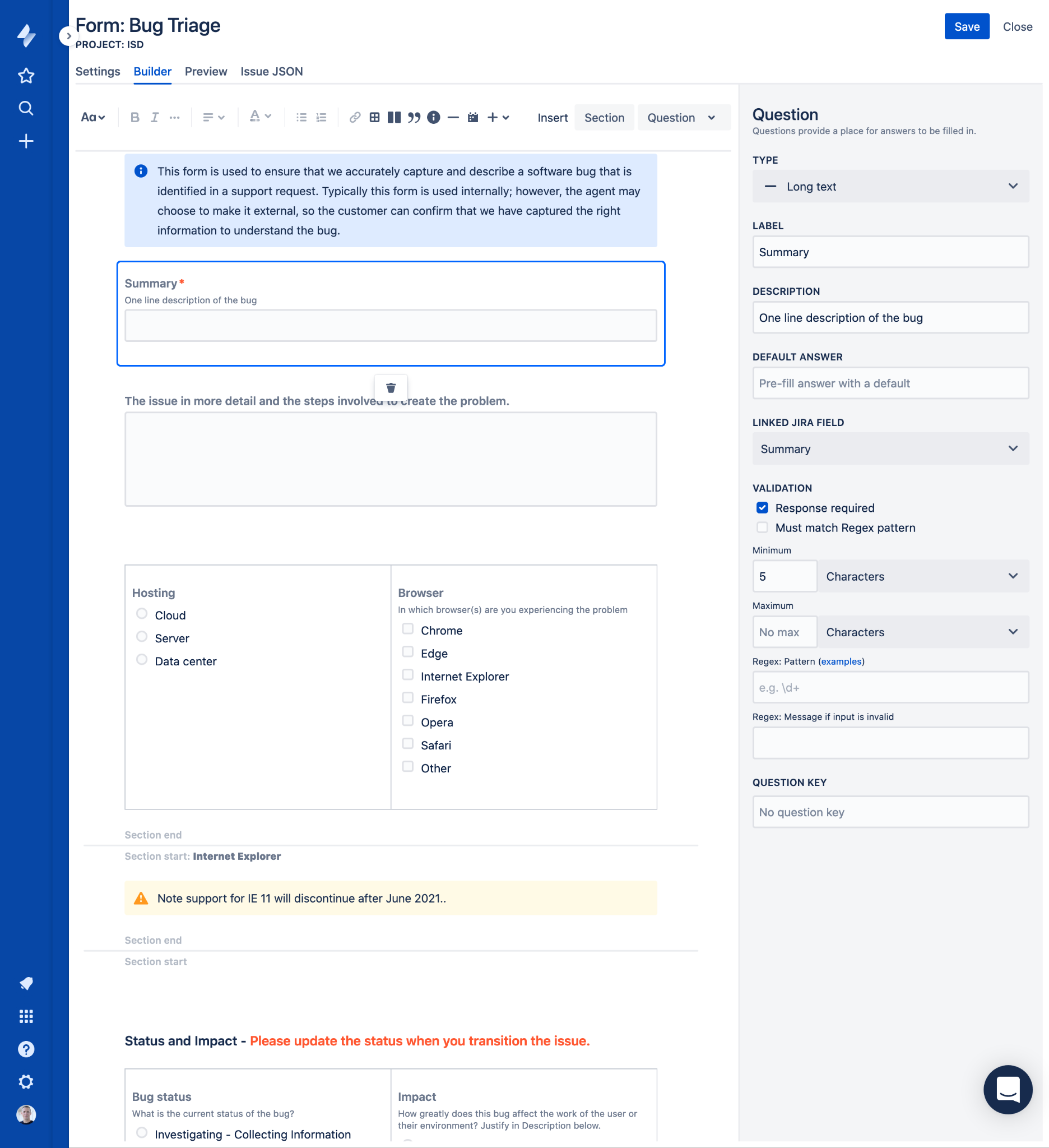
Standardized forms are essential for gathering the right information, but static forms are often frustrating for users. Jira Service Management offers a no-code, drag-and-drop form builder that supports conditional logic. This means the form can change dynamically based on the employee’s previous answers.
For example, if an employee selects “Leave of Absence,” the form can automatically display additional fields specific to the type of leave requested, such as medical or parental. This ensures that HR receives all the necessary data on the first attempt, eliminating the back-and-forth emails typically required to clarify a request. HR managers can also update these forms themselves without waiting for a Jira administrator or IT support, as they are no-code.
6. Secure Handling of Sensitive HR Cases
Security is a non-negotiable requirement for HR. Personnel files, salary discussions, and disciplinary actions involve highly sensitive data that must be protected. Jira Service Management provides granular security controls to ensure that only authorized individuals can view specific information.
Project-level permissions allow HR to keep their work entirely separate from IT or Engineering projects. Furthermore, issue-level security can be applied to individual tickets. This means that even within the HR team, access to a sensitive case can be restricted to a specific manager or legal counsel. This level of control is essential for maintaining compliance with privacy regulations and building trust with the workforce.
7. Improved Cross-Functional Workflows with IT, Legal, and Finance
HR does not operate in a vacuum. Most HR processes, such as payroll adjustments or equipment returns, require coordination with Finance, Legal, or IT. Jira Service Management excels at connecting these disparate teams. Because these departments are often already using the Atlassian stack, requests can be linked across different projects.

When an HR agent needs a contract reviewed by Legal, they can link the HR ticket to a Legal ticket. This provides a clear audit trail, allowing both teams to see the status of the related work without leaving their respective queues. This cross-functional alignment reduces bottlenecks and ensures that complex business processes move forward efficiently.
8. Better Visibility and Reporting for HR Leaders
You cannot improve what you do not measure. Many HR teams struggle to quantify their workload or demonstrate their impact on the business. Jira Service Management provides powerful reporting and analytics tools that give HR leaders real-time insights into their operations.
Dashboards can track metrics such as ticket volume, average resolution time, and employee satisfaction scores. HR leaders can identify which types of requests are taking the most time and where additional training or automation might be needed. This data-driven approach allows HR to move from “firefighting” to a more proactive resolution. One that justifies resource needs based on hard evidence.
9. Integration with HR Systems and Employee Tools
Jira Service Management is designed to fit into your existing technology ecosystem. It can integrate with Human Capital Management (HCM) platforms like Workday to pull in employee data automatically. This ensures that when a ticket is created, the HR agent immediately sees the employee’s department, manager, and start date.
In addition to this, the Atlassian Marketplace offers thousands of apps to extend the functionality of JSM. Whether you need to integrate with a specific payroll provider or add advanced analytics capabilities, there is likely an existing solution. This flexibility allows HR teams to build a “best-of-breed” stack that meets their unique requirements without the need for expensive custom development.
10. Proven Productivity and ROI at Enterprise Scale
The financial benefits of modernizing HR service delivery are significant. According to the Forrester Total Economic Impact™ study, organizations using Jira Service Management saw a 3-year benefit of $1.4 million in improved service desk productivity. Additionally, end-user productivity improved by over $400,000 as employees spent less time navigating bureaucratic hurdles.
Forrester’s research also highlighted significant time savings through automation, with some teams saving over 150 hours per month. For a large enterprise, these efficiencies translate into millions of dollars in reclaimed time and improved operational confidence. Investing in JSM for HR is not just about better software; it is about achieving real business results.

SPK and JSM for HR Teams
Implementing Jira Service Management for HR requires a deep understanding of how to map complex human processes to a digital workflow. This is where SPK and Associates provides unique value. As an Atlassian Gold Solution Partner, we specialize in helping engineering-centric organizations modernize their service management practices. We understand the specific challenges of regulated industries, such as medical devices and aerospace. Our team of experts can help you design an HR service desk that balances ease of use with strict security and compliance requirements. We don’t just install JSM, we act as advisors to ensure your technology investment drives actual business outcomes and improves the work lives of your employees.
Jira Service Management for Your HR Team
The transition to Jira Service Management for HR is a strategic move that aligns the “people” side of the business with the “product” side. By centralizing requests, automating workflows, and leveraging AI, HR teams can provide the high-quality support that modern engineering organizations demand. If your HR processes are still trapped in spreadsheets and email, it is time to consider a more efficient path forward. To learn more about how SPK and Associates can help you transform your HR service delivery, contact us today.