

Introduction
Hello and welcome to this video. Teams today face a difficult paradox. We are asking them to deliver higher quality products faster than ever.
Yet our teams are drowning in a sea of synchronous meetings. Physically, being in the same room, or even virtual meetings.
And every hour spent on a status meeting is an hour lost to deep work, innovation, and real problem solving. So this is where Loom actually helps transform the landscape of companies’ productivity.
Specifically, even in product engineering, software, CAD, PLM, those types of things. By shifting from a synchronous meeting-first approach to more of an asynchronous video culture, teams can help reclaim some of their time and focus on what really matters, which is building great products.
So we see this impact of this meeting fatigue every day in our role as consultants. And for this reason, we see Loom as actually a big solution to working faster and smarter.
When you integrate Loom into your tool stack, you’re not just adding another tool. You’re actually implementing a pragmatic remedy for the inefficiencies that stall these complex projects.
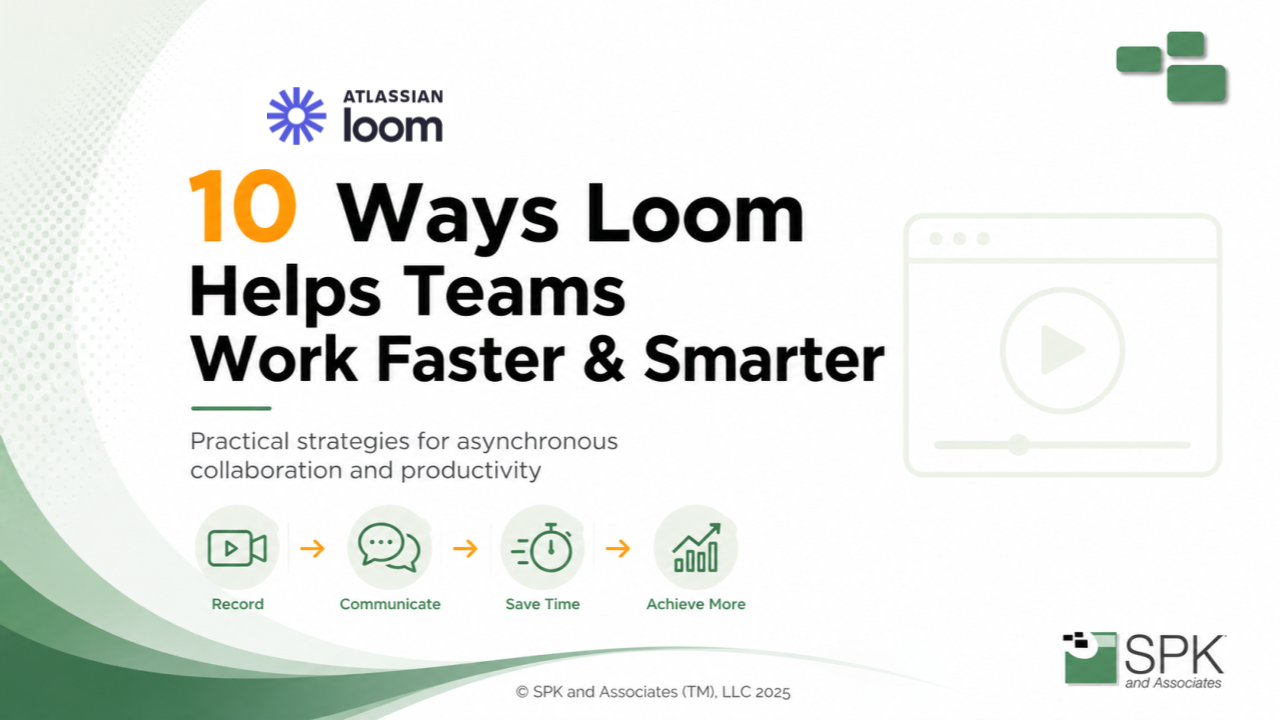
So here are 10 ways that we think Loom can actually help these teams work faster and smarter.
1. Reclaiming These Golden Hours of Deep Work
So the first is reclaiming these golden hours of deep work.
So I’ll give you a great example. Instead of a 9 a.m. creative morning sync for a marketing team that breaks up that morning, a content manager can actually record a Loom at 4:30 p.m. the previous day.
They walk through the upcoming campaign calendar, social media assets, and the asks for the creative team. And then that design team can then watch the video at the start of their day, allowing them to dive straight into their creative work without interrupting their momentum for the day.
2. Reducing Context Switching
The second one is reducing context switching.
So here’s a great example of a real-world context switch. So a developer asked a really complicated question. A complex question about a specific user story in Jira.
Rather than calling an impromptu meeting that pulls that product manager out of a strategic session, that product manager can record a two-minute Loom. They can use the screen share utility to point out the specific requirement and explain the logic of what’s in that Jira ticket.
The developer can get a clearer answer without a single calendar invite being sent.
3. Accelerating the Design Review Process
So the third one is accelerating the design review process.
So let’s talk about a UX/UI designer. So this designer finishes a new mobile app prototype.
Instead of waiting maybe three days for a gap in the stakeholders’ calendars, they can record a Loom that tours the Figma file that they’re working on.
They can explain the user flow and the reasoning behind the decisions that they made around the new navigation that’s being asked for.
So stakeholders can then leave comments directly on that Loom based upon the timeline. So that way they’re in sync with what is being shown.
And that designer can start iterating the next morning. So that way they’re not waiting for multiple days for calendar availability.
4. Streamlining Code Reviews
The fourth is streamlining code reviews.
Now, code reviews, obviously, are very software-specific, but these could be any types of reviews.
And in this case, let’s talk about a software-specific use case. So a quality assurance analyst finds a visual bug that is only triggered when a specific sequence of clicks happens.
So instead of writing a really long-winded, confusing bug report, they can record a Loom of the error that’s occurring in real time, and they can show what clicks happened to replicate that problem.
They can narrate through the steps and then show the console logs as well. So this visual evidence allows developers to identify the root cause a lot more quickly, significantly increasing their productivity.
So code review, doing it that way, actually gives you a lot more additional productivity.
5. Enhancing the Compliance and Traceability of Code
The fifth one is enhancing the compliance and traceability of code.
So teams as well, and supporting your legal requirements, your regulatory requirements.
So during a quarterly compliance review, a regulatory affairs lead needs to document that a new safety protocol was communicated to the staff.
So they can record a Loom, explain the updated SOP, and share it with the team. And then Loom has a “viewed by” list, which you can see who viewed the video and what was the timestamp for when it was viewed by each individual member of the team.
So that way that provides an audit trail, ensuring that your organization stays compliant. So a very simple way to share information about updated compliance.
6. Capturing Tribal Knowledge
The sixth is capturing tribal knowledge.
We all have this. So this is a good use case. I’ve experienced this type of thing in my IT history.
So a lead systems administrator who’s been there a long time is the only person that knows how to reset this legacy server environment after a power outage or after a power cycle.
So what they can do is actually use the Loom mobile app on their mobile phone and record a Loom walking through the physical server room, what to do physically, and then at console to that specific server to get it back online.
So this video can be saved in a shared Confluence space, ensuring that knowledge of this change and this update or this procedure can be saved, is available, even if that admin is on vacation or not available off shift.
So this is really important to capture tribal knowledge.
7. Helping Global Time Zones
Another one is helping global time zones.
So a sales director that’s in Raleigh, North Carolina, is briefing a regional team, regional sales team in Tokyo on a new pricing structure.
Instead of the one team staying up until midnight to get that information, the director records a Loom, walks through that new slide deck and the new pricing.
The team in Tokyo watches it during their morning coffee the next day and can record a Loom in response with any questions or actually just comment right on that Loom that was shared.
That way the global team is aware and can keep moving based upon the information that’s shared.
8. Improving Handoffs Between Hardware and Software
This number eight is improving handoffs between hardware and software, but this is really between any two groups of people or two departments that are not usually on the same team.
So in this case, I’ll give an example that’s real in the product realm.
So at the end of the month, the mechanical and electrical teams need to explain several complex product adjustments to the software team.
So instead of a long-winded email that might get misinterpreted or a bunch of Jira tickets that don’t maybe have enough context, the lead mechanical engineer can record a little Loom and look at the CAD model and actually show those software team members what they changed and why they changed it.
This explains the why behind each of the adjustments and ensures that the software team actually has a total understanding before they start making the next release.
9. Modernization of Internal Toolchain Training
And then number nine is the modernization of internal toolchain training.
So this is a great example of how you can help people get onboarded more quickly.
So in this case, this example is this organization implements a new CRM tool. And that can be any tool.
Rather than holding 10 different how-to internal webinars, a customer success lead can refer to and record that Loom message.
And it could be multiple Loom messages, several five-minute videos for different departments or different use cases.
Then new hires in each of these different departments can watch those videos as a part of their onboarding.
And this self-paced learning increases productivity by letting employees learn the tool without blocking their entire afternoon or trying to do it back-to-back with other things.
They can learn it at their own pace.
10. Driving Executive-Friendly Transparency
And then the last way here is driving executive-friendly transparency. This is a good one.
We’ve all had to brief an executive at some point.
So this case, this example is the VP of Sales needs to give the CEO a weekly update of their sales pipeline.
So instead of recording a 30-minute meeting, or instead of scheduling a 30-minute meeting with the CEO, that VP can record a three-minute Loom to go over their Salesforce dashboard and talk about maybe their three biggest deals, the current forecast, maybe any challenges that they have.
And then the CEO can watch that on their mobile device between meetings. It only takes three minutes. That way they’re informed without a single minute of their time being wasted.
And then when you do schedule a meeting, it’s actually context-specific. That executive has the information and they want to dive deeper and get more information.
So it really helps the conversation.
And that’s the 10 ways that you can get faster and smarter with Loom. Appreciate you watching.
Thanks.