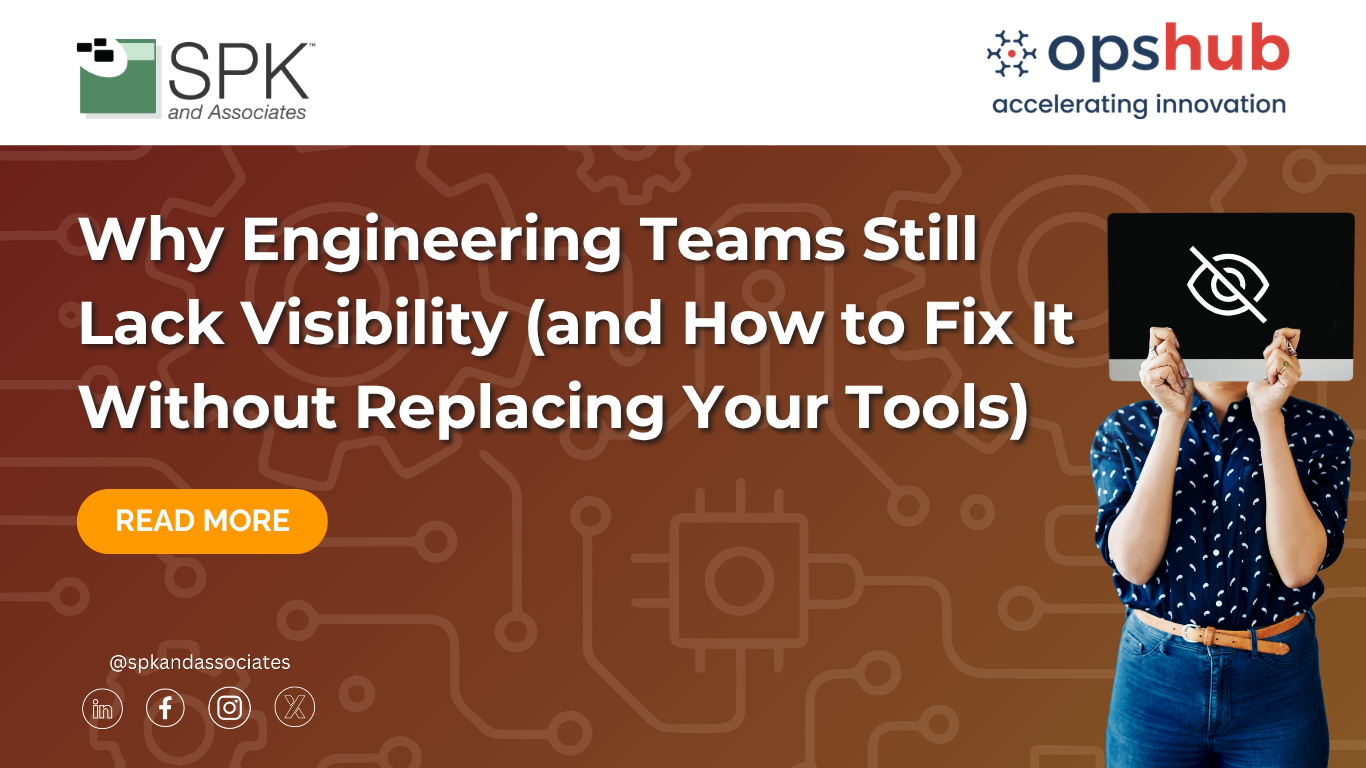

When developing complex products, visibility is the difference between a successful launch and a costly recall. Yet, despite having more tools than ever, most engineering leaders feel like they are flying blind. Critical information is scattered across a fragmented landscape of Jira tickets, Windchill PLM structures, GitLab repositories, CAD models, and ERP platforms. When visibility gaps emerge, the traditional executive response is often a “rip-and-replace” transformation. The assumption is that the only way to see the full picture is to force everyone onto a single, monolithic platform. However, for engineering teams in regulated industries like medical devices, aerospace, or automotive, this approach is often a recipe for disaster. It disrupts proven workflows, sacrifices best-of-breed functionality, and costs millions in lost productivity.
At SPK and Associates, we believe there is a better way. You don’t need to restart or replace your tools to get the visibility you deserve. By building a digital thread through strategic integration, you can achieve end-to-end traceability while keeping the tools your teams already know and love.
The Hidden Tax of Disconnected Engineering Systems
The cost of disconnected systems is a direct hit to engineering productivity and business performance. When data lives in silos, your most valuable resources, highly skilled engineers, spend up to 40% of their time on manual, non-value-added work. Instead of designing and solving problems, they are chasing data, reconciling spreadsheets, and manually updating status reports.
This fragmentation creates a “hidden tax” across the entire product lifecycle:
- Innovation Loss: When 60–70% of enterprise data goes unused because it’s trapped in a silo, your team loses the insights needed to innovate.
- Compliance Risk: In regulated environments, poor traceability isn’t just an inconvenience; it’s a liability. Up to half of all quality issues can be traced back to disconnected data. Organizations with fragmented systems are 2 to 3 times more likely to face audit findings.
- Financial Impact: Large enterprises lose an estimated $12–15 million annually due to poor data quality and the manual labor required to fix it.
- Reporting Blind Spots: Executives often receive reports that are days or weeks out of date because the data had to be manually aggregated from five different systems.

Ultimately, disconnected systems create a compounding effect where delays, misalignment, and rework become the norm rather than the exception.
Building a Digital Thread Without Replacing Your Tools
If the goal is visibility, the path forward shouldn’t be disruption. The most successful organizations are moving away from platform consolidation and toward a connected ecosystem. Here is how you can build a digital thread using your existing toolchain.
1. Inventory and Map the Ecosystem
The first step is understanding the environment you already have. You must inventory your tools across engineering, quality, and operations to identify exactly how data flows and where it stops. By mapping the dependencies between systems like Jira and Windchill, you can document the current state and pinpoint the exact gaps causing the most friction.
2. Define Critical Data Relationships
You don’t need to connect everything at once. Focus on the relationships that matter most for traceability: linking requirements to development, development to testing, and testing to quality outcomes. These connections form the backbone of your digital thread. When these relationships are supported by bi-directional synchronization, you eliminate manual handoffs and ensure everyone is working from a single version of the truth.
3. Enable Bi-Directional Synchronization
This is where many organizations struggle. Manual updates or fragile, one-way API scripts lead to data discrepancies and a lack of trust. To fix this, you need a robust integration layer. This is exactly where OpsHub Integration Manager (OIM) plays a key role. OIM enables real-time, bi-directional data synchronization across tools like Windchill, Jira, Azure DevOps, and Codebeamer. Changes made in one system are immediately reflected in the others, ensuring that a developer in Jira and a quality engineer in a PLM are always looking at the same data.
4. Maintain Context and Traceability
A true digital thread is more than just moving data; it’s about preserving the meaning of that data. A requirement must stay linked to its specific development work and validation results, regardless of which system those artifacts live in. OpsHub ensures these relationships are maintained as data moves, providing the “single source of truth” necessary for compliance and confident decision-making.
The Benefits of a Connected Engineering Ecosystem
When you establish a digital thread with the help of OpsHub and SPK, the benefits extend from the individual engineer up to the C-suite.
- Faster, Confident Decision-Making: Leaders no longer wait for manual reports. They have access to real-time insights, allowing them to prioritize work and address risks before they become crises.
- Reduced Cost of Quality: By enabling early defect detection and providing visibility into issues sooner, organizations can significantly reduce rework. In regulated environments, audits become a simple validation exercise rather than a frantic scramble to gather disconnected data.
- Improved Collaboration: When engineering, quality, and operations have visibility into how their work ties together, miscommunication drops. Teams can resolve issues faster and stay aligned on priorities without constant status meetings.
- AI Readiness: Modern AI and advanced analytics require high-quality, connected data. By building a digital thread today, you are creating the scalable foundation needed for the AI-driven engineering of tomorrow.
Check out real results for yourself:

Getting Started with OpsHub and SPK
Engineering organizations don’t need a “shiny new tool” to solve their visibility problems. They need their existing tools to talk to each other. At SPK and Associates, in partnership with OpsHub, we help organizations move beyond disconnected silos and toward a true digital thread. We don’t just provide software; we provide a strategic vision. We help you design a digital thread architecture tailored to your specific environment, ensuring your ALM, PLM, CAD, and DevOps tools work as one cohesive unit. Our approach prioritizes delivering value quickly with minimal disruption. You can see immediate improvements in traceability and visibility while keeping your teams focused on what they do best: engineering great products.
Ready to fix your visibility gaps without replacing your tools? Contact SPK and Associates today to start building your digital thread.