

PLM and Digital Strategy for CIOs
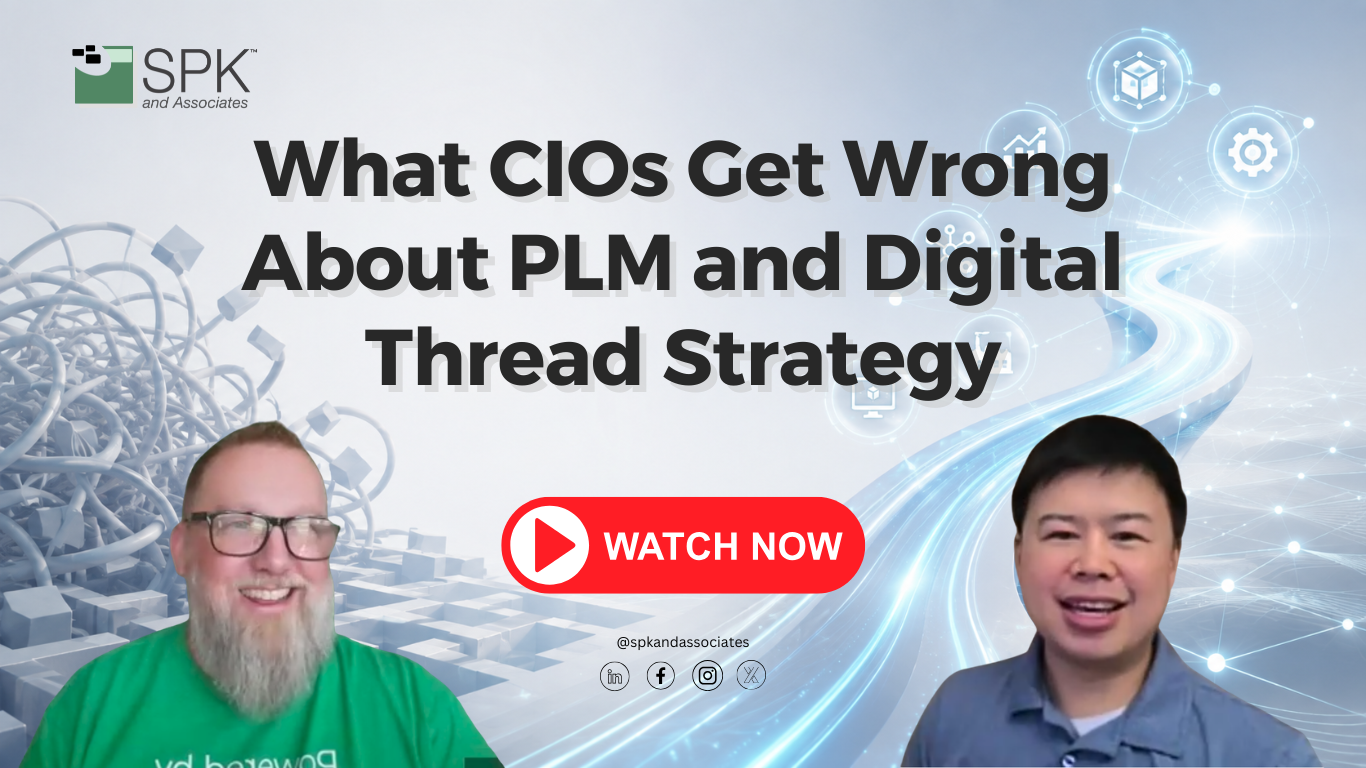
Hello, everyone, and welcome back to another SPK and Associates vlog. My name is Michael Roberts. I’m the Vice President of Sales and Marketing here at SPK and Associates.
Today, we’re tackling a topic that comes up consistently in our conversations with engineering leaders and IT leaders: What is in your PLM and digital thread strategy that connects your product data, and why are so many CIOs getting that wrong?
A lot of executives are approaching these PLM modernization and digital thread initiatives as purely a technological decision. You pick the right platform, and the rest just follows along.
But in our experience, that rarely is where these projects actually succeed or fail. It actually comes down to process alignment, integrations, governance, and whether the organization is actually ready for that change.
So today, I’m joined by Edwin Chung.
Ed, please introduce yourself.
Meet Ed Chung
Hi. Please call me Ed.
I’m the VP of Professional Services here at SPK and Associates. I’ve been here for almost 20 years, and I love working with people and making a difference.
Ed is a difference maker, and that’s why we’re going to talk through this problem today.
The title makes this sound a little salacious, where CIOs maybe aren’t getting these answers right, but I think there are some areas where we definitely can provide some additional insights, given the number of projects that we’ve completed over the years.
The Biggest Misconception About PLM Modernization
So, Ed, in your eyes, what’s the biggest misconception that CIOs have about PLM modernization and changing that PLM system?
Yeah, it’s not just CIOs. Everyone, right?
Everyone has this concept of, how do I say it? You can’t just swap out an old software or an old PLM system for a new one and expect transformation, right?
If people aren’t trained, if processes aren’t rethought, and teams aren’t aligned on what they want the new system to be, then you might wind up moving your same old processes from the square button to the circle button, and then you keep the same inefficiencies in your newer platform.
I do think it’s a little bit difficult to create huge change with certain old PLM systems just due to technology things. So I do believe in modernizing PLM systems, but you can’t just jump in, right?
The technology matters, but the real value comes from changing how people decide or manage product data or collaborate, especially collaborating across different life cycles, different teams, different groups, and different locations.
That is the name of the game, right?
And to add to the point that you’re making there, the processes are just as important as the software.
Part of the reason that I think we understand that is there’s this whole AI thing now that’s included in a lot of these tools, so that process has to maybe be rethought too.
So, yeah, not just a software swap.
Why Digital Thread Initiatives Struggle to Deliver Value
All right, so next question here, Ed.
Why are so many of these digital thread initiatives struggling to deliver value? What’s happening there?
One thing that I see often is people talk about digital thread like it’s a catchphrase, a word.
And now you’ve just said AI, right? So I’m a little bit triggered. I’m a little triggered because people are like, “Oh, we’ve got this digital thread, and we’re just going to throw AI at it. AI, please make digital thread.”
Oh my God.
Digital thread is not just a technical connector between systems, two systems or ten systems.
And AI is not a magical solution to a digital thread, right?
Digital thread is about defining ownership of the data, defining traceability, like solid, and this is where AI drops the ball, right? Solid, non-hallucinated traceability across the entire product life cycle for your product data.
Digital thread also, in order to maintain that traceability, needs defined processes and a plan for processes that adhere to and support how teams will use that information in the future.
So if engineering and manufacturing and quality and supply chain and customer service all manage the data differently, then connecting their systems alone, even with an AI chatbot, does not create a reliable digital thread.
Right?
You may have data flying around and moving, but if you don’t have a shared source of truth, then how are you going to make better, more efficient decisions for your business?
Yeah.
It’s more than just connecting those systems, right? We’ve been through that drill before.
What Engineering Leaders Should Prioritize First
Okay, last question, Ed.
Given the problem state that we talked about, what should engineering leaders prioritize first before they do these big transformative solutions and changes?
I’m a big proponent of getting buy-in.
Buy-in from the people who you’re supporting, right?
The goal is not, “Spend money on a new system.”
The goal is, “Hey, I want to improve people’s lives. I want to improve business outcomes,” but doing so through improving efficiency for my employees, improving accuracy, improving quality, and reducing errors.
Ask people, right?
Ask people where the information breaks down today.
Ask people who owns each piece of product data.
Ask people where, and this is one of my favorites, Michael, you’ve heard me talk about it before, where are people re-entering information?
Where are people copying and pasting from the left side to the right side, or downloading to desktop and uploading from desktop, and then getting caught waiting for seven days on some approval because that person is on vacation?
And therefore, they’re working around it by using some spreadsheet.
Real-World Workflow Problems
We were just talking about this with another client, right?
They’re getting all of this information out of Oracle, and they’re putting it in a spreadsheet, and this other person is putting in another column of the spreadsheet.
They show it to this other person, and I’m like, “Sorry, I’m ranting now.”
Hey, great. Super.
But that’s the real world, right?
That’s the real world.
It is the real world.
And it makes me a little sad because I don’t want, you know, I literally just had this guy who’s on vacation with his family, and people are calling him up like, “Hey, the spreadsheet’s out of date.”
And I’m like, that I want to help you out.
Hey, that guy buys into the change.
Please put in a PLM system connected to this PDM system, automated, so that his team does not rely on him 24/7 to do that.
That is buy-in.
Not just from him, but from his management, who also don’t want to call him on vacation, and their management, and all these things.
Get Buy-In Before Choosing Technology
Buy-in. Get buy-in.
Then after you get buy-in, planning, right?
You need to do planning, but again, the planning comes after you get the people and the workflows bought in.
People bought in, workflows planned, and then pick a technology that enables that operating model, not the reverse.
Not just get the new shiny.
The new shiny.
That’s right. That’s right.
That’s part of the equation, but that’s not the only part of the equation.
Ed, thank you very much for your experience and your insight and your thoughtful words.
Thank you.
Is that it?
I’m happy to, anytime. Please grab me. Always here.
You, Michael, or anyone else, grab me. I’m happy to talk your ears off.
Thanks again, Ed.
Key Takeaway: PLM Modernization Is More Than Technology
So, if there’s one thing I think is a pretty clear takeaway, it’s that PLM modernization and digital thread success isn’t just about the technology you pick.
It’s about changing process, governance, organizational readiness, and, as Ed said, getting buy-in and making sure that you are aligned to the outcomes.
So, if you’re an engineering or an IT leader and you’re wrestling with any of these types of things that we’ve talked about here today, you can contact us.
In the description, there’ll be a link to our website and our contact page. Please reach out.
We’ll have that conversation with you and your team.
This is exactly the type of thing that our team helps other teams work through.
And if you like this video, be sure to give it a thumbs up and subscribe to the SPK and Associates YouTube channel for more content around PLM, CAD, digital thread, and product engineering insights.
Thanks again for watching, and we’ll see you on the next one.
Thanks, everyone.
Bye.