
Key Takeaways
- Governance must come before scale: AI agents can access data and take actions, meaning clear rules around what they can see and do must be established before widespread deployment.
- Follow the principle of least privilege: Agents should only receive the system access and permissions required for their specific tasks, reducing the risk of over-permissioned AI.
- Shadow AI creates serious data risks: When employees use unauthorized public AI tools for convenience, they risk exposing source code, documents, customer information, and other sensitive data.
- Proper governance enables faster, safer adoption: Approved tools, data classification, identity management, human approvals, monitoring, training, and private AI architectures can create the boundaries organizations need to scale AI confidently.
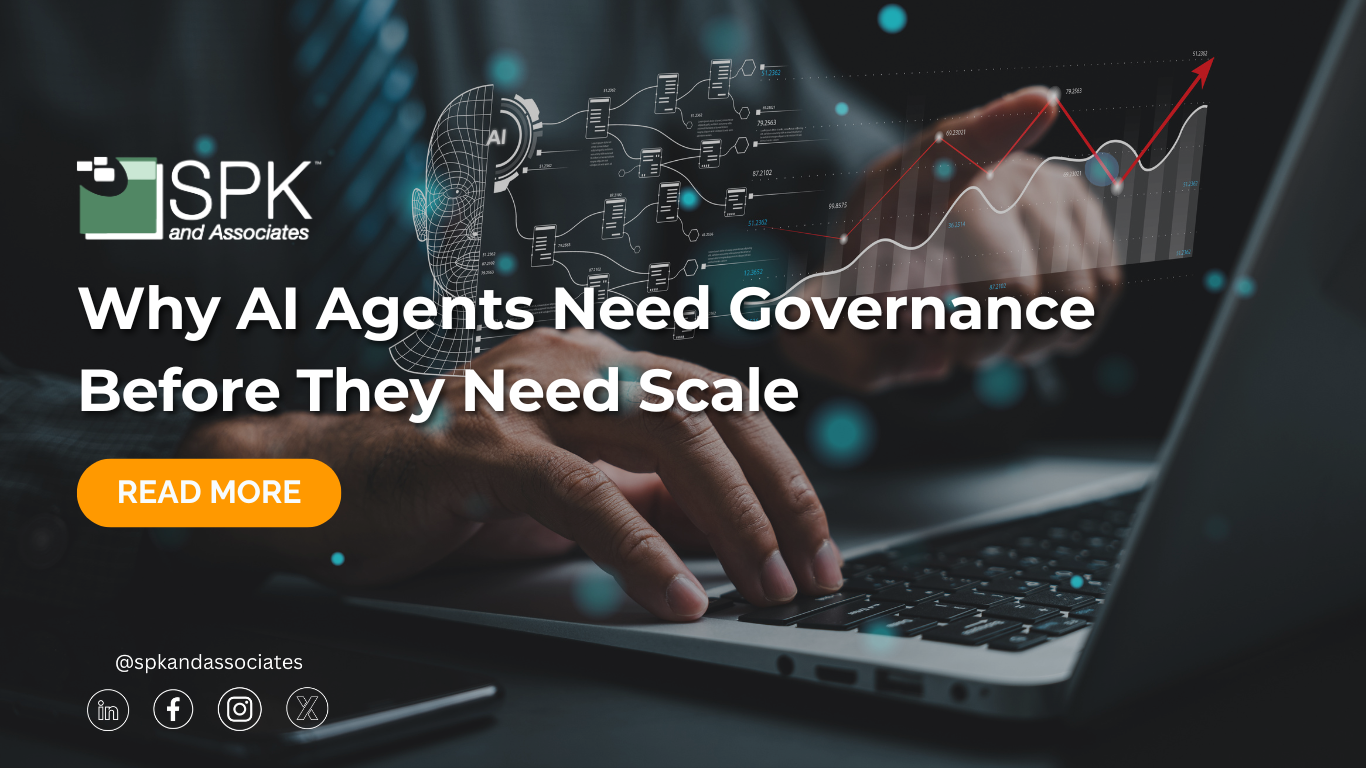
AI agents are quickly moving from experimentation into everyday business workflows. Unlike traditional AI tools that simply generate an answer, agents can interact with systems, retrieve company data, create or modify records, execute tasks, and make decisions across connected applications. That autonomy creates enormous opportunities for productivity. It also dramatically increases the consequences of poor governance. For organizations adopting agentic AI, the question should not simply be, “How quickly can we deploy AI?” It should be, “What should this AI be allowed to see, do, and share?”
Teams must establish governance, control access, define data policies, and set clear risk boundaries before aggressively scaling AI agents across the organization. When executed correctly, effective governance does not stop innovation, but it instead creates the foundation organizations need to adopt AI confidently while protecting sensitive information.
Why AI Governance Matters Before Scaling Agents
One of the biggest mistakes organizations can make with AI is treating AI adoption like the rollout of any other productivity application. AI agents are unique because their value often comes from connectivity. An agent may need access to Jira, GitLab, source code repositories, PLM systems, requirements, documentation, email, or other enterprise systems to understand context and complete work. Every additional connection expands what the agent can potentially access. Before organizations scale those connections, they need clear boundaries around identity, permissions, acceptable data, human oversight, and system access.

Applying Least Privilege to AI Agents
One of the most important principles is least privilege. The principle of least privilege means an AI agent should receive only the permissions required to perform its specific task. If an agent needs to retrieve information from a system but does not need to modify it, there is no reason to provide write permissions. If it only needs access to one project, repository, or knowledge base, giving it companywide access creates unnecessary risk. Designing these integrations correctly requires planning and testing, but the investment can prevent AI from becoming an over-permissioned entry point into critical business systems.
Understanding How AI Providers Handle Data
Organizations should also understand what happens to information once it enters an AI platform. Privacy policies can differ between providers and even between subscription tiers. Businesses should understand how information is stored, whether teams use it to improve models, who may have access to it, and what controls exist around retention. This becomes particularly important when employees work with proprietary algorithms, source code, engineering documents, emails, customer information, or other confidential materials.
Preventing Shadow AI
Another major challenge is shadow AI, where employees begin using AI applications or connecting AI tools to company systems without approval from IT or security teams. Employees do not often try to create security problems; they just want to work faster. They may upload a document for summarization, paste source code into a chatbot to troubleshoot an issue, or connect an AI application to another platform because it eliminates several manual steps. However, once sensitive information enters an unauthorized system, the organization may have little visibility into where that information is stored or how the system handles it.

Training therefore must be part of AI governance. Employees should understand what information they can share with approved AI tools, what should never leave controlled environments, and how to cleanse sensitive details from prompts or code snippets when appropriate.
Protecting Intellectual Property and Regulated Data
These controls become especially important for engineering organizations. Product designs, source code, requirements, CAD information, test results, regulatory documents, proprietary algorithms, and manufacturing processes can represent some of a company’s most valuable intellectual property. For organizations operating in regulated industries, exposure can create more than a cybersecurity problem. Companies may also have requirements surrounding data integrity, traceability, confidentiality, documentation, validation, and controlled access.
AI governance should therefore establish which types of information agents can access, what systems they can interact with, which actions require human approval, and where AI processing is permitted. For organizations with particularly sensitive workloads, private AI environments can provide additional control over connectivity, data storage, privacy, content filtering, and usage.
Real-World Examples of Sensitive Information Reaching AI Tools
The risks surrounding AI governance are not theoretical. Several high-profile cases demonstrate how quickly confidential information can leave controlled environments when employees use public LLMs.
Samsung: Engineers Share Proprietary Information with ChatGPT
One of the most widely discussed early examples involved Samsung employees using ChatGPT shortly after employees were reportedly permitted to use the technology in 2023. Engineers reportedly entered sensitive company information into ChatGPT, including source code and internal meeting information. Reports indicated that Samsung identified multiple incidents involving confidential data within weeks of allowing employees to use the platform. The incident highlights a basic but critical AI governance lesson: employees need clearly defined boundaries regarding what information they can enter into public AI systems.

Amazon: Employees Warned Against Sharing Confidential Information
Amazon also warned employees not to share confidential company information with ChatGPT after reportedly seeing responses that closely resembled internal Amazon material. The concern demonstrates why organizations cannot rely exclusively on employees to independently determine what is safe to share. AI acceptable-use policies should clearly define which tools are approved and what categories of company information are restricted.

CISA: Sensitive Documents Uploaded to a Public AI Tool
More recently, reports emerged that CISA’s interim chief uploaded sensitive documents to a public version of ChatGPT. While the incident reportedly did not result in serious consequences, security professionals used it to highlight the risks associated with uploading sensitive information into unauthorized AI platforms. This example is particularly important because it illustrates that AI governance problems are not limited to inexperienced employees or organizations without cybersecurity expertise. Convenience can override good security practices almost anywhere when clear technical controls and policies are not in place.
The broader concern is shadow AI. Employees working quickly may choose free or public AI tools because they are readily available, even when their company has not approved them for handling company information.
This is exactly why organizations must implement governance before AI usage expands throughout it.
Governance Makes AI Scale Possible
Organizations do not need to choose between AI innovation and security. The goal of AI governance should be to create an environment where employees and AI agents can move faster within clearly defined boundaries. Before scaling AI agents, organizations should establish policies around approved AI tools, data classification, identity management, least-privilege access, application integrations, human approvals, monitoring, employee training, and cost controls.
For highly sensitive environments, organizations may also want to evaluate private AI architectures that provide greater control over where data is stored, what system(s) models can connect to, how content is filtered, and how usage is managed. These controls may require more work at the beginning of an AI initiative, but they make scaling safer later.
AI Governance, Then Scaling
AI agents can significantly improve how engineering and business teams work. They can retrieve information, automate repetitive tasks, connect previously disconnected workflows, and help employees make decisions faster. However, those capabilities are exactly why governance must come first. The companies that successfully scale agentic AI will not necessarily be the ones that deploy the most agents the fastest. They will be the organizations that create secure, governed environments where AI can operate responsibly. If you need help implementing AI, contact our experts.