
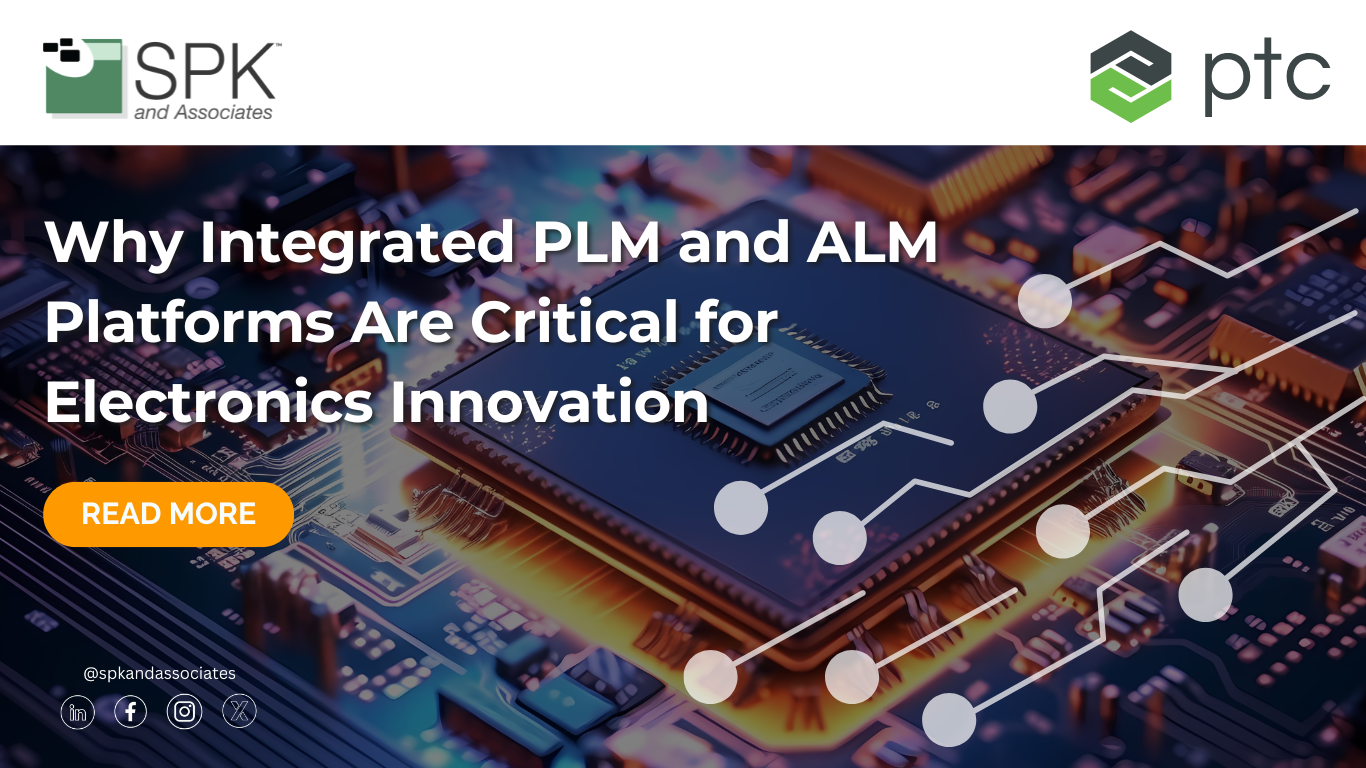

Innovations in the electronics industry are being rapidly introduced, which has led product lifecycles to shrink and software to become central to nearly every device. Companies are under constant pressure to launch smarter, more connected products ahead of the competition. For electronics and high-tech organizations, this creates a difficult balancing act. Teams must accelerate innovation while managing hardware complexity, embedded software, regulatory requirements, and more.
This is where integrated Product Lifecycle Management and Application Lifecycle Management platforms become essential. Electronics companies can no longer afford to manage mechanical design, electrical design, software development, requirements, quality, manufacturing, and compliance in disconnected systems. When product and software teams operate in silos, innovation slows down, rework increases, and risk becomes harder to control. Integrated PLM and ALM platforms help organizations connect the full product lifecycle, from requirements and design through manufacturing, service, and end-of-life. This connected approach is becoming a critical foundation for digital transformation, AI adoption, and long-term competitiveness in the electronics industry.
Common Challenges in the Electronics Industry
Electronics and high-tech companies are constantly facing several pressures.
Design Complexity
Short product lifecycles and fierce competition demand rapid new product introductions, but fragmented systems and legacy tools often slow down collaboration and decision-making. As hardware, software, connectivity, and AI become more deeply integrated, design complexity increases. With this complexity increase, the risk of errors, delays, and rework grows.
Supply Chain Issues
Supply chain volatility adds another layer of difficulty. Component shortages, geopolitical disruption, and supplier risk can quickly impact product availability. Without real-time visibility into parts, BOMs, suppliers, and alternate designs, teams may struggle to understand which products are affected or how quickly they can respond.
Costs
At the same time, rising costs and margin pressure make inefficiency more expensive. Manual processes, duplicated engineering work, limited design reuse, and rework can drive up development costs and reduce profitability. Companies cannot always pass increased material and labor costs to customers, so they need better ways to protect margins while continuing to innovate.
Requirements
Regulatory and sustainability expectations are also expanding. Electronics companies must manage requirements related to safety, cybersecurity, environmental compliance, product passports, and circular economy practices. This includes standards such as RoHS, REACH, ISO 26262, and ASPICE. When compliance data is scattered across systems, audit preparation becomes time-consuming, and launch timelines are put at risk.
Talent Shortage
Finally, the talent shortage is forcing smaller teams to handle more complex work. The demand for AI, machine learning, software, systems engineering, and advanced engineering expertise continues to outpace supply. To keep up, companies need tools that help existing teams work more efficiently, reduce manual tasks, and preserve engineering knowledge.
How Integrated PLM and ALM Help
Integrated PLM and ALM platforms help electronics organizations create a digital thread that connects product, software, quality, and manufacturing processes. Instead of treating hardware and software development as separate activities, one connected environment aligns:
- Requirements
- Design data
- BOMs
- Software changes
- Test results
- Risks
- Defects
- Quality records
- Manufacturing information
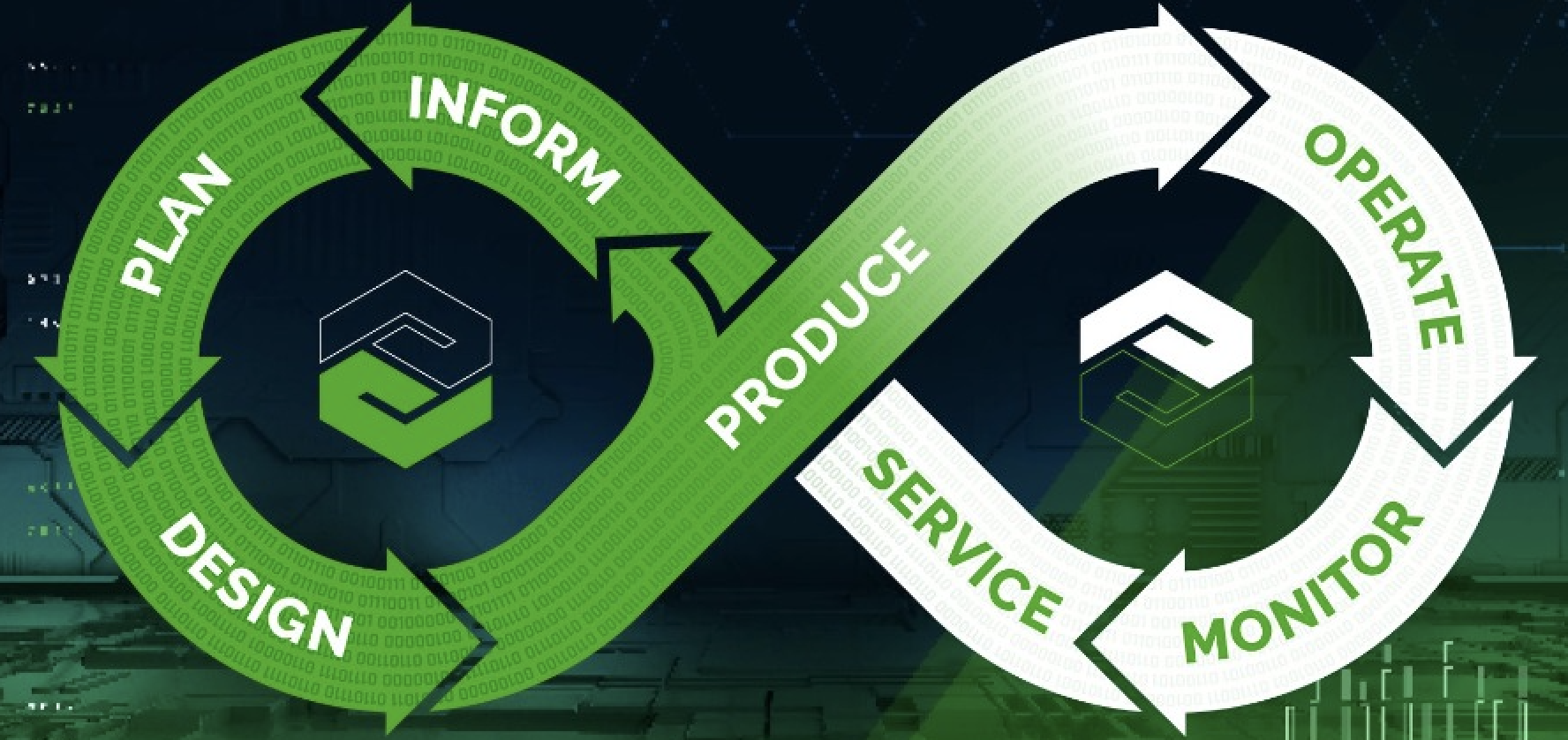
This integrated approach is especially valuable for breaking down organizational silos, improving collaboration, addressing talent shortages, and managing regulatory and quality concerns.
Breaking Down Siloed Organizational Structures
Many electronics companies still rely on legacy systems, homegrown tools, spreadsheets, and department-specific processes. When engineering, software, quality, manufacturing, and supply chain teams each use separate systems of record, decision-making slows and duplicate work increases. This leads to teams losing visibility into product status, requirements, changes, and risk.
Integrated PLM and ALM platforms help connect product data, software data, and business processes into a more accurate source of truth. With capabilities like configuration management, BOM transformation, enterprise change management, and systems integration, teams can evaluate changes faster, identify impacted parts and requirements sooner, reduce manual effort, and improve resource utilization.


Improving Collaboration Tools and Practices
Poor collaboration is a major barrier to electronics innovation. This is especially true when products include mechanical components, electrical systems, embedded software, connectivity, and complex supplier networks. If teams, suppliers, and contract manufacturers are not working from the same information, they are more likely to duplicate work or discover issues too late.
Integrated PLM and ALM platforms improve collaboration by giving stakeholders real-time access to accurate product and software information. Digital traceability, configuration management, product variability management, and supply chain collaboration help teams reduce misalignment, collaborate earlier, support secure data sharing, and improve lifecycle visibility.
Helping Teams Manage Talent Shortages
The electronics industry faces a growing talent gap. As smaller teams are asked to manage more work, organizations risk burnout, quality issues, delayed releases, and knowledge loss when experienced employees leave. Integrated PLM and ALM platforms help teams do more with existing resources by reducing time spent searching for information or manually documenting changes. Design reuse, product variability management, collaborative development tools, and controlled change management help teams protect quality and accelerate time-to-market.


Managing Regulatory Hurdles and Quality Concerns
Regulatory and quality demands are becoming more complex across electronics and high-tech. When PLM, ALM, quality, and testing systems are disconnected, teams may struggle to prove requirements were tested, changes were reviewed, defects were resolved, or quality issues were properly addressed. Integrated PLM and ALM platforms connect requirements management, validation, test management, quality, change tracking, and configuration management. This helps teams link requirements to designs, software work items, test cases, defects, risks, and quality records. This connection supports earlier issue detection, stronger compliance, faster resolution, and reduced rework.
PTC’s Approach to Integrated PLM and ALM
PTC’s approach is built around connecting the full product lifecycle through a unified digital thread. Instead of focusing only on one part of the process, PTC helps organizations connect engineering, software, manufacturing, quality, service, and enterprise systems.
Windchill serves as PTC’s enterprise PLM foundation, helping companies manage:
- Product data
- Configurations
- BOMs
- Change processes
- Manufacturing information
- Supplier collaboration
- Quality processes
- Digital product traceability

Codebeamer extends this connected environment into ALM, supporting:
- Requirements management
- Risk management
- Test management
- Validation
- Software development traceability
- Compliance

Together, Windchill and Codebeamer help electronics organizations align physical product development with software development. This is critical as electronics products become more software-defined, connected, intelligent, and regulated.
PTC also differentiates through four key areas:
Highly configurable, scalable, and open architecture
Windchill can adapt to diverse business needs and expand across different software environments. This is important for electronics companies that often operate across multiple regions, product lines, engineering teams, and supplier networks.
Integrations
Windchill can integrate with PTC and third-party systems such as ERP, MES, CAD, ALM, and other enterprise platforms. This helps companies connect existing systems rather than forcing every team into a single rigid workflow.
SaaS
PTC’s SaaS-based options reduce the effort required to set up and run systems, allowing internal teams to spend more time on innovation and productivity instead of infrastructure maintenance.
AI
PTC embeds AI into intelligent product lifecycle management by using connected, contextual product data to support better decisions, automate processes, and unlock value across engineering, manufacturing, and service workflows.
For electronics companies, this means PTC is not just helping teams store product data. It is helping them connect product data, software data, process data, and quality data in ways that improve speed, visibility, and control.
Integrated ALM/PLM Customer Experiences
PTC customers have demonstrated the value of integrated lifecycle management across complex, regulated, and engineering-intensive environments. These customers have seen benefits such as improved engineering efficiency, reduced development costs, faster time-to-market, fewer errors, improved product quality, and stronger regulatory compliance.
For electronics and high-tech companies, the value is clear. Integrated ALM and PLM helps organizations:
- Reduce redundant engineering work by improving design reuse and visibility
- Accelerate product releases by connecting requirements, design, testing, and change management
- Improve collaboration with suppliers and contract manufacturers through secure, real-time product data sharing
- Strengthen compliance by connecting requirements, validation, quality, and traceability
- Improve product quality by detecting issues earlier and linking them to the affected product configuration
- Support smaller engineering teams by reducing manual effort and improving access to trusted information
As electronics innovation becomes more complex, these proof points matter. Companies that connect PLM and ALM are better positioned to respond to market changes, manage regulatory pressure, address supply chain risk, and deliver high-quality products faster.

Integrated ALM and PLM for Electronics
Electronics innovation requires connected teams, connected systems, and connected data. As products become smarter, companies need a better way to manage complexity across the full lifecycle. Integrated PLM and ALM platforms help electronics organizations improve collaboration, manage engineering capacity, and strengthen compliance. By connecting all the information that makes up a product and its software, companies can create a digital thread that supports faster and more confident innovation. PTC’s integrated approach with Windchill and Codebeamer gives electronics and high-tech companies the foundation they need to compete in a high-speed market defined by speed. If your organization is looking to accelerate product development and prepare for the future of intelligent connected products, reach out to our team.